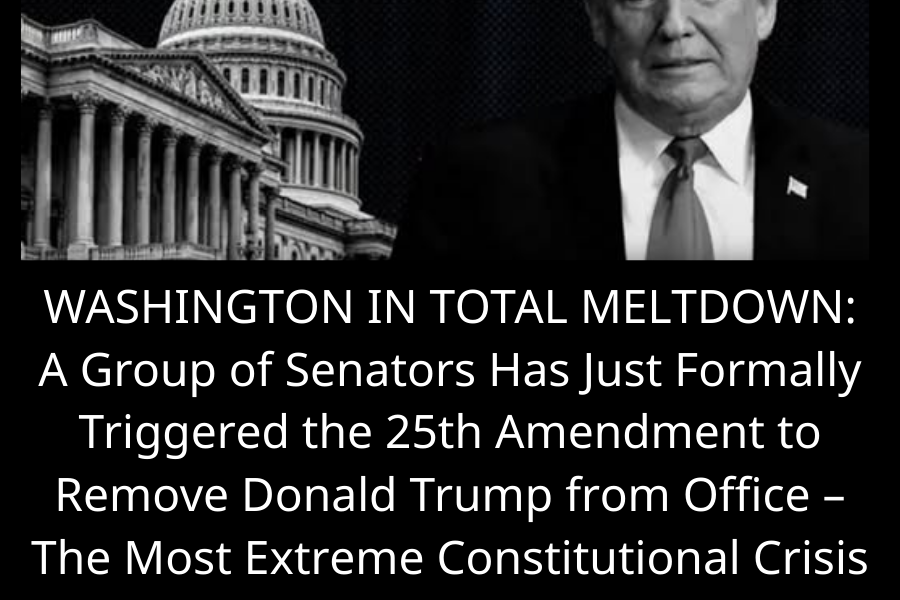
The Constitutional Earthquake: When the 25th Amendment Becomes a Political Weapon
The Headline That Breaks the Internet
Let’s not pretend this is a routine political development. The 25th Amendment is not a procedural footnote. It is the constitutional emergency brake, designed for moments so grave, so destabilizing, that the normal mechanisms of governance have failed. It exists for presidents who are dead, comatose, or so fundamentally broken that they cannot function.
And now, according to this report, a group of U.S. Senators has formally invoked it against Donald Trump.
If true, this is not politics. This is constitutional warfare. It is the legislative branch declaring, in the most official terms possible, that the elected President of the United States is unfit to serve. It is the nuclear option, deployed not against a foreign adversary, but against the leader of their own government.
The post frames it as a “TOTAL CRISIS IN WASHINGTON.” That’s not hyperbole. It’s an understatement.
Deconstructing the 25th: What It Actually Does and How It Works
Before we analyze the politics, we need to understand the mechanism. The 25th Amendment, ratified in 1967, provides the procedure for presidential succession and incapacity. Section 4 is the relevant part here: it allows the Vice President and a majority of the Cabinet to declare the President “unable to discharge the powers and duties of his office.” The President can contest it, triggering a congressional vote. If two-thirds of both houses agree the President is unfit, the Vice President becomes Acting President permanently.
The key detail: Section 4 has never been used. Not during Reagan’s assassination attempt. Not during Wilson’s stroke. Not during the darkest days of any administration. It is the constitutional equivalent of a fire extinguisher in a glass case—break only in case of absolute, undeniable emergency.
The post claims Senators are invoking it. Not the Cabinet. Not the Vice President. Senators. This is procedurally unusual—the amendment doesn’t give Congress a direct role in the initial declaration. But Congress can pressure the Vice President and Cabinet to act, and can ultimately vote on the President’s fitness if he contests the declaration.
So what we’re witnessing, if accurate, is a coordinated political assault using every lever of constitutional power available.
The Allegations: “Incapacity to Lead” and “National Security at Stake”
The post lists two core justifications for the 25th invocation:
1. Incapacity to Lead: This is the medical/psychological argument. It suggests Trump is not just making bad decisions, but is fundamentally unable to perform his duties. This could reference anything from cognitive decline to emotional instability to the psychological toll of constant political warfare. It’s the hardest argument to prove and the easiest to weaponize.
2. National Security at Stake: This is the practical argument. It suggests that Trump’s behavior—his decisions, his rhetoric, his instability—is actively endangering the country. This could reference recent immigration enforcement controversies, his public feuds with allies (like the UK carrier incident), or the broader polarization paralyzing the government.
The post also mentions “recent incidents” and “extreme polarization” as the context. This is vague by design. It allows readers to fill in the blanks with whatever Trump outrage most recently occupied their feed.
The Two Americas React: Protecting the Nation or Political Coup?
The question at the end of the post is the whole point: “Do you believe the Senate is acting to protect the nation, or is this an extreme political move against Donald Trump?”
This is the Rorschach test of the Trump era. There is no neutral answer. There is only which America you inhabit.
For Trump’s opponents: This is justice delayed. After two impeachments, four indictments, and endless evidence of what they see as fundamental unfitness, the 25th is the only remaining tool to remove a man they believe is a danger to the republic. They see the invoking Senators as heroes, finally willing to use the Constitution’s emergency powers for their intended purpose.
For Trump’s supporters: This is the ultimate betrayal. It’s not about fitness; it’s about revenge. It’s Democrats and RINOs using a constitutional mechanism to overturn an election they couldn’t win fairly. They see it as a coup, an assault on democracy itself, and proof that the “deep state” will stop at nothing to destroy their leader.
For the constitutional purists: This is a dangerous precedent. Even if you believe Trump is unfit, using the 25th for political purposes—rather than genuine medical incapacity—sets a terrifying precedent. What happens when the next president faces a hostile Congress? Will the 25th become a routine tool of partisan warfare?
The Procedural Reality: Can This Actually Succeed?
The post is heavy on drama, light on mechanics. So let’s ask the hard questions:
Who are these Senators? Are they Democrats only, or is there bipartisan support? Without Republican buy-in, the 25th is dead on arrival. The Vice President and Cabinet—all Trump appointees—would never trigger Section 4 without overwhelming pressure. And the two-thirds vote required to override a presidential challenge is nearly impossible in today’s polarized environment.
What’s the evidence of “incapacity”? Has there been a medical diagnosis? A public breakdown? Specific incidents that meet the constitutional standard? Or is this a political judgment dressed in clinical language?
What’s the timing? Why now? What recent events triggered this escalation? The post mentions “recent incidents” but doesn’t name them. Without specifics, it’s impossible to evaluate the justification.
Is this real or trial balloon? This could be a genuine legislative move, a strategic leak to gauge public reaction, or complete fiction designed to generate outrage. In the current media environment, all three are possible.
The Historical Precedent: What the Founders Feared
The 25th Amendment exists because the original Constitution was unclear about presidential incapacity. When James Garfield lay dying for 80 days, the government essentially stopped functioning. When Woodrow Wilson had a debilitating stroke, his wife secretly ran the country. The amendment was designed to prevent those constitutional crises.
But the Founders also feared something else: the weaponization of removal mechanisms. They built impeachment with a high bar (two-thirds conviction) precisely to prevent Congress from overturning elections on partisan grounds. The 25th, with its lower threshold for temporary removal (simple majority of Cabinet), was meant for medical emergencies, not political disputes.
If Senators are now using it as a political tool, they are entering uncharted—and potentially dangerous—constitutional waters.
The Verdict: A Story Still Being Written
Right now, this is a headline without a body. We don’t know who these Senators are. We don’t know what evidence they have. We don’t know if this is the beginning of a genuine constitutional crisis or a political stunt designed to dominate the news cycle.
But we know what it represents: the complete breakdown of trust between the executive and legislative branches. The normalization of extraordinary measures. The exhaustion of normal politics.
Whether the 25th Amendment is the right tool for this moment depends entirely on whether you believe Trump’s unfitness is medical or political, temporary or permanent, dangerous or merely controversial.
What’s not debatable is this: the invocation of the 25th Amendment, however it plays out, marks a new chapter in American political conflict. The old rules are gone. The emergency brake is now just another pedal. And no one knows where the road ends.
The political storm the post warns about is not coming. It’s already here. And the 25th Amendment—designed for the most extreme crises in American history—has just become the latest battlefield.