# The Perk That Died: Delta Just Did What No Politician Had the Guts to Do
Watch the line.
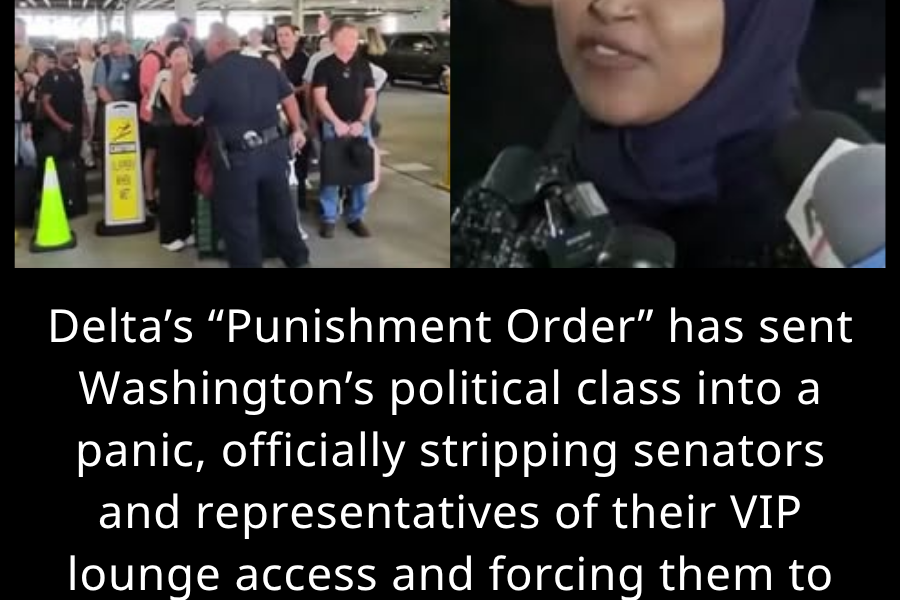
That’s the image you need to hold in your head. The line at the airport. Snaking through the terminal. Wrapping around columns. Stretching past the ticket counters, past the baggage drop, past the point where you start checking your watch and calculating whether you’re going to make your flight. The line that never seems to move. The line that turns seasoned business travelers into sweaty, frustrated, clock-watching wrecks. The line that has become the symbol of everything broken about the way Washington treats the people who keep the country moving.
Now imagine that line, and imagine a member of Congress walking past it.
Not because they’re late. Not because they have a medical emergency. Not because there’s some legitimate, understandable reason to bypass the hundreds of people who have been standing there for an hour. Just because they’re a member of Congress. Just because they have a title. Just because the system has always given them a pass, a shortcut, a way to avoid the inconvenience that everyone else has to endure.
That’s been the arrangement for years. Decades, maybe. Members of Congress, their staffers, their entourages—they got special treatment at the airport. Priority escorts. Fast-track help. People who would whisk them past the lines, past the waiting, past the grumbling masses who had been standing there since before dawn.
And then Delta Air Lines CEO Ed Bastian looked at that arrangement, looked at the shutdown that was entering its fifth week, looked at the TSA agents working without paychecks while the politicians who caused the shutdown kept collecting theirs, and decided: *No more.*
No more special treatment. No more cutting the line. No more royalty perks for the people who created the crisis. Members of Congress and their staffers now stand in the same lines as everyone else. They wait like everyone else. They suffer like everyone else. Their fancy titles mean nothing. Their status is whatever their frequent flyer miles say it is—just like the rest of us.
The move was simple. It was brutal. It was exactly what millions of Americans have been begging someone to do for years.
And the applause was deafening.
—
### The Line That Built a Movement
Let’s talk about what a TSA line actually is. It’s not just a queue. It’s a pressure cooker. It’s a test of patience, of stamina, of basic human decency. You stand there with your shoes off, your laptop out, your liquids in a baggie, watching the minutes tick by and your connection get closer and closer to impossible. You watch the families with small children. You watch the elderly travelers who can barely stand. You watch the business people checking their phones, calculating the cost of missing another meeting.
And you wait. Because there’s no other option. Because the system is what it is. Because the people who run the system have decided that this is how it’s going to be.
Now imagine watching a member of Congress walk past all of that. A member of Congress who, by the way, hasn’t missed a single paycheck during the shutdown. A member of Congress who caused the shutdown, or helped cause it, or at least didn’t do enough to stop it. A member of Congress who has the power to end the whole thing tomorrow, if they could just agree on something, anything, but who instead has chosen to let the shutdown drag on while the TSA agents work for free and the lines get longer and the travelers get angrier.
That member of Congress walks past the line. They get the escort. They get the fast-track. They get to their flight with time to spare. They don’t see the faces of the people they left behind. They don’t hear the muttered curses. They don’t feel the resentment building, line by line, traveler by traveler, day by day.
Bastian saw it. Or someone at Delta saw it. Or enough people complained that the message finally got through. And someone made a decision: *We’re not doing this anymore. Not during a shutdown. Not when our employees—the TSA agents, the gate agents, the ground crew—are working without pay because the people we’re giving special treatment to can’t do their jobs.*
The perks ended. The lines became equal. And for the first time in maybe forever, the people who caused the mess had to live in it.
—
### The “Inexcusable” Word
Bastian used a word that politicians hate. He said the shutdown was “inexcusable.” Not “unfortunate.” Not “regrettable.” Not “a situation we hope to resolve soon.” Inexcusable. As in: there is no excuse for this. As in: the people doing this should be ashamed of themselves. As in: I am not going to help you pretend this is normal.
Then he went further. He called the use of essential workers as “political chips” a disgrace. That’s the phrase that should be printed on every editorial page, repeated on every news broadcast, shouted at every press conference: *Political chips.* That’s what TSA agents have become. That’s what air traffic controllers have become. That’s what every federal worker who has been told to show up without a paycheck has become.
A chip. A bargaining chip. A piece on the board. Something to be used, sacrificed, discarded as the game requires.
Bastian looked at that game and decided he wasn’t going to play. He wasn’t going to help the people who were playing it. He wasn’t going to let them cut the line while the chips they were using stood in it. He wasn’t going to give them one more perk, one more privilege, one more reason to think that the game doesn’t cost them anything.
The perks are gone. The line is equal. And for the first time in five weeks, the people who made the mess have to stand in it.
—
### The Entitlement That Was
Let’s go back to the question that everyone is asking: Why did members of Congress get special treatment at the airport in the first place?
There’s an official answer, probably. Something about security. Something about continuity of government. Something about the need for legislators to travel quickly in case of an emergency. It sounds reasonable. It sounds responsible. It sounds like the kind of thing that a serious government does to make sure that the people who make the laws can get where they need to go.
But the unofficial answer is simpler. They got special treatment because they demanded it. They got special treatment because they could. They got special treatment because no one ever told them no. They got special treatment because the airlines were afraid that if they didn’t give it, the Congress would make their lives difficult. They got special treatment because the system was set up to give the people at the top whatever they wanted, whenever they wanted it, no questions asked.
Delta just asked the question. And the answer turned out to be: *There’s no good reason for this. There’s never been a good reason for this. We’ve just been doing it because we’ve always done it, and no one ever stopped us.*
Bastian stopped. And now every other airline has to decide: Are they going to keep giving special treatment to the people who caused the shutdown? Are they going to keep letting members of Congress cut the line while the TSA agents who work for them go without pay? Are they going to keep pretending that the people who made the mess deserve better treatment than the people who are suffering from it?
The pressure is on. Delta has drawn the line—literally. Now everyone else has to choose a side.
—
### The Online Roar
The reaction was immediate. It was loud. It was exactly what you’d expect from a country that has spent five weeks watching its government fall apart while the people who caused it kept their paychecks and their perks.
*”Finally, someone with a spine.”*
That was the first wave. The relief. The recognition that someone, somewhere, had decided to stop accommodating the people who were making everyone else miserable. Bastian didn’t make a political statement. He didn’t endorse a party. He didn’t take sides in the budget fight. He just said: *If you’re going to do this to the country, you’re going to do it from the back of the line like everyone else.*
Then came the second wave. The anger. The demand for more.
*”About damn time… Those TSA folks are out here grinding without paychecks while politicians play their little games.”*
That’s the line that captures the mood. The TSA agents are grinding. They’re showing up every day. They’re doing their jobs. They’re keeping the country moving. And they’re doing it for free. Not because they want to. Not because they have to. Because the politicians who control their paychecks decided to use them as chips in a game that has nothing to do with them.
And now the politicians have to stand in the same lines as everyone else. No more escorts. No more fast-track. No more pretending that the crisis they created doesn’t apply to them.
The third wave was the demand for permanence.
*”Make this PERMANENT! Our time is just as valuable as theirs!”*
That’s the part that should worry every member of Congress who has ever enjoyed a perk they didn’t earn. Because the people are not just angry about the shutdown. They’re angry about the entire system. The system that treats Congress like royalty. The system that gives them special treatment everywhere they go. The system that has convinced them that they are better than the people they represent.
Delta just poked a hole in that system. And now the people are demanding that the hole become a crater.
—
### The TSA Grind
Let’s not forget who this is really about. Not the politicians. Not the perks. Not the lines. The TSA agents. The people who show up every day, who put their hands on your luggage and your body, who make sure that the plane you’re about to board isn’t carrying something that will turn it into a missile. The people who do a job that most Americans wouldn’t want, for pay that most Americans wouldn’t accept, under conditions that most Americans wouldn’t tolerate.
And during the shutdown, they’ve been doing it for free.
Not because they want to. Not because they’re heroes—though they are. Because they have to. Because if they don’t show up, the lines get longer. The flights get canceled. The economy stops. They know this. The politicians know this. That’s why the TSA agents are the perfect chips. They can’t strike. They can’t walk out. They can’t do anything except show up and work and wait for the people who control their paychecks to stop playing games.
That’s what Bastian was talking about when he called it a disgrace. Not the inconvenience to travelers. Not the long lines. The use of human beings as bargaining chips. The assumption that the TSA agents will just keep working, will just keep grinding, will just keep showing up no matter how long the shutdown lasts.
He couldn’t fix the shutdown. He couldn’t make the politicians agree. He couldn’t get the TSA agents their paychecks. But he could do one thing: He could make the people who caused the problem stand in the same lines as the people who are suffering from it. He could make them wait. He could make them feel what everyone else has been feeling for five weeks. He could take away one small piece of the entitlement that has allowed them to pretend the shutdown doesn’t affect them.
It’s not much. It’s not enough. But it’s something. And for millions of Americans who have been watching this crisis unfold with growing rage, it’s the first thing anyone has done that feels like justice.
—
### The Dominoes That Need to Fall
Delta made the move. Now the question is: Who’s next?
Every airline that operates out of Washington, D.C.—every airline that has ever given a member of Congress a special escort, a fast-track pass, a way to avoid the line—is now on notice. Delta has set the standard. Delta has taken the hit. Delta has done the thing that everyone was afraid to do.
Now the others have to decide. Do they follow? Do they keep giving special treatment to the people who caused the shutdown? Do they let members of Congress cut the line while the rest of the country waits? Do they risk the backlash that will come when travelers realize that some airlines are still treating politicians like royalty?
The smart ones will follow. They’ll see the reaction. They’ll see the applause. They’ll see the demand for permanence. And they’ll realize that the political calculus has changed. That the old arrangement—the one where Congress got whatever it wanted because no one wanted to make them angry—is over. That the people are watching. That the people are angry. That the people will remember which airlines treated them like citizens and which airlines treated them like subjects.
The dominoes need to fall. Every airline, every airport, every vendor that has ever given special treatment to members of Congress needs to ask themselves the same question Bastian asked: *Why are we doing this? What justifies this? What happens if we stop?*
The answer to the last question is becoming clear. If you stop, the people cheer. If you stop, the people remember. If you stop, you become the airline that had the courage to treat members of Congress like the rest of us.
That’s not just good ethics. That’s good business.
—
### The Permanent Question
The demand to make the change permanent is the most important part of this story. Because the shutdown will end. It always does. The politicians will eventually agree on something. The TSA agents will get their back pay. The lines will return to normal. The crisis will fade from the headlines.
But the perks don’t have to come back. The special treatment doesn’t have to resume. The arrangement that allowed members of Congress to cut the line doesn’t have to be restored.
Delta can make this permanent. Every other airline can make it permanent. And if they do, something will change in Washington. Not overnight. Not dramatically. But something will shift. The assumption that Congress deserves special treatment—that they are better than the people they represent, that they should be accommodated everywhere they go, that the rules that apply to everyone else don’t apply to them—will take a hit. A small hit. A hit that can be ignored. But a hit that will leave a mark.
Because every time a member of Congress stands in a TSA line, they will be reminded that they are not special. That they are not royalty. That they work for the people standing in line with them. That the perks they used to take for granted are gone, and they’re not coming back.
And maybe—maybe—that reminder will make them think twice before using essential workers as political chips again. Maybe it will make them think twice before letting the shutdown drag on for another week, another month, another year. Maybe it will make them realize that the pain they’ve been inflicting on others is now pain they have to share.
That’s the hope. That’s the bet. That’s the thing that might make this moment matter, even after the shutdown ends and the headlines fade.
—
### The Last Wait
The line at the airport stretches on. The TSA agents keep working. The politicians keep fighting. The shutdown keeps grinding.
But something is different now. When a member of Congress walks into the terminal, they don’t get the escort. They don’t get the fast-track. They don’t get to pretend that the crisis they created doesn’t apply to them. They stand in the line. They wait like everyone else. They watch the minutes tick by. They check their watches. They calculate whether they’re going to make their flight.
And maybe, for the first time, they understand what they’ve been doing to the rest of the country. Not the policy. Not the politics. The human cost. The families missing their vacations. The business travelers missing their meetings. The TSA agents missing their paychecks. The millions of Americans who have been standing in lines like this for five weeks, wondering why the people who caused it all don’t have to stand in them too.
Delta gave them the answer: They do now. They stand in the same lines. They wait the same waits. They feel the same frustration. And maybe, just maybe, that frustration will turn into action. Maybe it will turn into the one thing that has been missing from this entire crisis: the will to end it.
That’s the bet Bastian made. That’s the hope behind the move. That’s the thing that might make this moment matter, long after the shutdown is over and the lines are gone.
The perks are dead. The line is equal. And for the first time in five weeks, the people who made the mess have to live in it.
Now let’s see if they do something about it.