The Princess and the Extradition: When Somaliland Clapped Back
Let’s start with the tweet. Because the tweet is everything.
The Republic of Somaliland. A breakaway state that has been fighting for international recognition for decades. A nation that exists in every way that matters—its own government, its own military, its own currency, its own borders—except on the maps of the countries that refuse to acknowledge it. That nation. That government. That official X account.
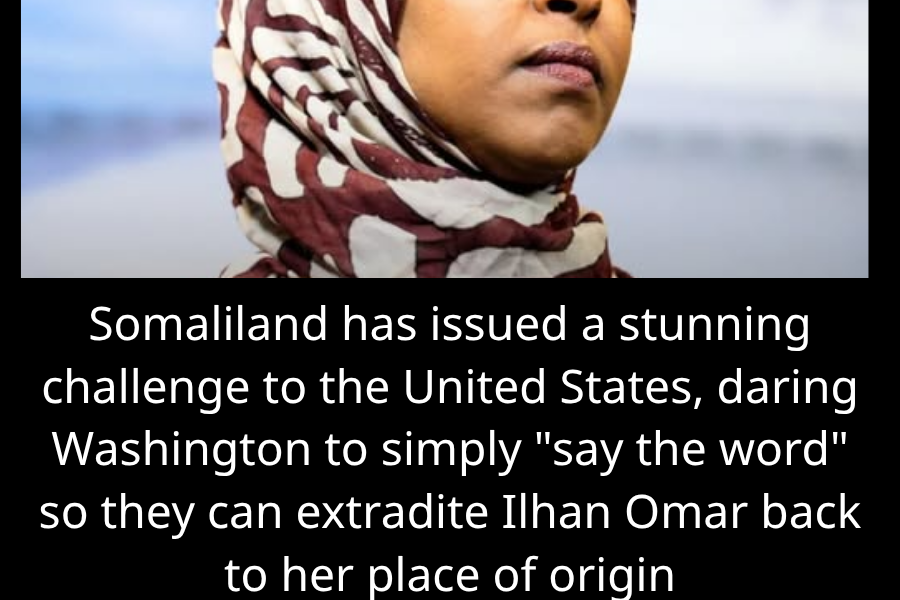
Responding to JD Vance. Responding to allegations of immigration fraud against Ilhan Omar. Responding not with a diplomatic statement, not with a careful parsing of legal technicalities, not with the kind of language that usually comes from official government accounts.
Responding with this:
“Deportation? Please you’re just sending the princess back to her kingdom. Extradition? Say the word…”
Read that again. Feel the energy. The confidence. The casual dismissal of the idea that deporting Ilhan Omar would be some kind of punishment. The implication that for Somaliland, Ilhan Omar is not a problem to be solved but a daughter to be welcomed home.
Say the word.
Three words. An open invitation. A challenge wrapped in a promise. The United States wants to get rid of her? Somaliland says: Send her back. We’ll take her. She’s ours. She’s always been ours.
The tweet is funny. It’s sharp. It’s the kind of social media clap-back that gets screenshotted and shared and turned into a thousand memes. But beneath the humor, there’s something serious. Something that the progressive left in America has never quite known how to handle.
Ilhan Omar is not just an American politician. She is a Somali politician. A Somalilander. A figure who, for all her fame in the United States, is seen very differently in the land of her birth.
And Somaliland just made that very, very clear.
The Vance Allegation
Let’s back up. JD Vance, the Vice President, recently accused Ilhan Omar of immigration fraud. The details are still emerging. The evidence is still being gathered. The legal process, if there is one, is still in its early stages.
But the allegation itself is explosive. A sitting member of Congress, accused by the Vice President of the United States, of lying about her immigration status. Of obtaining her citizenship through fraudulent means. Of being, in effect, not the person she claimed to be when she swore the oath of allegiance to the United States.
If true, the consequences are catastrophic. Loss of citizenship. Loss of office. Potential criminal charges. The end of a political career that has been, for better or worse, one of the most consequential in modern American history.
If false, the consequences are still serious. A Vice President making accusations against a member of the opposing party. A government weaponizing immigration law against a political opponent. A deepening of the divisions that already threaten to tear the country apart.
Either way, the stakes are enormous. And into that maelstrom stepped Somaliland, with a tweet that managed to be both hilarious and deeply revealing.
The Princess and the Kingdom
Somaliland’s tweet refers to Omar as a “princess” and Somaliland as her “kingdom.” That’s not just a turn of phrase. It’s a statement of political identity.
Ilhan Omar was born in Mogadishu, Somalia. But her family is from the northern regions that now constitute Somaliland. In the complex clan politics of the Horn of Africa, that means something. It means she is not just a Somali. She is a member of a specific clan, from a specific region, with specific ties to the territory that has declared itself independent from the rest of Somalia.
For Somaliland, Omar is a native daughter. Someone who, despite her fame in America, despite her political career on the other side of the world, remains connected to the land of her ancestors. Someone who, if she were to return, would be received not as a deportee but as a hero.
The tweet is designed to make that point. To remind Americans that what they see as a scandal, what they see as a liability, what they see as a problem to be solved, is seen very differently in other parts of the world. To suggest, gently but firmly, that the United States does not have a monopoly on Ilhan Omar. That she belongs to Somaliland too. And that Somaliland would be happy to have her back.
The Extradition Question
The word “extradition” is doing a lot of work here. It’s a legal term. A formal term. A term that implies criminal charges, international treaties, and the kind of legal processes that take years and involve multiple governments.
Somaliland is not recognized by the United States. There is no extradition treaty between the two countries. There is no formal diplomatic relationship at all. The idea of extraditing Ilhan Omar from the United States to Somaliland is, from a legal perspective, nonsense.
But the tweet is not a legal document. It’s a political statement. It’s using the language of extradition to make a point: that Somaliland considers Omar one of its own, that it would welcome her back, and that the United States should think carefully before treating her as a criminal.
Say the word.
It’s a dare. A challenge. A way of saying: You think you’re punishing her by sending her back? You think deportation is a threat? For us, it’s a homecoming. Try us.
The Immigration Fraud Allegations
The allegations against Omar are serious. They go to the heart of her identity as an American citizen. If true, they would mean that everything she has built—her career, her platform, her political power—rests on a lie.
But the allegations are also politically charged. Vance is a Republican. Omar is a Democrat. The accusations come at a moment when the Trump administration is aggressively pursuing immigration enforcement, deportations, and the denaturalization of immigrants who obtained their citizenship through fraud.
The timing is not coincidental. The Vance administration has made clear that it intends to use the full power of the federal government to investigate and prosecute immigration fraud, even against high-profile targets. Omar is a high-profile target. And the allegations against her, whatever their merits, provide the administration with an opportunity to make an example of one of its most prominent critics.
Somaliland’s tweet adds a new dimension to the story. It suggests that even if the allegations are true, even if Omar is deported, even if she loses her American citizenship, she will not be left stateless. She will not be abandoned. She has somewhere to go. Someone to welcome her.
That’s not a legal defense. It’s not a political argument. It’s a reminder that Ilhan Omar is not just an American story. She is also a Somali story. A Somaliland story. And that story does not end if the American chapter closes.
The Recognition Problem
Somaliland’s tweet also highlights a broader issue: the question of recognition. For thirty years, Somaliland has governed itself. It has maintained peace and stability while the rest of Somalia descended into chaos. It has held democratic elections. It has built functioning institutions. It has done everything a country is supposed to do.
And yet, no major power recognizes it. Not the United States. Not the United Kingdom. Not the United Nations. The international community continues to treat Somaliland as part of Somalia, even though Somalia has no control over its territory and no ability to govern its people.
The tweet is a reminder of that injustice. A reminder that Somaliland exists, that it has a voice, that it can speak on the world stage even if the world refuses to listen. A reminder that the United States, for all its power, cannot simply ignore the realities on the ground in the Horn of Africa.
Ilhan Omar is a symbol of those realities. A symbol of the connection between the Somali diaspora and the land of their ancestors. A symbol of the complex, messy, transnational identities that defy easy categorization.
Somaliland’s tweet is a claim to that symbol. A way of saying: She is ours. You may have borrowed her, but she belongs to us. And if you don’t want her, we’ll take her back.
The Progressive Dilemma
For progressive Democrats, the Somaliland tweet is uncomfortable. It highlights the tension between Omar’s identity as an American politician and her identity as a Somali-Somalilander. It raises questions about where her loyalties lie, who she represents, and what her ultimate commitments are.
Those questions have followed Omar throughout her career. Her critics have long accused her of being more loyal to Somalia than to the United States. Her supporters have dismissed those accusations as racist, as Islamophobic, as attempts to delegitimize a woman of color in public life.
Somaliland’s tweet complicates that narrative. Because it’s not a right-wing critic making the accusation. It’s an African government. A government that claims Omar as its own. A government that is happy to take her back if the United States doesn’t want her.
For progressives who have defended Omar against accusations of dual loyalty, the tweet is a problem. It suggests that the accusations have some basis in reality. That Omar is, in fact, seen as a “princess” of a foreign “kingdom.” That her ties to the land of her birth are not just personal but political.
That doesn’t mean the accusations of fraud are true. It doesn’t mean Omar has done anything wrong. But it does mean that the story is more complicated than progressives have been willing to admit. And that the Somaliland tweet has made that complexity impossible to ignore.
The Meme War
On social media, the Somaliland tweet has become a meme. A clap-back. A moment of levity in a story that is otherwise very serious. People are laughing at the idea of Ilhan Omar as a “princess.” People are sharing the tweet as an example of how to respond to American arrogance. People are enjoying the spectacle of a small, unrecognized African state dunking on the Vice President of the United States.
But memes have a way of becoming something more. A way of capturing a truth that more serious discourse misses. A way of crystallizing a feeling that can’t be expressed in policy papers or legal briefs.
The feeling here is one of defiance. Of refusing to accept the terms of the debate as the United States has defined them. Of saying: You think deportation is a punishment? We think it’s a homecoming. You think extradition is a threat? We think it’s an invitation. You think you have the power to decide Ilhan Omar’s fate? We have a say too.
It’s a powerful message. And it’s one that the United States, for all its power, cannot easily answer.
The Last Word
“Say the word.”
Three words. An open invitation. A challenge wrapped in a promise.
The United States is debating whether Ilhan Omar committed immigration fraud. Whether she should be deported. Whether she should lose her citizenship. Whether her political career should end in disgrace.
Somaliland is watching that debate. And it has made its position clear: If the United States doesn’t want her, Somaliland does.
She is not a problem to be solved. She is a daughter to be welcomed home. She is not a criminal to be punished. She is a princess to be received. She is not a liability to be discarded. She is a native daughter of a nation that has spent thirty years fighting for the recognition it deserves.
The tweet is funny. It’s sharp. It’s the kind of social media moment that gets screenshotted and shared and turned into a thousand memes. But beneath the humor, there’s something serious. Something that the United States, in its arrogance, has forgotten:
Ilhan Omar is not just an American. She is also a Somalilander. And Somaliland is proud to claim her.
Say the word.
The United States might not be ready to say it. But Somaliland is. And that, in the end, might be the most important thing of all.