The Jeffries Indictment: Naming Names in the War Over Islamophobia
The Accusation
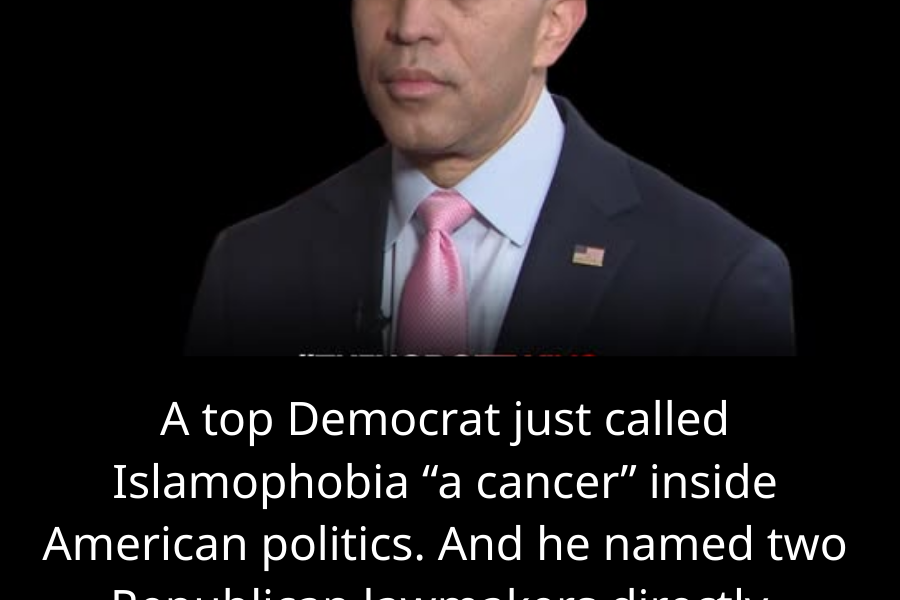
Let’s start with what Hakeem Jeffries actually said, because the House Democratic Leader chose his words with surgical precision:
“The vile and disgusting rhetoric from sick individuals like Randy Fine and Tommy Tuberville is disgraceful. Islamophobia is a cancer and has no place in America.”
Two Republicans named. Two specific targets. One unified condemnation.
Jeffries didn’t speak in generalities about “some people” or “certain members.” He named names. He called them “sick individuals.” He labeled their words “vile and disgusting.” And he framed the issue not as a political disagreement but as a moral crisis—a “cancer” that must be eradicated.
The context matters: Tuberville had just posted his defiant defense of calling out “Radical Islamists” who “gun down innocent Americans.” Fine, a Florida state senator, has a long history of inflammatory rhetoric about Muslims, including calls to ban Sharia law and statements linking Islam to terrorism.
Jeffries is drawing a line. And he’s daring Republicans to cross it.
The Targets: Why Fine and Tuberville?
Tommy Tuberville is the easier target. His recent post—”I don’t give a rip about being politically correct. Innocent Americans are being gunned down in the streets almost daily by Radical Islamists whose ‘religion’ teaches them it’s righteous to kill Christians”—was designed to provoke. It conflates a religion with its most violent adherents. It paints an entire faith as inherently murderous. It’s the kind of rhetoric that plays to a base but alienates everyone else.
Randy Fine is less known nationally but equally controversial in Florida. He’s made a career out of attacking Muslims, pushing legislation to ban “foreign law” (a dog whistle for Sharia), and linking American Muslims to terrorism. His rhetoric has been condemned by Muslim advocacy groups for years.
Jeffries chose them strategically. They’re not the most powerful Republicans, but they’re among the most visible in their anti-Muslim rhetoric. Calling them out puts other Republicans in a difficult position: defend them and be associated with their extremism, or distance themselves and risk alienating the base.
The “Cancer” Metaphor: Why It Matters
Jeffries didn’t call Islamophobia a “problem” or an “issue.” He called it a “cancer.”
Cancer is not something you manage. Cancer is not something you debate. Cancer is something you eradicate—surgically, aggressively, without compromise. The metaphor is intentionally extreme because Jeffries believes the problem is extreme.
He’s also signaling that this is not a matter of “both sides” or “reasonable disagreement.” In his view, attacking an entire religion is not a legitimate political position. It’s a sickness. And treating it as anything less is to enable it.
This framing forces a choice. Are you with Jeffries in eradicating the cancer? Or are you with those spreading it? There is no middle ground.
The Silence of Republican Leadership
Jeffries’ most pointed accusation is directed not at Fine and Tuberville, but at the Republican leaders who let them speak without consequence.
“Accused Republican leadership of a shocking and deeply unpatriotic silence in the face of it.”
“Unpatriotic” is a powerful word. It suggests that by failing to condemn anti-Muslim rhetoric, Republican leaders are betraying the country itself. They’re allowing a cancer to grow. They’re prioritizing political convenience over national unity.
Is this fair? It depends on what you expect from leadership.
Some Republicans will argue that they can’t police every statement from every member. They’ll say that Tuberville and Fine are entitled to their opinions, even if those opinions are unpopular. They’ll point to Democratic silence on anti-Christian rhetoric as evidence of double standards.
But Jeffries’ point is that silence is not neutral. When leaders refuse to condemn bigotry, they implicitly condone it. When they let members attack an entire religion without consequence, they signal that such attacks are acceptable. Silence is a choice. And in this case, Jeffries argues, it’s the wrong choice.
The Mamdani Connection: Why New York Matters
Jeffries’ condemnation is also tied to the ongoing controversy surrounding New York City Mayor Zohran Mamdani—the first Muslim mayor of New York, who has been the target of relentless attacks from conservatives questioning his loyalty, his faith, and his fitness for office.
Mamdani represents something the far right cannot accept: a visible, powerful, proudly Muslim American leader in the country’s largest city. His existence is a refutation of the idea that Muslims don’t belong. And his success has made him a target.
Tuberville’s rhetoric doesn’t mention Mamdani by name, but the implication is clear. When you say “Radical Islamists are gunning down Americans,” and when Mamdani is in the news every day, the connection is drawn whether you intend it or not.
Jeffries is defending not just an idea, but a person—an elected official, a fellow Democrat, a symbol of Muslim American achievement. He’s saying: this man deserves better than to be smeared by association with terrorists.
The Muslim American Response
Muslim American organizations have largely praised Jeffries for his forceful condemnation. The Council on American-Islamic Relations (CAIR) issued a statement thanking him for “standing up to bigotry” and calling on other leaders to follow his example.
But there’s also frustration that it took this long. Muslim Americans have been subjected to this rhetoric for decades, with only occasional pushback from political leaders. Jeffries’ statement is welcome, but it’s also overdue.
The broader Muslim community is watching to see whether this is a one-time statement or the beginning of sustained advocacy. Will Democrats make fighting Islamophobia a priority? Or will they move on to the next controversy once the news cycle shifts?
The Republican Response: Defiance or Distance?
So far, Republican leadership has been muted. No major figures have rushed to defend Tuberville or Fine, but none have condemned them either.
Some Republicans are privately frustrated with Tuberville’s timing. His statement came just as the party was trying to present a unified front on immigration and border security. Now they’re forced to answer questions about Islamophobia instead of talking about their agenda.
Others are more supportive. They see Tuberville as speaking truth to power, refusing to be cowed by political correctness. They believe that attacking his rhetoric is itself a form of silencing—that Americans have a right to criticize any religion, including Islam.
This divide within the party mirrors the broader divide in the country. Some Republicans want to move toward the center on cultural issues. Others believe the culture war is the only fight that matters. Tuberville’s statement forces them to choose.
The Verdict: A Defining Moment
Hakeem Jeffries just did something rare in modern politics: he drew a clear line and dared the other side to cross it.
He named names. He used strong language. He framed the issue in moral terms. And he put Republican leadership on notice: silence is complicity.
Whether this moment becomes a turning point or just another flashpoint depends on what happens next. If Republicans continue to tolerate anti-Muslim rhetoric, Jeffries will have a powerful argument that the party is irredeemably bigoted. If they distance themselves from Tuberville and Fine, Jeffries can claim victory in forcing accountability.
Either way, the issue is now front and center. Islamophobia is no longer a background concern—it’s a named enemy, a “cancer” that must be eradicated. And Hakeem Jeffries has positioned himself as the surgeon.
The question is whether anyone will join him in the operating room.