Tyrus, Kat, and the Price of Manufactured Outrage
It always starts with laughter.
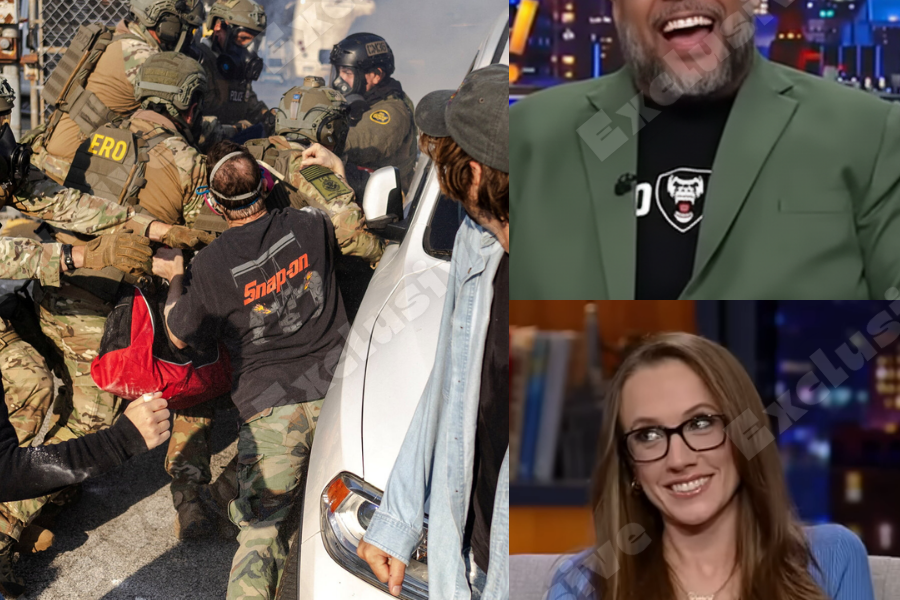
The crowd roars, the lights are hot, and Tyrus flashes that slow, heavy grin — the one that tells you he knows exactly how far he can go before anyone in Standards & Practices blinks. Beside him, Kat Timpf chuckles like the only sane person in a collapsing circus. For five straight minutes, they roast political figures by name — age jokes, body jabs, cheap cracks about speech patterns, hairlines, waistlines. It’s the kind of “equal opportunity humor” that never quite lands equally.
Then, with a single pivot, the laughter dies and the empathy switch flips on. Suddenly, the same hosts who mocked half of Washington are somber, even tearful, over the “plight” of I.C.E. agents left to fend for themselves in Chicago. Suddenly, this is about honor, sacrifice, and the American worker betrayed by leadership.
That’s not a tonal shift. That’s a business model.
Watch the transcript closely — it’s a study in emotional engineering. First, the warm-up: degrade the opposition, reduce them to punchlines. Then, activate moral gravity by defending the chosen “victims” of the night. Every segment follows the same rhythm — mockery, outrage, empathy, repeat. It’s not news; it’s neurochemistry. And the crowd rewards every beat with applause that sounds rehearsed but isn’t. It’s genuine. That’s what makes it work.
Tyrus and Kat know their audience’s blood pressure better than any doctor. They don’t sell facts — they sell friction. The show’s formula is simple: make you feel the chaos, then offer a side to stand with. They pretend to mourn the fall of civility while monetizing its corpse.
The Chicago “stand-down” story was their golden ticket that night. They played the leaked police audio like a forbidden tape from a collapsing republic. Officers begging for help. Agents surrounded. Bureaucrats saying “do not send.” It was perfect raw meat for their narrative — proof that the government had abandoned the enforcers, that leadership had gone “soft,” that ordinary men with badges were being left to die for political correctness. Never mind that the real details were messy, disputed, incomplete. In television, ambiguity is the enemy of engagement.
And yet, listen between the lines: while the panel feigns compassion for officers, their tone betrays something colder. They aren’t grieving; they’re investing. Every gasp and furrowed brow adds another deposit into the outrage economy.
Because this isn’t a story about I.C.E. or Chicago or even violence. It’s about attention, and the transactional logic of media anger. The same hosts who mock Kamala Harris’s laugh and Joe Biden’s age suddenly talk about “duty” and “honor” like born-again patriots. It’s the oldest exchange in political television — the bánh ít đi, bánh quy lại of American media: you give me your fury, I’ll feed you righteousness.
And it works because the audience doesn’t see the trade. They see sincerity, not strategy. They don’t realize that empathy here isn’t a virtue — it’s a product. Each sigh for I.C.E. agents, each “God bless our law enforcement,” each mock-heroic lament about the “dangerous times we live in” — all of it is prepackaged sentiment designed to neutralize guilt. The viewer can laugh cruelly at Rosie O’Donnell one minute and cry noble tears for the “forgotten cop” the next, all without ever confronting the contradiction. That’s not hypocrisy; that’s craftsmanship.
What makes it darker is how self-aware it’s become. When Tyrus says, “something bad is going to happen,” he’s not warning. He’s prophesying — and profiting from the inevitability. The panel’s “concern” is predictive programming: priming the audience to expect violence so they’ll tune in for the replay. The more chaos unfolds, the more “proof” they have that they were right all along.
The show becomes both the arsonist and the fire marshal. They torch the discourse with mockery, then walk through the ashes preaching order and decency. It’s performance as prophecy — and business as usual.
In the end, Tyrus and Kat aren’t journalists, comedians, or activists. They’re brokers in emotional futures. They buy low on cynicism, sell high on outrage, and leave their viewers feeling both furious and righteous — the perfect psychological loop for endless engagement.
And that’s the trick no one says out loud: the outrage isn’t accidental. It’s the point.