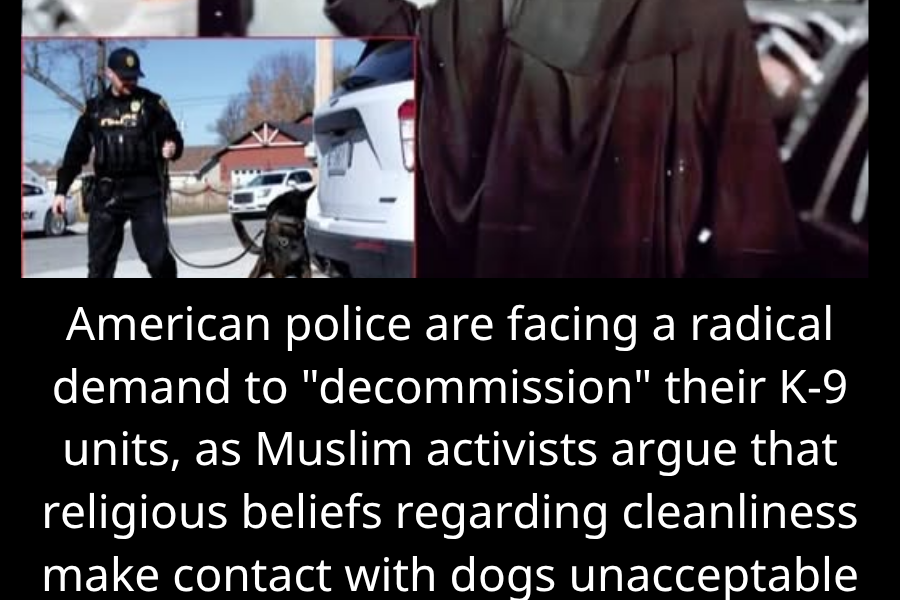
The Dog in the Room: When Religious Belief Meets Police Work
Let’s start with something everyone can agree on: No one should be afraid to call for help when they need it.
That’s the baseline. That’s the contract. That’s the thing that police departments across America spend millions of dollars trying to build and maintain. Trust. The belief that when something goes wrong, when danger comes, when you need someone to show up and make things right—you can pick up the phone and help will come.
Now, a new complication has entered that contract.
Muslim activists are raising a concern that police departments have never really had to think about before. It’s about dogs. Specifically, about police K-9 units. About the animals that have been part of law enforcement for generations, used for tracking, for detection, for protection, for all the things that make police work safer and more effective.
The activists say that for Muslims, dogs present a religious challenge. Traditional Islamic teachings consider dogs’ saliva to be ritually impure. Contact with dogs requires a specific purification process. For some Muslims, even being near a dog—especially in close quarters like a vehicle or a station—creates a conflict between their religious obligations and their interaction with law enforcement.
The ask is simple: Don’t bring the dog to the car. Don’t require a Muslim driver to sit in a vehicle with a canine. Don’t make entering a police station a religious decision.
But simple asks often lead to complicated questions. And the questions here are the kind that don’t have easy answers.
The Religious Foundation
Let’s be clear about what Islamic tradition actually says. Because this isn’t about disliking dogs. It’s not about fear. It’s about something deeper.
In Islamic jurisprudence, dogs are considered najis—ritually impure. The impurity is specifically in their saliva. A Muslim who comes into contact with a dog’s saliva must wash the affected area seven times, once with soil or sand, before being considered ritually clean for prayer.
This is not a fringe interpretation. It’s mainstream. It’s taught in mosques across the world. It’s observed by millions of Muslims who take their faith seriously. For them, a dog in a police car isn’t just an inconvenience. It’s a religious violation. It’s something that requires ritual purification. It’s something that, if unavoidable, creates a barrier between them and their religious obligations.
The activists making this argument are not asking for special treatment. They’re asking for the same consideration that police departments already give to other religious and cultural practices. They’re asking to be able to interact with law enforcement without having to choose between their faith and their safety.
That seems reasonable. Until you start thinking about the logistics.
The Operational Reality
Police K-9 units exist for a reason. Dogs can do things that humans cannot. They can find drugs that are hidden in places no officer could reach. They can track suspects through terrain that would be impossible for a human to follow. They can detect explosives before they detonate. They can protect officers in situations where a human backup might not arrive in time.
These are not luxuries. They are tools. Essential tools. Tools that save lives.
The officer in a patrol car with a K-9 is not trying to offend anyone’s religious sensibilities. He’s doing his job. The dog is not there as a statement. It’s there because it’s part of the equipment, like the radio and the lights and the computer terminal. It’s there because the department has determined that this is the most effective way to keep the community safe.
Now, the activists are asking that officers with K-9s not approach vehicles occupied by Muslims. They’re asking that those officers stay back. That other officers, without dogs, be sent instead. That in the middle of a traffic stop, a call, an emergency, the police department consult an invisible list of who can approach which car based on the driver’s religion.
That’s the part that makes police departments nervous. Because in an emergency, you don’t have time to consult a list. You don’t have time to radio back to dispatch and ask if there’s a non-K-9 unit available. You don’t have time to figure out the religious affiliation of the person you’re trying to help.
You respond. You do your job. You use the tools you have. And if that causes a religious problem, you deal with it afterward.
The Station Problem
The issue goes beyond traffic stops. Some Muslims are reportedly refusing to enter police stations that have canines present. Even in emergencies. Even when they need help. Even when the alternative is leaving a crime unreported, a dangerous situation unresolved, a victim without recourse.
This is where the concern becomes acute. Because a police station is a police station. It’s not a mosque. It’s not a private home. It’s a government building where law enforcement operates. And for many departments, that operation includes K-9 units. Dogs are housed at stations. Dogs are trained at stations. Dogs are present at stations because that’s where the work happens.
If a Muslim victim of crime refuses to enter a station because there’s a dog somewhere in the building, what is the department supposed to do? Move the dog? Every time? Build separate entrances? Designate some stations as “dog-free” and others as not?
The logistics spiral quickly. And at the bottom of that spiral is a question that no one wants to ask: At what point does accommodation become something else? At what point does the effort to respect religious beliefs start to compromise the ability to do the job?
The Hesitation Problem
The activists make a point that deserves to be taken seriously. They say that without accommodation, some Muslims will hesitate to seek help. They will avoid reporting crimes. They will delay emergency response. They will, in effect, become less safe because the system that is supposed to protect them has not made room for their faith.
That’s a real problem. It’s a problem that police departments should care about. Because when people stop reporting crimes, crimes don’t stop happening. They just stop being solved. When people avoid interacting with police, they don’t become safer. They become more vulnerable. When a community loses trust in law enforcement, the only people who benefit are the criminals.
So the question is not whether police departments should care about this. They should. The question is how to balance that care with the operational realities of law enforcement.
The Precedent Question
Here’s where the conversation gets uncomfortable.
Police departments already accommodate religious and cultural practices. They have for years. Female officers may request to be present when searching Muslim women. Dietary restrictions are considered in training and detention settings. Religious holidays are factored into scheduling and operations.
These accommodations work because they are specific, manageable, and do not compromise the core functions of law enforcement. They are adjustments, not overhauls. They are about treating people with dignity while still doing the job.
The K-9 question is different. It’s not about one officer being assigned to a specific task. It’s about the basic functioning of K-9 units—units that are deployed across the country, that are integrated into patrol operations, that are essential to everything from drug interdiction to search and rescue.
Accommodating the request would mean fundamentally changing how K-9 units operate. It would mean creating a system where officers with dogs cannot engage with a significant portion of the population. It would mean maintaining separate response protocols based on religious identity. It would mean asking officers to know, in real time, who can approach which car based on a characteristic they cannot see and are not trained to assess.
That’s not an accommodation. That’s a restructuring. And it’s the kind of restructuring that police departments, already stretched thin, are not eager to undertake.
The Interfaith Question
It’s worth noting that not all Muslims share this view. Islamic practice around dogs is not monolithic. Some Muslims follow the traditional interpretation that dogs are ritually impure. Others have adopted different views, noting that dogs are mentioned in the Quran as companions and guardians, and that the tradition of purity may have developed in specific historical contexts that don’t necessarily apply today.
There are Muslim police officers. There are Muslim K-9 handlers. There are Muslims who have dogs as pets, who work with dogs, who see no conflict between their faith and their contact with canines. The tradition is not uniform, and the demand for accommodation is not universal.
That doesn’t make the activists’ concerns less valid. It just complicates the picture. Because if some Muslims are comfortable with dogs and others are not, how does a police officer know which is which? How does a department create a policy that respects the beliefs of some without imposing those beliefs on others?
The answer is not simple. And anyone who says it is simple hasn’t thought about it long enough.
The Middle Ground
There is probably a middle ground here. It looks something like this:
Police departments can train officers to be aware of the religious concerns. They can instruct officers that when a driver expresses a religious objection to dogs, the officer should make reasonable efforts to accommodate—within the constraints of safety and operational necessity. They can make sure that stations have areas where K-9s are not present, so that individuals who need to enter the station can do so without encountering dogs.
These are not radical changes. They are adjustments. They are the kind of adjustments that police departments make all the time when they encounter new challenges.
What they cannot do is create a blanket policy that says K-9 units cannot approach vehicles occupied by Muslims. They cannot tell officers to guess the religious identity of drivers before making a stop. They cannot remove K-9s from patrol entirely because some people might be uncomfortable with their presence.
That’s not accommodation. That’s surrender. And it’s the kind of surrender that would make communities less safe, not more.
The Trust Equation
At the heart of this issue is trust. Trust between police and the communities they serve. Trust that has been eroded over decades, that is being rebuilt slowly and painfully, that is essential to public safety.
The activists are right that police departments need to take religious concerns seriously. They are right that when people are afraid to call for help, everyone is worse off. They are right that a police department that does not consider the needs of all its citizens is a police department that is not doing its job.
But trust is a two-way street. It requires police to accommodate legitimate concerns. And it requires communities to understand that police have a job to do, and that job sometimes involves tools and methods that not everyone will love.
The K-9 unit is not going away. The dog is not going to be banned from patrol. But there are ways to be thoughtful about how K-9 units are deployed, how interactions are handled, how stations are designed. There are ways to respect religious beliefs without compromising public safety.
The question is whether both sides are willing to find them.
The Final Question
No one wants a Muslim victim of crime to hesitate to call for help. No one wants a Muslim driver to feel that their faith is being violated during a routine traffic stop. No one wants religious practice to be a barrier to public safety.
But no one wants police officers to be unable to do their jobs. No one wants K-9 units, which save lives and solve crimes, to be sidelined because of a concern that could be addressed with better training and communication.
The middle ground exists. It requires effort from both sides. It requires police departments to take religious concerns seriously and to make reasonable accommodations. And it requires religious communities to understand that law enforcement cannot be tailored to every individual preference, that sometimes the dog is going to be there, and that the presence of a dog is not an attack on faith.
This is not a crisis. It’s a conversation. And like most conversations about religion and public life, it will require patience, understanding, and a willingness to see the other side.
The dog is not the enemy. The police are not the enemy. The only enemy is the idea that we can’t figure this out together.
We can. We have to. Because the alternative—a community that hesitates to call for help, a police department that cannot use its most effective tools—is a world that is less safe for everyone.
And no one wants that.