The Ghost Files: 300,000 Dead People Who Could Still Vote
Let’s do the math slowly.
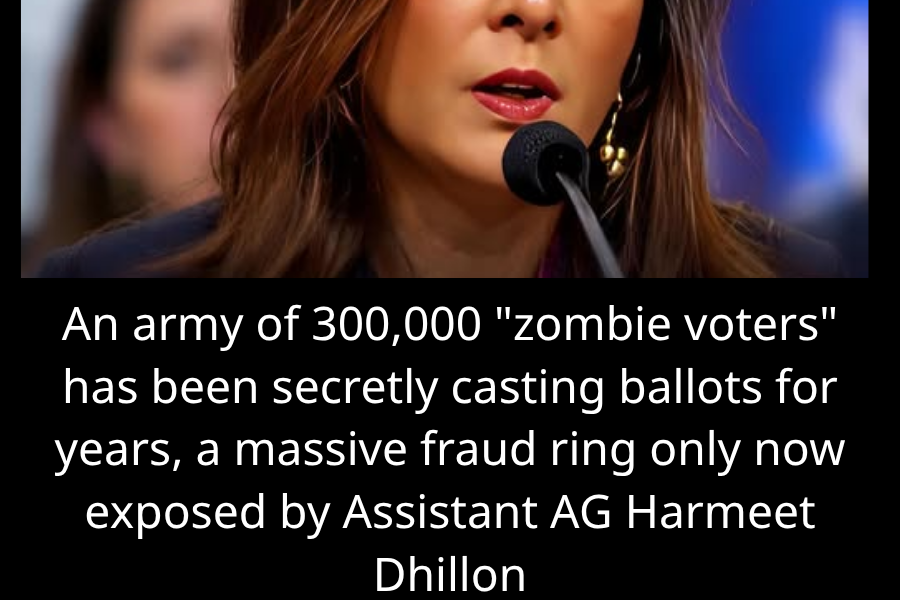
Three hundred thousand. That’s the number Harmeet Dhillon just dropped. Three hundred thousand dead people—deceased individuals, people who have shuffled off this mortal coil, people who are, to use the technical term, no longer with us—still sitting on state voter rolls. Eligible to vote. Registered to vote. Waiting to be activated like sleeper agents in a bad spy movie.
Three hundred thousand. That’s the population of a small city. That’s the number of people who live in Cincinnati. Or Pittsburgh. Or Tampa. An entire city’s worth of ghosts, waiting to cast ballots in the next election.
And here’s the part that should terrify you: That’s just from reviewing a fraction of the records. Fifty to sixty million. A partial slice. A taste. A preview. The DOJ hasn’t even looked at the whole country yet. And they’ve already found three hundred thousand dead people who are apparently eager to exercise their constitutional rights from beyond the grave.
Dhillon didn’t say this to be dramatic. She didn’t say it to make headlines. She said it because the Department of Justice—the agency that spent years telling you voter fraud was a myth—has now admitted, on the record, that the voter rolls are so filthy that they’ve identified over 300,000 dead people still on them.
And they’re just getting started.
The Fraction That Broke Everything
Let’s be precise about what Dhillon said.
She said the DOJ reviewed 50 to 60 million records. That’s not the whole country. That’s not every state. That’s just the states that cooperated. The states that handed over their voter rolls and said “sure, come look.” The states that weren’t hiding anything. The states that were, presumably, the most compliant, the most transparent, the most willing to be audited.
And in that sample—in the easy states, the cooperative states, the states that said “please, come in and see how clean our rolls are”—they found 300,000 dead people.
Three hundred thousand.
Now think about the states that didn’t cooperate. The states that fought the DOJ. The states that sued to keep the feds out of their voter rolls. The states that have spent years insisting that everything is fine, that there’s no fraud, that anyone who asks questions is a conspiracy theorist.
What are they hiding? How many ghosts are on their rolls? How many dead people are waiting to vote in the next election, ready to be activated by someone who knows how to game the system?
Dhillon didn’t say. She didn’t have to. The math does it for you. If the cooperative states have 300,000 dead people, what do the non-cooperative states have? Double? Triple? A million? Two million?
The number is staggering. And it’s only going to get bigger as the DOJ digs deeper.
The “One Case” Standard
Dhillon used a phrase that should be engraved on the wall of every election office in America:
“Even one such case warrants action.”
That’s the standard. That’s the bar. One dead person on the voter rolls is one too many. One ghost who can be activated to cast a ballot is a threat to the integrity of the entire system. Because it’s not about the number. It’s about the possibility. It’s about the fact that if one dead person can vote, a thousand can. A hundred thousand can. Three hundred thousand can.
The response from the left has always been: “Well, it’s just a few cases. It’s not systematic. It doesn’t change the outcome.” That’s the argument. That’s the dismissal. That’s the way they’ve waved away every fraud concern for years.
But Dhillon just flipped that argument on its head. She’s not saying 300,000 dead people voted. She’s not saying there was fraud. She’s saying there’s the capacity for fraud. The setup. The perfect condition for fraud to happen. Because if the rolls are full of dead people, what else is on them? What other ineligible voters are waiting to be activated? What other ghosts are sitting there, ready to be claimed by anyone who knows how to work the system?
She’s not saying the system is broken because of what happened. She’s saying the system is broken because of what could happen. And that, by itself, is enough to demand action.
The Cleanup Has Begun
The DOJ is not just identifying the dead people. They’re doing something about them.
Dhillon said the department is cross-checking records. They’re suing non-compliant states. They’re forcing cleanups under federal law. They’re using the full weight of the Justice Department to scrub the voter rolls of the ghosts that have been sitting there for years, decades, maybe since the last century.
This is what election integrity looks like. Not a press release. Not a speech. Not a new law. Just basic, boring, necessary maintenance. The kind of thing that should have been happening all along. The kind of thing that would have prevented the rolls from getting this bloated, this corrupted, this full of dead people in the first place.
But it didn’t happen. For years, the system was allowed to decay. For years, the people in charge looked the other way. For years, anyone who pointed out the problem was called a conspiracy theorist, a threat to democracy, a racist trying to suppress the vote.
And now the DOJ has the receipts. 300,000 of them. And they’re just getting started.
The Non-Compliant States
Here’s where it gets interesting.
Dhillon mentioned that the DOJ is suing non-compliant states. States that refused to cooperate. States that fought the audit. States that, for whatever reason, didn’t want the feds looking at their voter rolls.
What are those states hiding? Why would any state refuse to clean up its rolls? Why would any state fight to keep dead people on the voter list? Why would any state spend taxpayer money defending the right of ghosts to stay registered?
The answers are obvious. And they’re not pretty.
Some states have spent years building their political power on the backs of bloated voter rolls. They know that clean rolls mean fewer voters. They know that fewer voters mean tighter margins. They know that tighter margins mean they might lose. So they fight. They sue. They delay. They do everything they can to keep the rolls exactly as they are: messy, unverified, full of ghosts waiting to be activated.
Dhillon is calling them out. She’s not naming names—not yet. But the lawsuits will do that. The court filings will do that. The discovery process will do that. And when it all comes out, when the non-compliant states are forced to open their books, we’re going to find out just how many dead people they’ve been protecting.
The number will be bigger than 300,000. Much bigger.
The “Perfect Setup”
Dhillon called it a “perfect setup for fraud.”
That’s the key phrase. That’s the one that should keep you up at night.
Because fraud doesn’t happen because one person votes illegally. Fraud happens because the system is set up to allow it. Because the rolls are dirty. Because the safeguards are weak. Because the people in charge don’t want to know what’s really happening.
300,000 dead people on the rolls is not evidence of fraud. It’s evidence of vulnerability. It’s evidence that the system is not secure. It’s evidence that if someone wanted to commit fraud—if someone wanted to activate those dead voters, to cast ballots in their names, to tilt an election—they could. The infrastructure is there. The ghosts are waiting. The only thing missing is the will to use them.
And that’s what Dhillon is trying to prevent. Not the fraud that happened. The fraud that could happen. The fraud that will happen if the system isn’t fixed. The fraud that does happen in every election, somewhere, because the rolls are full of dead people and no one is checking.
She’s not saying the last election was stolen. She’s saying the next election could be. And she’s trying to make sure it isn’t.
The Ghost Vote Problem
Let’s talk about how this actually works.
A dead person on the voter roll is not a problem by itself. The problem is what happens when someone decides to use that dead person’s registration. All you need is a name, an address, and a ballot. In states with mail-in voting, that’s easy. You request a ballot for the dead person. You fill it out. You send it in. You vote.
No one checks. No one verifies. No one knows. The dead person doesn’t complain. The system doesn’t flag it. The ballot gets counted. The ghost votes.
It doesn’t have to be organized. It doesn’t have to be systematic. It just has to happen enough times in enough close races to change outcomes. A few hundred ballots here. A few thousand there. In a close election, that’s all it takes.
And the system is set up to allow it. Because the rolls are full of dead people. Because no one is cleaning them. Because the people in charge have spent years insisting that fraud doesn’t happen, that it’s a myth, that anyone who asks questions is a threat to democracy.
Dhillon is proving them wrong. One dead voter at a time.
The Number That Will Grow
Three hundred thousand is just the beginning.
That’s from a partial review. A slice. A taste. The DOJ hasn’t even gotten to the non-compliant states yet. They haven’t gotten to the states that fought the audit. They haven’t gotten to the states that have been hiding their rolls for years.
When they do, the number will grow. Maybe to a million. Maybe to two million. Maybe to a number so large that even the people who have spent years denying the problem will have to admit it exists.
And then what? What happens when the country realizes that there are more dead people on the voter rolls than there are people in some states? What happens when the ghosts outnumber the living in key precincts? What happens when the “myth” of voter fraud becomes an undeniable, documented, proven reality?
The system changes. Or it breaks. One of the two.
Dhillon is betting on change. She’s betting that if she can show the country the scale of the problem, the pressure will build. The non-compliant states will comply. The dirty rolls will be cleaned. The ghosts will be exorcised. And the next election will be a little more secure than the last one.
It’s a good bet. But it’s not guaranteed. Because the people who have been protecting the dead voters aren’t going to give up without a fight. They’ve spent years building this system. They’ve spent years defending it. They’ve spent years calling anyone who questioned it a conspiracy theorist.
They’re not going to just hand over the ghost files and say “you’re right, we were wrong.” They’re going to fight. They’re going to sue. They’re going to delay. They’re going to do everything they can to keep the rolls exactly as they are: messy, unverified, full of ghosts waiting to be activated.
Dhillon knows this. That’s why she’s not waiting. That’s why she’s moving now. That’s why she’s suing. That’s why she’s forcing the issue. Because every day the rolls stay dirty is a day when fraud could happen. Every ghost on the list is a potential vote waiting to be stolen. Every non-compliant state is a ticking time bomb.
The Transparency Demand
The headline says: “Share if you’re demanding full transparency!”
That’s the ask. That’s the call. That’s what Dhillon is trying to build. A movement. A demand. A public insistence that the voter rolls be cleaned, that the dead be removed, that the system be made secure.
Because this isn’t something the DOJ can do alone. They can sue. They can audit. They can identify. But they can’t make the public care. They can’t make the public demand action. They can’t make the public hold their elected officials accountable for the state of the rolls.
That’s your job. That’s our job. That’s the job of everyone who wants to live in a country where elections are secure, where fraud is prevented, where the ghosts don’t decide who wins.
Dhillon gave us the number. 300,000. That’s the opening bid. That’s the first domino. That’s the evidence that the problem is real, that it’s massive, that it’s been hidden for years by the people who were supposed to be protecting the system.
Now it’s our turn. Now we demand. Now we insist. Now we make sure that every state complies, that every roll is cleaned, that every ghost is removed before the next election.
Because the alternative is unthinkable. The alternative is a system where the dead vote. The alternative is a system where fraud is possible. The alternative is a system that no one trusts, that no one believes in, that no one accepts as legitimate.
Dhillon is trying to prevent that. She’s trying to save the system from itself. She’s trying to make sure that when the next election happens, the people who vote are the people who are supposed to vote. The living. The citizens. The ones who actually have a stake in the outcome.
Not the ghosts. Not the dead. Not the 300,000 names that should have been removed years ago.
The Last Ghost
Three hundred thousand dead people on the voter rolls. That’s the number. That’s the headline. That’s the bombshell.
But the real number is bigger. The real number is what’s hiding in the non-compliant states. The real number is what comes out when the lawsuits are done, when the audits are complete, when every roll in every state has been scrubbed.
That number will be the final indictment. That number will be the proof that the system was broken. That number will be the evidence that the people who told us fraud was a myth were lying, or ignorant, or both.
Dhillon gave us the first number. The partial number. The tip of the iceberg.
Now we demand the rest. Now we demand that every state open its books. Now we demand that every ghost be identified, every dead voter removed, every vulnerability closed.
Because the ghosts are not going to vote themselves. They’re not going to cast ballots on their own. They’re waiting. They’ve been waiting for years. They’ll keep waiting until someone decides to use them.
Unless we stop it. Unless we clean the rolls. Unless we demand transparency. Unless we make sure that when the next election comes, the only people voting are the people who are supposed to vote.
The living. The citizens. The ones who actually have a stake in the outcome.
Not the ghosts. Not the 300,000. Not the millions more waiting to be found.
Dhillon started the cleanup. Now it’s our turn to finish it. Demand transparency. Demand action. Demand that the dead be removed from the rolls before they decide the next election.
Because the alternative is a country where the dead vote. And that’s not a country worth living in.