The Maher Paradox: When a Joke About Peace Becomes a Threat of War
The Setup: A Comedian Walks Into a Minefield
Let’s start with the context, because Bill Maher doesn’t do anything without context.
For decades, Maher has hosted Real Time on HBO, a platform where he delivers monologues that blend comedy, commentary, and provocation. He’s a liberal who loves to annoy liberals. He’s an atheist who mocks religion. He’s a free-speech absolutist who delights in saying the unsayable. His entire career is built on the premise that nothing should be off-limits.
So when he looked at the escalating conflict with Iran—the strikes, the deaths, the blockade, the oil shock—and delivered a line about Trump deserving the Nobel Peace Prize, his audience knew what was coming. It was sarcasm, pure and simple. The kind of sarcasm that points at a catastrophe and says, “Well, I guess this is what winning looks like.”
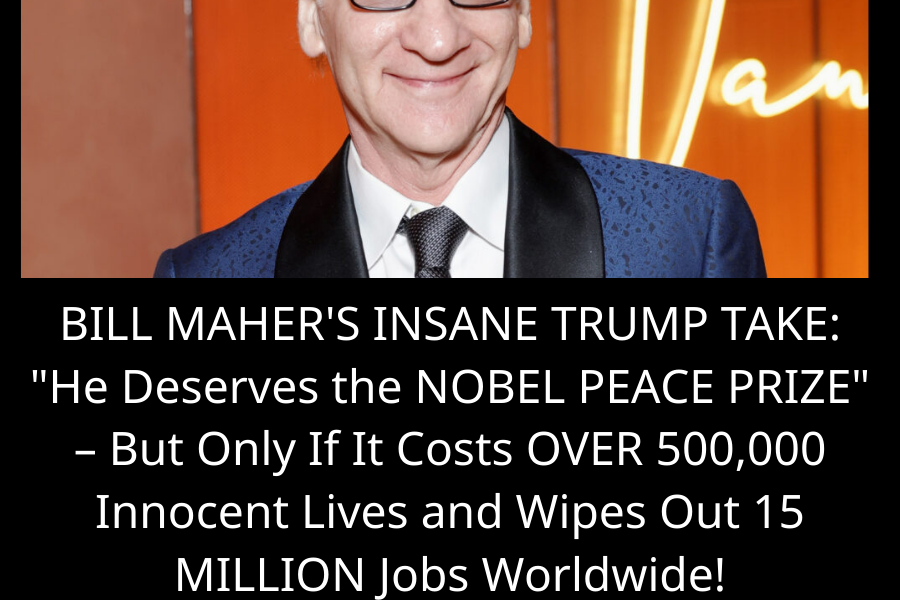
“If Trump somehow makes those three regimes fall, he should get a Nobel Peace Prize.”
The line landed. The audience laughed. Then the internet did what it does.
The Joke: What Maher Actually Said
Let’s parse the quote carefully, because the meaning is in the delivery.
Maher wasn’t endorsing Trump. He wasn’t suggesting that the president actually deserves a Nobel. He was making a darkly comic observation about the gap between rhetoric and reality. Trump says he’s making peace. Maher says, in effect: If by “peace” you mean overthrowing three regimes, causing half a million deaths, and destroying 15 million jobs—sure, give him the prize. That’s the kind of peace we’re getting.
It’s the same kind of joke a comedian might make about a politician who promises to “drain the swamp” while filling it with alligators. The humor comes from the absurdity of the disconnect—the gap between what leaders say and what they do.
The problem is that in 2026, with the world on edge and the Middle East in flames, even sarcasm can feel like a live grenade.
The Numbers: The Real Cost of “Victory”
Maher’s joke wasn’t凭空 invented. It was based on real projections—estimates of what a full-scale regional war could cost.
500,000 innocent lives. That’s not hyperbole; that’s the low-end estimate from experts who have modeled the humanitarian impact of regime collapse in Iran, plus the ripple effects through Iraq, Syria, Lebanon, and beyond. Civil wars, starvation, disease, reprisal killings—these are the predictable consequences of toppling a government without a plan for what comes next.
15 million jobs destroyed worldwide. The global economy is already reeling from the blockade of the Strait of Hormuz. Oil at $100 a barrel is just the beginning. Supply chains that took decades to build are snapping. Industries that depend on stable energy prices are collapsing. The job losses won’t be confined to the Middle East; they’ll hit every corner of the globe.
These are not talking points. They are projections based on historical precedent. We have seen what happens when regimes fall without stable successors—in Iraq, in Libya, in Syria. The pattern is consistent: chaos, death, and economic devastation that lasts for generations.
Maher’s joke was pointing at that pattern and saying: This is what “peace” looks like.
The Threats: When Comedy Becomes a Target
The twist in this story—the detail that turns it from political commentary into something darker—is the reported death threats.
According to multiple sources, Maher received anonymous threats against his family immediately after the comment. Not the usual online harassment. Not angry tweets. Credible threats—the kind that require security details, that force a man to look over his shoulder, that turn a joke into a matter of life and death.
If true, this is a chilling development. It suggests that the stakes of political discourse have escalated to a point where even sarcastic criticism can trigger violent responses. It suggests that there are people out there—whether deranged individuals or organized groups—who are willing to kill to silence dissent.
Maher has been saying provocative things for thirty years. He’s been threatened before. But the timing of these threats—immediately after a joke about Trump and Iran—suggests a specific kind of danger. In a country polarized by war, with emotions running high and violence already in the air, the line between political disagreement and lethal threat has become dangerously thin.
The Backlash: Why the Joke Exploded
The reaction to Maher’s comment has been as intense as the comment itself.
To his supporters, he’s a truth-teller—a man willing to say what others won’t, to point out the gap between rhetoric and reality, to mock the absurdity of calling a war a “peace.” They see the threats against him as proof that he’s hitting a nerve, that the truth is dangerous, that the forces of censorship and intimidation are real.
To his critics, he’s a traitor—a man who mocks American leadership while the country is at war, who gives comfort to the enemy by questioning the mission, who uses his platform to undermine national unity. They see his sarcasm as a form of sabotage, a way of legitimizing the enemy’s narrative.
To the Trump camp, he’s irrelevant—just another coastal elite mocking the heartland, just another celebrity who doesn’t understand what it means to fight for your country. They’ll use his comments to rally their base, to prove that the left is out of touch, to argue that the media is the enemy.
And in the middle of it all is Maher, a comedian who just wanted to make a point, now facing death threats and security details and a national firestorm.
The Bigger Question: What Is “Peace” Anyway?
Beneath the controversy lies a question that no one wants to answer: What does “peace” actually mean in the context of this war?
Trump says he wants peace. He says the strikes are aimed at ending the threat, at securing the region, at protecting America. But peace is not just the absence of conflict. It is the presence of stability, of safety, of a world where people can live without fear.
If the result of this war is 500,000 dead and 15 million jobs destroyed, is that peace? If the region descends into chaos and civil war, is that peace? If the Iranian people trade one tyrant for a dozen warlords, is that peace?
Maher’s sarcasm points at these questions without answering them. It says: Look at what we’re actually doing. Look at the cost. And then tell me again about the Nobel Prize.
The Verdict: A Joke That Became a Warning
Bill Maher’s comment was not insane. It was not treasonous. It was not even particularly original. It was a comedic observation about the gap between rhetoric and reality—the kind of observation that has been the backbone of political satire since Aristophanes.
What made it explosive was the context. In a time of war, when emotions are raw and the stakes are life and death, even sarcasm can feel like an attack. And when that sarcasm triggers death threats, it reveals something dark about where we are as a country.
We are no longer a nation that can laugh at itself. We are no longer a nation that can tolerate dissent. We are a nation at war—with Iran, with each other, and with the very idea that comedy should be free.
Maher will survive. He has security, money, and a platform. But the threats against him are a warning to everyone else: speak carefully. The price of a joke may be your life.
And in that warning, there is no punchline. Only fear.