The Clyburn Warning: Will the SAVE Act Silence Black Voices in Congress?
The Voice of Experience Speaks
Let’s start with who Jim Clyburn is, because his words carry weight that few others can claim.
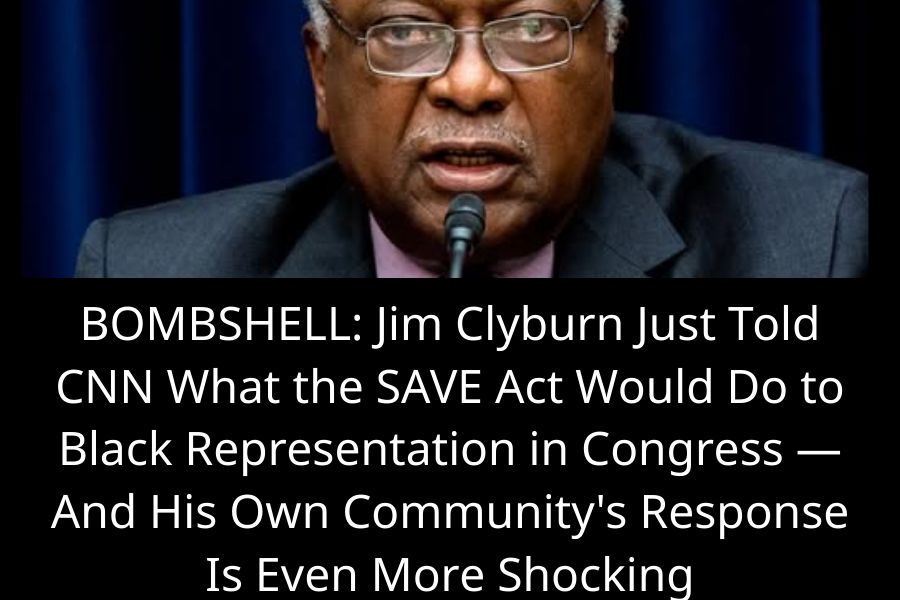
James E. Clyburn is not just another member of Congress. He’s the Majority Whip, a position of immense power. He’s the highest-ranking African American in the history of congressional leadership. He’s been in the House since 1993, representing South Carolina’s 6th District. He’s seen generations of Black politicians rise and fall. And in 2020, he delivered the endorsement that saved Joe Biden’s campaign and changed the course of American history.
When Clyburn speaks about voting rights, he speaks from decades of experience—including experience with the very laws that once barred Black Americans from the ballot box entirely.
His warning about the SAVE America Act is stark: “It will reduce dramatically the number of African Americans that are starting to serve in the Congress.”
This is not a prediction about inconvenience. This is a prediction about representation—about who gets a seat at the table, whose voices are heard, whose interests are represented in the halls of power.
The Mechanism: How the SAVE Act Could Suppress Black Candidates
Clyburn’s argument is not about conspiracy. It’s about mechanics. The SAVE Act, in his view, would create barriers that disproportionately affect Black voters, and fewer Black voters means fewer Black representatives.
Here’s how the logic works:
1. Voter ID Requirements: The Act would require specific forms of identification that many Black Americans—particularly elderly Black Americans, particularly poor Black Americans—do not possess. Getting those IDs requires time, money, and documentation that many don’t have. The result: fewer Black voters at the polls.
2. Citizenship Verification: The Act would require proof of citizenship to register. Again, this sounds neutral, but the burden falls heaviest on those who move frequently, who lack stable housing, who don’t have easy access to birth certificates. Black Americans are disproportionately represented in these categories.
3. Purges of Voter Rolls: The Act would make it easier to remove names from registration lists. Historically, these purges have targeted Black and minority voters at higher rates.
4. The Cumulative Effect: Fewer Black voters means Black candidates have a harder time winning. In majority-Black districts, the impact might be minimal. But in the districts where Black candidates are just reaching the tipping point—where a few thousand votes make the difference—the SAVE Act could tip the scales permanently.
The Historical Context: Nothing New Under the Sun
Clyburn’s warning resonates because it echoes history. For most of American history, voting was deliberately made difficult for Black Americans. Poll taxes. Literacy tests. Grandfather clauses. Violence and intimidation. The Voting Rights Act of 1965 was supposed to end all that.
But the tools have changed, not the goal. Modern voter ID laws, registration restrictions, and roll purges achieve the same result as the old barriers—just with a patina of legitimacy. They’re not called “Jim Crow”; they’re called “election integrity.” But the effect, Clyburn argues, is the same.
The SAVE Act, in his view, is just the latest iteration of a centuries-old effort to limit Black political power. It’s dressed in different clothes, but it’s the same beast.
The Counter-Argument: Integrity, Not Suppression
Supporters of the SAVE Act would reject Clyburn’s characterization entirely. They’d argue:
-
Everyone needs ID: The requirements apply equally to all voters. There’s no racial targeting in the text of the law.
-
Voter fraud is real: Even if rare, it undermines confidence in the system. Every illegal vote dilutes the votes of law-abiding citizens.
-
Citizenship verification is common sense: Only citizens should vote. Ensuring that non-citizens don’t participate is not suppression; it’s enforcement.
-
Black Americans support voter ID: Polls consistently show that Black voters, like all voters, support voter ID requirements by wide margins.
In this framing, Clyburn is not defending voting rights; he’s defending a system that allows fraud. He’s prioritizing the interests of politicians over the integrity of elections.
The Representation Argument: Why It Matters
Clyburn’s focus on congressional representation is strategic. It’s not just about the abstract right to vote; it’s about who holds power once the votes are counted.
Black representation in Congress has grown steadily over the decades, but it’s still far from proportional. Every Black member of Congress represents not just a district but a constituency—a voice for issues that might otherwise be ignored. Criminal justice reform, voting rights, economic inequality, police accountability—these issues get attention because Black members put them on the agenda.
If the SAVE Act reduces the number of Black members, it doesn’t just change the composition of Congress; it changes what Congress talks about. Issues that matter to Black communities will get less attention. Legislation that affects Black lives will face less scrutiny. The voices of millions of Americans will be quieter.
The Verdict: A Fight for the Future
Jim Clyburn has been in this fight for decades. He’s seen the Voting Rights Act gutted by the Supreme Court. He’s watched as states across the country passed increasingly restrictive voting laws. He’s witnessed the steady erosion of the protections that generations fought and died to secure.
His warning about the SAVE Act is not hypothetical. It’s based on experience—on watching what happens when barriers go up and voters are turned away.
Whether you believe him depends on whether you believe that voter ID laws are about integrity or suppression. Whether you trust that the system is fair or suspect that it’s rigged. Whether you think the old battles are over or just taking new forms.
But one thing is certain: when Jim Clyburn says the SAVE Act will reduce Black representation in Congress, he’s not guessing. He’s seen it before. And he’s telling you it’s happening again.
The question is whether anyone is listening.