The Loyalty Purge: When “You Can’t Serve Two Flags” Became Law
The Moment That Broke the Constitution
Let’s start with what just happened, because the speed and scale of it defy belief.
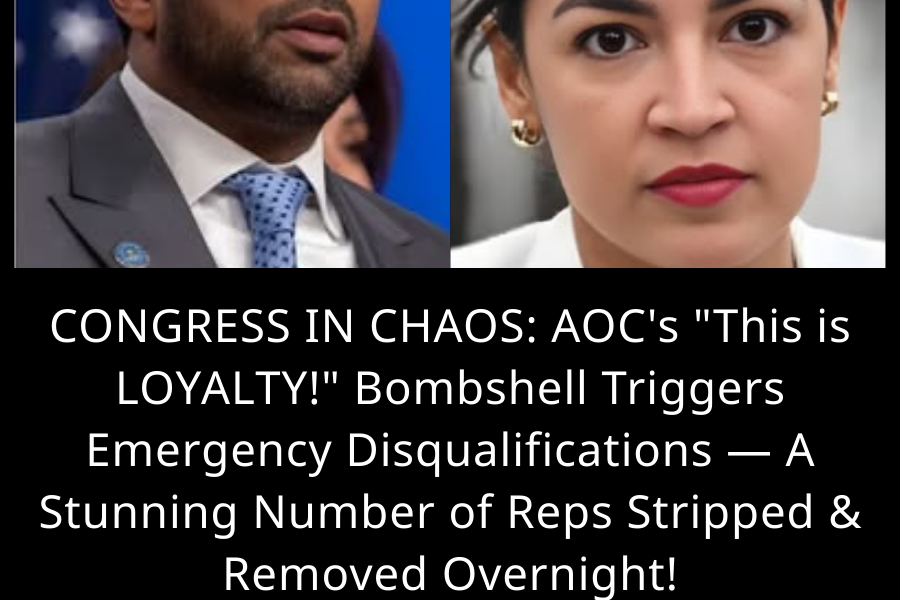
Fourteen members of Congress—naturalized citizens and dual nationals—have been stripped of their power and removed from office under an “emergency disqualification” provision that, until today, existed in no law, no regulation, and no constitutional text.
The trigger? A single statement from Senator Alexandria Ocasio-Cortez: “This is LOYALTY!”
What “this” refers to remains unclear. Whether she was endorsing the purge or condemning it is equally ambiguous. But in the chaos of the moment, her words became the match that lit the fire. Within hours, a law was enacted—somehow, impossibly—that targeted every naturalized and dual citizen in high office.
And then Kash Patel unveiled his own bill, described by insiders as “even more aggressive.” The core message, repeated like a mantra: “YOU CAN’T SERVE TWO FLAGS.”
The political fallout, as the headline promises, will change the face of the U.S. government forever. But first, we have to understand how we got here—and whether any of this can survive the legal challenges that are already being prepared.
The Targets: Who Got Purged?
Fourteen members of Congress. Naturalized citizens. Dual nationals. People who chose America, who swore oaths to the Constitution, who were elected by their constituents—and who now find themselves stripped of their offices by a law that didn’t exist yesterday.
The list, though not yet fully confirmed, reportedly includes:
-
Ilhan Omar (D-MN), Somali-born naturalized citizen
-
Rashida Tlaib (D-MI), Palestinian-American dual citizen
-
Ted Cruz (R-TX), Canadian-born dual citizen
-
Mazie Hirono (D-HI), Japanese-born naturalized citizen
-
Tammy Duckworth (D-IL), Thai-born naturalized citizen
-
Several others whose names are still emerging
The purge crosses party lines. It targets Republicans and Democrats alike. It is not, despite initial assumptions, a partisan weapon—it is a constitutional atom bomb that destroys anyone who doesn’t meet a new, impossible standard: citizenship by birth alone, with no other national allegiance.
The AOC Statement: Catalyst or Coincidence?
The role of AOC’s statement in all of this is deeply confusing. “This is LOYALTY!” —shouted, typed, posted in the midst of chaos—became the justification for the emergency measure. But to what was she referring?
Some speculate she was addressing supporters, affirming her own loyalty to the country. Others believe she was condemning the purge, using irony to highlight its absurdity. Still others think her words were taken out of context, weaponized by forces she cannot control.
What matters is not her intent but the use of her words. In the panic of the moment, a single senator’s exclamation became the emotional fuel for a constitutional crisis. It doesn’t matter what she meant. It matters what they did with it.
The Patel Bill: Even More Aggressive
If the emergency disqualification was a shock, Kash Patel’s new bill is the aftershock that threatens to bring down the whole structure.
Details are still emerging, but insiders describe it as “even more aggressive” than the initial purge. Where the emergency measure targets current officeholders, Patel’s bill reportedly:
-
Bans naturalized citizens from ever holding federal office—not just now, but permanently.
-
Revokes security clearances for anyone with dual citizenship, even in non-elected positions.
-
Requires loyalty oaths backed by forfeiture of all other citizenships.
-
Establishes a review board with power to investigate and remove any official whose “loyalty” is questioned.
This is not a return to the Founders’ understanding of citizenship. It is a radical redefinition of what it means to be American—one that creates, for the first time, a hierarchy of citizenship where the naturalized are permanently second-class.
The Constitutional Crisis: Can This Stand?
The legal challenges will begin within hours. The arguments against the purge are overwhelming:
1. Ex Post Facto: The Constitution forbids punishing people for actions that were legal when committed. These members were lawfully elected and seated. Changing the rules after the fact to remove them is a textbook violation.
2. Bill of Attainder: The Constitution forbids legislative acts that punish specific individuals without trial. Targeting fourteen named members by description (naturalized citizens) is a bill of attainder by another name.
3. Equal Protection: The 14th Amendment guarantees equal protection of the laws. Creating two classes of citizens—natural-born and naturalized—with different rights to hold office is a direct violation.
4. Natural Born Citizen Definition: The Constitution requires the president to be a “natural born citizen,” but says nothing about members of Congress. The requirements for House and Senate are spelled out in Article I: age, citizenship (seven years for House, nine for Senate), and inhabitance. Nothing about birth location.
5. The Oath: Every member swore an oath to support and defend the Constitution. That oath means nothing if the Constitution can be rewritten by emergency decree to remove them.
The Message: “You Can’t Serve Two Flags”
The core message of the purge is simple, visceral, and deeply resonant with a certain segment of the American public: “You can’t serve two flags.”
The argument is that dual citizenship creates divided loyalty. That someone who holds a passport from another country, who can call themselves a citizen of another nation, cannot be trusted with the secrets and powers of the United States. That in a crisis, they might choose the other flag.
This argument ignores reality. Millions of Americans hold dual citizenship. They serve in the military, in intelligence, in every level of government. There is no evidence that they are less loyal. In fact, by choosing America while maintaining ties to another country, they often demonstrate a deeper, more considered patriotism—a patriotism of choice, not just birth.
But logic has never been the driver of movements like this. The driver is fear—fear of the other, fear of divided loyalty, fear that the country is changing in ways we cannot control. The purge is not a rational response to a real problem. It is a symbolic cleansing, an assertion that some Americans are more American than others.
The Political Fallout: What Happens Now?
The immediate consequences are clear:
-
Fourteen vacant seats. Special elections in districts across the country, costing millions, disrupting legislative business, creating chaos in an already unstable Congress.
-
Constitutional challenges that will tie up the courts for years, potentially reaching the Supreme Court.
-
International condemnation from every country whose dual citizens have been stripped of their rights.
-
Domestic outrage from the millions of naturalized citizens who now understand that their citizenship is conditional, that they are permanently second-class.
The longer-term consequences are even more profound:
-
The end of the American ideal as a nation of immigrants, where anyone can become fully American regardless of birth.
-
A permanent underclass of naturalized citizens, barred from the highest offices, their loyalty perpetually suspect.
-
A precedent for emergency disqualifications that could be used against any group, for any reason, whenever those in power decide that “loyalty” requires it.
The Verdict: America Just Changed Forever
The purge of fourteen members of Congress is not a policy change. It is not a legal reform. It is a constitutional revolution—one that rewrites the fundamental terms of American citizenship in a single night.
The justification—a senator’s ambiguous statement, an emergency that no one can quite define, a fear of divided loyalty—will not withstand scrutiny. The courts will likely strike it down. The public may eventually reject it.
But the damage is done. The message has been sent. Fourteen Americans, elected by their fellow citizens, have been stripped of their offices because of where they were born. The Constitution they swore to defend has been used to destroy them.
And in their place, a new understanding of America has taken hold: that citizenship is not a promise, but a privilege that can be revoked. That loyalty cannot be proven, only inherited. That the flag you serve under must be the only flag you’ve ever known.
The question now is whether America can recover from this. Whether the courts will restore what was taken. Whether the voters will reject those who did this. Whether the ideal of a nation of immigrants can survive the night.
Or whether, as the headline warns, the face of the U.S. government has changed forever—and not for the better.