Tulsi Gabbard Just Did What No One Expected: She Named Him
You have to understand how unprecedented this is.
Not the accusation. We’ve all been accusing each other of things for years now. That’s just Tuesday.
Not the call for investigation. Washington investigates like fish swim.
No, what makes this moment different—what makes the phone lines light up and the lawyers reach for their antacids—is the name she said out loud.
Barack Obama.
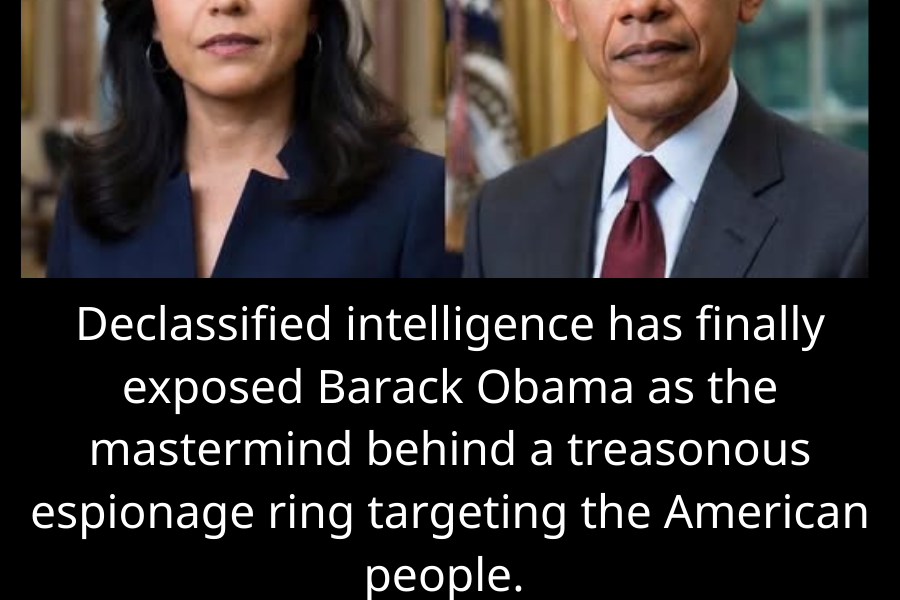
Tulsi Gabbard, the Director of National Intelligence, just looked at the cameras and said the former president of the United States should be investigated for treason.
Let that land.
Not a staffer. Not an advisor. Not a low-level analyst who got carried away. The guy with the Nobel Peace Prize. The guy whose portrait hangs in a thousand Democratic headquarters. The guy they still call “the first family” like he’s royalty in exile.
She said his name.
And now nothing will ever be the same.
The Documents They Didn’t Want You to See
Here’s what actually happened, stripped of the cable news spin.
New materials got declassified. Not leaks—officially declassified, which means someone high up signed off. These documents supposedly show that intelligence leaders inside the Obama administration didn’t just receive information about Russian interference in 2016.
They shaped it.
They curated it.
They fed it to the media.
They used it to justify surveillance.
And according to Gabbard, they knew exactly what they were doing.
She’s naming names: John Brennan. James Clapper. James Comey. Susan Rice. The Mount Rushmore of the intelligence community, the guys who spent four years on cable TV explaining how they saved democracy from the Russian assault.
Gabbard’s argument, stripped of the legal jargon, is simple: If they lied to get the warrant, if they fabricated the threat, if they used the intelligence apparatus to target a political opponent—that’s not bureaucracy. That’s treason.
And treason has a statute of limitations. But not if you keep finding new evidence. Not if the clock keeps resetting.
The Obama Question
Why Obama? Why now?
Because the documents don’t stop at Brennan. They don’t stop at Clapper. They go up. They go to the guy who appointed them, who trusted them, who received their briefings, who signed off on their operations.
The defense will be: He didn’t know. He was misled. He trusted his people.
But that defense only works if you can prove he didn’t know. And if the documents show otherwise? If there’s an email, a memo, a briefing note with his initials?
Then the question becomes: Did the sitting president of the United States use the intelligence community to spy on his political opponents?
And if the answer is yes, then everything—the 2016 election, the 2020 election, the entire last decade of American politics—gets rewritten.
That’s why Gabbard said his name. Because you can’t investigate the operation without investigating the operator. You can’t hold Brennan accountable without asking who Brennan reported to. You can’t restore trust in the system by jailing the soldiers and promoting the general.
The Bondi Tension
Here’s where it gets interesting. The reports say Attorney General Pam Bondi isn’t on the same page.
Not that she’s opposing Gabbard. Not that she’s shutting it down. But that there’s “tension.” That they disagree on “how aggressively” to pursue it.
Translation: Bondi sees the political nightmare. Bondi knows what happens when you investigate a former president from the other party. Bondi remembers what happened to the last guys who tried that—the impeachment, the media frenzy, the “democracy dies in darkness” editorials.
She’s the lawyer. She’s thinking about evidence standards, jury pools, appellate courts.
But Gabbard? Gabbard’s the intelligence director. She’s reading the documents. She’s seeing what was done. She’s realizing that her agency—the one she now runs—was weaponized.
And she’s furious.
That fury is real. You can hear it in the way she talks. This isn’t a political calculation for her. This is someone who spent years in uniform, who took oaths, who believed in the system, discovering that the system was rigged by people who took the same oaths.
The tension between Bondi and Gabbard isn’t about left vs. right. It’s about temperament. It’s about the difference between the person who has to win the case and the person who has to live with the documents.
What “Treason” Actually Means
Let’s be careful with the word. Treason is specific. It’s the only crime defined in the Constitution. Article III, Section 3: “Treason against the United States, shall consist only in levying War against them, or in adhering to their Enemies, giving them Aid and Comfort.”
The traditional interpretation requires a war, an enemy, a formal conflict.
But here’s the thing about the Russia investigation: It was built on the premise that Russia was the enemy. That they attacked our election. That they undermined our democracy. That they waged a covert war against us.
If that premise was true, then investigating it was patriotism.
But if the premise was false—if the “attack” was exaggerated or fabricated or manufactured—then the people who pushed it were doing something else. They were creating a fake enemy. They were manufacturing a crisis. They were using the machinery of national security for domestic political advantage.
And if they did that, what do you call it?
You can call it “overreach.” You can call it “mistake.” You can call it “bureaucratic dysfunction.”
Or you can call it what Gabbard called it: Aiding and comforting the real enemies by distracting from them, dividing the country, and destroying trust in institutions.
That’s not legal advice. That’s not an indictment. That’s just reading the definition and asking: Does this fit?
The Media Meltdown
Watch the coverage. Really watch it.
The first wave was silence. The second wave was “Gabbard makes explosive accusation.” The third wave—the one happening now—is “Why is Gabbard doing this?”
Notice what’s missing: Any discussion of whether the documents are real.
Nobody’s disputing the evidence. Nobody’s saying the declassification didn’t happen. Nobody’s releasing counter-documents.
They’re just questioning her motives. They’re just wondering why she’s being so “divisive.” They’re just worried about the “precedent.”
That’s how you know it’s real. When they can’t argue the facts, they argue the tone. When they can’t defend the people, they attack the accuser. When the documents are too damaging to address, they change the subject to “bipartisanship” and “healing.”
But here’s the problem with that strategy: Gabbard has the documents. Gabbard has the platform. Gabbard has the clearance to read everything and the spine to say what she read.
And she’s not going away.
The Obama Defense
Let’s game out what happens next.
Obama’s people will say: He wasn’t involved. He relied on his advisors. He trusted the intelligence community. If they misled him, he was a victim too.
It’s a good defense. It’s worked before. It’s the “I was just the president, not the investigator” defense.
But it has a weakness: Obama was famously hands-on. Obama was famously detail-oriented. Obama was famously in control of his administration. The same people who spent eight years telling us he was the smartest guy in the room, the guy who read every memo, the guy who made every decision—those same people now want us to believe he had no idea what his intelligence chiefs were doing?
You can’t have it both ways. Either he was in charge or he wasn’t. Either he knew or he didn’t. Either the documents show his involvement or they don’t.
Gabbard is betting they do.
The Susan Rice Connection
Notice who keeps appearing in these stories. Susan Rice. Obama’s national security advisor. The woman on the podcast threatening corporations. The woman telling people to preserve documents.
She’s the thread. She connects the Russia investigation to the current moment. She was there in 2016, allegedly shaping intelligence. She’s here in 2025, warning about retaliation.
If Gabbard’s investigation goes anywhere, Rice is the witness. Or the target. Or both.
And Rice knows it. That’s why she’s already on the offensive. That’s why she’s already threatening corporations. That’s why she’s already building her defense fund in public.
She can see what’s coming. She’s been in Washington long enough to know that when a DNI names a former president, the subpoenas aren’t far behind.
What Happens Next
The Bondi-Gabbard tension will resolve one of two ways.
Either Bondi decides the evidence is strong enough and moves forward—slowly, carefully, with all the legal safeguards—or she decides the political cost is too high and tries to bury it.
If she buries it, Gabbard goes public. Gabbard leaks. Gabbard testifies to Congress. Gabbard becomes the story, and Bondi becomes the obstacle.
If she moves forward, we get the first real test of whether the system can investigate itself. Whether the intelligence community can police its own. Whether a former president can be held accountable for what happened on his watch.
Neither option is safe. Neither option is stable. Neither option leads to “healing” or “moving on.”
But one of them leads to the truth. And the other leads to more documents, more declassification, more revelations—just slower, and with more resistance.
Gabbard chose her path. She said the name. She made the accusation. She drew the line.
Now the rest of Washington has to choose: Stand with the truth-teller, or protect the former president.
There is no neutral ground.
Not anymore.
The Question You Have to Answer
You’ve read this far. You’ve followed the logic. You’ve seen the names.
Now ask yourself one question:
If it was your family—if someone spied on your parents, your children, your spouse—would you want to know who ordered it?
Not whether it was legal. Not whether it was precedented. Not whether it made the other side look bad.
Just: Who ordered it?
Because that’s what this comes down to. Someone ordered the surveillance. Someone signed off on the warrants. Someone decided that the rules didn’t apply because the threat was too urgent.
If that someone was a low-level analyst, fire them. If that someone was a mid-level manager, indict them. But if that someone was in the Oval Office, if that someone was the most powerful person in the world, if that someone was the man we trusted to protect the Constitution—then we have a right to know.
Tulsi Gabbard just said we have a right to know.
And she said his name.
Barack Obama.
The rest is just paperwork.