The Night the Money Froze: Jeanine Pirro Just Declared War on the Shadow Economy
It happened overnight. That’s the part that has Washington terrified.
Not a hearing. Not a press conference. Not a carefully staged announcement with cameras and podiums and the usual political theater. Just a legal filing. A reclassification. A signature on a document that, within hours, sent shockwaves through the networks of power that have operated in the shadows for decades.
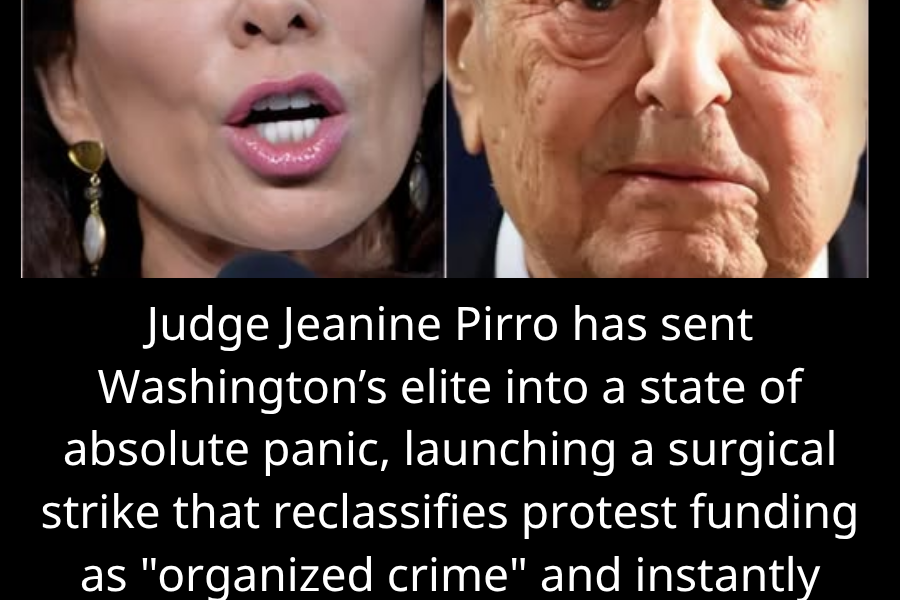
Judge Jeanine Pirro took the financial infrastructure of organized protest—the money that has funded marches, movements, and mayhem across the country—and redefined it. Not as politics. Not as activism. Not as the protected exercise of First Amendment rights.
As organized crime.
And with that single stroke, the rules changed. Overnight. The money that flowed freely through foundations, nonprofits, and shell corporations is now frozen. The accounts that fed the machine are now sealed. The people who moved the money—the intermediaries, the fixers, the “philanthropists” who have spent years pretending their billions were about social justice—are now staring at federal subpoenas and the very real prospect of RICO charges.
This is not a political fight anymore. This is a legal war. And Jeanine Pirro just fired the first shot that could end the era of dark money for good.
The Organized Crime Reclassification
Let’s be precise about what Pirro did, because the implications are staggering.
The legal framework for organized crime in the United States—RICO, the Racketeer Influenced and Corrupt Organizations Act—was designed to take down the Mafia. It was built to go after criminal enterprises that used legitimate businesses as fronts for illegal activity. It gives prosecutors the power to freeze assets, to seize property, to target the money itself rather than just the individuals moving it.
What Pirro has done is argue that the networks funding large-scale protests meet the legal definition of organized crime. Not because protesting is illegal. Because the structure of the funding—the layers of nonprofits, the undisclosed donors, the coordinated national strategy, the use of money to influence public policy through mass mobilization—mirrors exactly the kind of criminal enterprise that RICO was designed to dismantle.
The implications are immediate and devastating for the Soros network. If protest funding is reclassified as organized crime, every foundation that funnels money to activist groups becomes a potential racketeering target. Every donor who writes checks to organizations that orchestrate mass protests becomes a potential co-conspirator. Every intermediary who moves money from billionaire accounts to street-level organizing becomes a potential defendant.
This is why Washington is panicking. Not because Pirro filed a motion. Because she changed the legal lens through which the entire dark money apparatus is viewed. And once that lens is in place, nothing looks the same.
The Billionaire in the Crosshairs
George Soros has spent decades building a financial empire designed to influence politics around the world. His Open Society Foundations have poured billions into organizations that shape elections, fund protests, and advance a specific ideological agenda across six continents. He has been open about this. He has been proud of this. He has framed it as philanthropy, as activism, as the work of a concerned citizen using his wealth to make the world better.
But the legal line between “philanthropy” and “racketeering” is thinner than most people realize. If the goal of the funding is to create social disruption, to pressure governments, to achieve political outcomes through mass mobilization rather than democratic processes, that’s not charity. That’s something else. And that something else, in Pirro’s legal framework, looks a lot like organized crime.
The Soros network has already responded. The usual statements have been issued. The usual denials have been made. The usual attacks on Pirro—partisan, political, motivated—have been launched. But behind the scenes, the panic is real. Because the assets are frozen. The accounts are sealed. The money that was supposed to be there for the next wave of protests, the next election cycle, the next political fight—isn’t.
And the people who run the Soros network know that once the legal machinery of RICO is set in motion, it doesn’t stop. It doesn’t negotiate. It doesn’t settle. It seizes. It freezes. It takes everything. And it asks questions later.
The Wall Street Connection
The panic isn’t limited to the activist networks. Wall Street is watching too. Because the same financial infrastructure that moves money to protest organizations moves money to campaigns, to super PACs, to the whole shadow economy of political influence that has grown up over the past two decades.
The banks that process the transactions. The law firms that structure the foundations. The accountants who manage the tax-exempt status of organizations that exist solely to funnel billionaire money into politics. All of them are now looking at the Pirro reclassification and asking themselves the same question:
Are we next?
Because if protest funding is organized crime, what about campaign funding? What about super PACs? What about the whole elaborate architecture of dark money that has turned American politics into a multibillion-dollar industry with no transparency, no accountability, and no limits?
The people who built that architecture thought they were protected. They thought the First Amendment, the campaign finance laws, the regulatory structure that treats political spending as free speech would shield them from consequences. They thought that as long as they followed the forms—the 501(c)(4)s, the LLCs, the pass-through entities—they could do whatever they wanted with their money and no one could stop them.
Pirro just told them they were wrong. And the institutions that have profited from dark money for decades are suddenly very, very nervous.
The Dark Money Era
Let’s go back to 2010. Citizens United. The Supreme Court opened the floodgates. Corporations and billionaires could spend unlimited amounts on political advocacy. The justification was free speech. The result was an explosion of money that has corrupted American politics in ways that are still being understood.
Since then, billions of dollars have flowed through the system with no transparency. Donors hidden behind shell corporations. Contributions routed through multiple layers of nonprofits. Money that could come from anywhere—foreign governments, hostile powers, criminal enterprises—pouring into American elections with no one able to trace it.
This is the dark money era. And for fifteen years, the people who built it have insisted it’s legal, it’s protected, it’s the price of democracy. They’ve argued that any attempt to regulate it is an attack on free speech, an assault on the First Amendment, a threat to the very fabric of American political life.
But Pirro is not regulating speech. She’s prosecuting crime. And the distinction is everything. Because the First Amendment doesn’t protect racketeering. The Constitution doesn’t shield criminal enterprises. And if the structure of dark money funding meets the legal definition of organized crime, all the campaign finance rulings in the world won’t save it.
The Freeze
The assets are frozen. That’s the detail that has Washington in shock. Because freezing assets is not a warning. It’s not a threat. It’s not a “we’re looking into this” press release. It’s action. It’s consequences. It’s the moment when legal theory becomes financial reality.
Billion-dollar foundations that have operated for decades without oversight suddenly can’t access their own accounts. Organizations that were planning the next wave of protests, the next round of elections, the next push for their agenda, are finding that the money isn’t there. The pipelines that have fed the progressive infrastructure for a generation have been cut.
And the people who run that infrastructure are realizing, perhaps for the first time, that there is no appeal. No court of public opinion that can unfreeze assets. No friendly journalist who can make the problem go away. No political intervention that can undo what Pirro has set in motion.
The money is frozen. And until the legal process plays out, it’s going to stay frozen. That could be months. It could be years. It could be forever, if the assets are ultimately seized as the proceeds of organized crime.
The Silence from the Left
The most telling response has been the silence. Not the statements. Not the press releases. The silence behind them. The people who normally rush to defend the Soros network, who normally fill cable news with denunciations of any investigation into dark money, have been noticeably quiet.
They know. They know what RICO means. They know what asset freezes mean. They know that once the legal machinery of organized crime prosecution is set in motion, there’s no political spin that can stop it. There’s no “both sides” argument that can unfreeze accounts. There’s no friendly judge who can make the problem disappear.
The left has spent years building a financial infrastructure that operates outside the normal rules of political accountability. They have defended that infrastructure as necessary, as virtuous, as the only way to counter the power of corporate money. They have argued that billionaire funding of progressive causes is different from billionaire funding of conservative causes, that the ends justify the means, that the purity of the mission excuses the opacity of the funding.
Pirro just called their bluff. And the silence from the people who normally have so much to say tells you everything you need to know about how effective the strike has been.
The International Reach
The phrase “global assets” appears in the headlines for a reason. Because the Soros network is not just domestic. It’s international. Foundations in dozens of countries. Funding for organizations that operate across borders. Money that has influenced elections in Europe, in Latin America, in Africa, in the places where the United States has strategic interests and geopolitical rivals.
The freeze extends to those assets too. Because if the network is an organized criminal enterprise, it doesn’t matter where the money is. It doesn’t matter what flag flies over the bank. The reach of U.S. law—especially RICO, especially in cases involving national security and political influence—is global.
This is why foreign governments are watching. This is why European leaders who have taken Soros money are suddenly nervous. This is why the international network of progressive funders, the people who thought they could operate with impunity across borders, are now realizing that there is no safe harbor. No jurisdiction that will protect them. No country that will risk a confrontation with the U.S. Justice Department over the frozen assets of an organization that has been reclassified as a criminal enterprise.
The Washington Panic
The headline says Washington is in a “state of panic.” That’s not hyperbole. It’s observation.
Because the people who run Washington—the consultants, the strategists, the media figures, the operatives—have built their careers on dark money. They have taken salaries from foundations that exist only to funnel billionaire wealth into political causes. They have built organizations that depend entirely on the continued flow of untraceable cash. They have created a system where their jobs, their influence, their entire way of life depends on the machinery that Pirro is now dismantling.
And they are watching that machinery freeze in real time. They are watching the accounts go dark. They are watching the foundations scramble to find lawyers who can explain what happened. They are watching the whole elaborate structure of political money that they spent decades building collapse around them.
This is not a political setback. This is an existential crisis. For the people who run the progressive infrastructure, for the donors who funded it, for the politicians who depended on it, the Pirro strike is not a loss. It’s a liquidation. And the panic in Washington is the sound of people who have spent their lives building something that is now being taken apart, piece by piece, in front of them.
The Era That’s Ending
Pirro’s move is being called the end of the dark money era. That might be optimistic. The forces that created dark money—the Supreme Court decisions, the regulatory failures, the political corruption—didn’t disappear overnight. But something has changed.
For the first time, the people who built the dark money machine are facing consequences. Not political consequences. Not electoral consequences. Legal consequences. Financial consequences. The kind of consequences that don’t go away when the news cycle turns. The kind of consequences that follow you for the rest of your life.
The Soros network thought it was untouchable. It thought the billions of dollars, the army of lawyers, the political connections, the ideological allies in media and government would protect it from any real accountability. It thought that as long as it controlled the narrative, as long as it could frame any investigation as political persecution, it could continue operating forever.
Pirro proved them wrong. Not with a speech. Not with a campaign. With a legal filing that changed the rules of the game. And the people who spent decades building the dark money machine are now watching it freeze, watching it crumble, watching it disappear into the legal machinery they thought would never be used against them.
The Final Account
The money is frozen. The investigation is moving. The era of dark money is ending. That’s the story. That’s the headline. That’s the thing that will be written about for decades, if Pirro is right, if the legal framework holds, if the courts accept the reclassification of protest funding as organized crime.
But there’s another story, quieter, deeper, more important. It’s the story of the people who thought they could buy a country. Who thought that with enough money, with enough lawyers, with enough foundations and nonprofits and shell corporations, they could shape American politics to their will without anyone ever knowing where the money came from.
They were wrong. Not because the system worked. Because someone decided to make it work. Someone decided that the law applied to everyone. Someone decided that the era of dark money needed to end. And someone had the courage to take the first step.
Jeanine Pirro took that step. She aimed the full authority of her office at the financial infrastructure of organized protest. She froze the assets. She changed the classification. She started the legal process that could end the dark money era for good.
Now the investigation moves forward. The subpoenas will come. The documents will be reviewed. The truth—the full, ugly truth about where the money came from and where it went and what it was used for—will eventually come out.
And when it does, the people who thought they were untouchable will finally understand what it means to be accountable. Not to politics. Not to the media. Not to public opinion. To the law.
The money is frozen. The game is over. The era of dark money is ending.
And Washington—the real Washington, the one that runs on cash and corruption and the illusion that the rules don’t apply—is terrified. Because if Pirro can do this to Soros, she can do it to anyone. And everyone who ever took dark money knows it.
The freeze is just the beginning. The reckoning is coming. And for the first time in a generation, the people who thought they could buy America are about to find out what it costs to try.