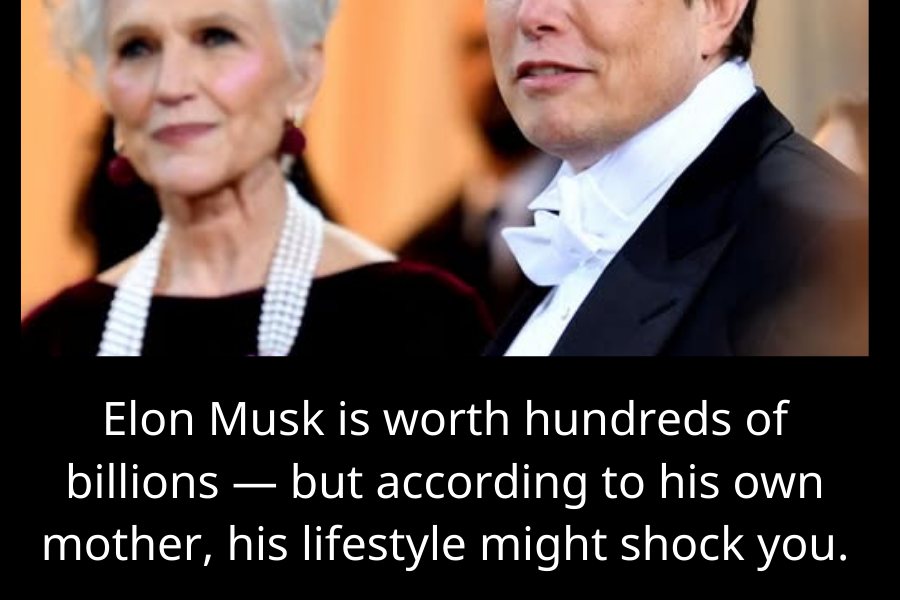
The Billionaire Who Lives Like a College Student: Maye Musk’s Portrait of the World’s Richest Man
The Image That Breaks Every Stereotype
Let’s paint the picture Maye Musk has given us:
The world’s richest man—worth more than $800 billion, a sum so vast it exceeds the GDP of most countries—comes home to a refrigerator that’s practically empty. One towel in the bathroom. No fancy cars, no sprawling mansions, no yachts floating in exotic harbors. Just a man, a bare fridge, and a single piece of terry cloth.
It’s an image so stark, so contrary to every expectation of how the ultra-wealthy live, that it forces a question: Is Elon Musk genuinely this ascetic, or is this a carefully constructed persona?
Maye Musk, the mother who knows him better than anyone, insists it’s real. Her son, she says, simply doesn’t care about material possessions. He doesn’t notice the empty fridge because he’s too busy thinking about Mars. He doesn’t need 50 towels because one does the job. He lives not in luxury but in functional minimalism—everything serves a purpose, nothing exists for show.
The Contrast: How the Other Half Lives
To understand why this revelation is so striking, consider how most billionaires live.
The typical ultra-wealthy person accumulates: multiple homes in multiple countries, each staffed and maintained. A fleet of vehicles ranging from daily drivers to exotic collectibles. Art collections worth more than most people’s retirement accounts. Clothes, watches, jewelry—all the signifiers of wealth that signal to the world: I have made it.
Elon, by contrast, has reportedly lived in a tiny prefab home near SpaceX, slept on friends’ couches during Tesla’s production hell, and generally treated material comfort as an afterthought. His wealth is not in things but in ownership—stock, companies, the means of production. He doesn’t buy yachts; he builds rockets.
This is not the lifestyle of a man who loves money. It’s the lifestyle of a man who loves what money can do—build factories, launch satellites, tunnel under cities, connect brains to computers. The money itself is just fuel. The mission is everything.
The Fridge Story: What It Really Says
The bare fridge is the detail that sticks. A refrigerator is the most intimate domestic object—it reveals what we eat, how we live, whether we plan ahead or grab whatever’s there. Elon’s fridge, according to his mother, reveals a man who simply doesn’t think about food.
This is either endearing or concerning, depending on your perspective. Endearing because it shows a man so focused on the big picture that he forgets the small stuff. Concerning because forgetting to eat is not a sign of health.
But it also reveals something about the nature of extreme wealth. When you have $800 billion, you don’t need to think about groceries. Someone else thinks about them—or you just order whatever, whenever, and it appears. The empty fridge isn’t deprivation; it’s the ultimate luxury of not having to care.
The One Towel: Minimalism or Mania?
The single towel is even more revealing. A man with unlimited resources chooses not to acquire more towels. Why?
-
He doesn’t notice. Towels are below his level of attention. The house could have one towel or a hundred; he’d never know the difference.
-
He doesn’t care. Towels are functional. One works. Why have more?
-
He’s signaling. The one towel is a story, a brand, a statement: I’m not like other billionaires. I’m still the guy who sleeps on the floor and works through the night.
Whatever the reason, the one towel has become a symbol of Musk’s peculiar relationship with wealth. He has more money than anyone in history, and he lives like a grad student pulling an all-nighter.
The Mother’s Perspective: Pride and Concern
Maye Musk’s decision to share these details is interesting in itself. She’s not just describing her son; she’s framing him. The bare fridge and one towel are not complaints; they’re points of pride. Look at my son, she seems to say. He has everything and wants nothing. He’s still the same person he always was.
There’s a protective quality to this framing. In an era of intense scrutiny on the ultra-wealthy, where billionaires are often portrayed as greedy, detached, and decadent, Maye offers an alternative portrait: a man who lives simply, who doesn’t indulge, who remains focused on work rather than pleasure.
It’s also a reminder that Musk’s relationship with money has always been complicated. He’s been broke, rich, broke again, and now unimaginably wealthy. He’s lived through the extremes and seems to have concluded that the middle—the comfortable, predictable, moderately wealthy existence—holds no appeal. He’s either all in or all out.
The Public Reaction: Admiration, Skepticism, and Mockery
The internet, as always, has opinions:
The Admirers: “This is why he’s successful. He’s not distracted by stuff. He’s focused on the mission.”
The Skeptics: “Sure, his fridge is empty because someone else fills it. His one towel is probably $500 Egyptian cotton. This is billionaire cosplay.”
The Mockers: “With $800 billion, he could afford a second towel. Just saying.”
The Concerned: “Dude, eat something. Take care of yourself. Mars can wait.”
The truth probably lies somewhere in the middle. Musk’s lifestyle is genuinely spartan compared to his peers, but it’s also the lifestyle of someone who has people to handle the details. The empty fridge is real, but so is the private jet that takes him anywhere he wants to eat.
The Bigger Question: What Does Wealth Mean When You Don’t Use It?
Elon Musk’s bare fridge forces a larger philosophical question: What is wealth for?
For most people, wealth is about consumption—buying things, experiences, security. For Musk, wealth seems to be about creation—building things, taking risks, pushing boundaries. He doesn’t want to own a yacht; he wants to own the company that builds the submarines that might one day explore Europa’s oceans.
This is either inspiring or terrifying, depending on your view of concentrated power. Inspiring because it shows what wealth can achieve when it’s reinvested rather than consumed. Terrifying because $800 billion in one person’s hands—no matter how ascetic his lifestyle—is still $800 billion in one person’s hands.
The Verdict: A Man Out of Time
Maye Musk’s portrait of her son is ultimately a portrait of a man who doesn’t quite belong to his own era. He lives like a monk but thinks like a futurist. He ignores the present because he’s obsessed with what comes next. The bare fridge and one towel are not signs of deprivation; they’re signs of displacement. Elon Musk doesn’t live in 2026. He lives in 2050, or 2100, or on Mars, or wherever his mind happens to be.
The rest of us can only watch, bemused, as the world’s richest man opens his empty fridge, grabs a towel that’s seen better days, and gets back to work on the next civilization.
Whether that’s admirable or insane depends entirely on whether you think the future he’s building is one you want to live in.