The Battle of the Billion-Dollar Budgets: Scott Bessent vs. Gavin Newsom and the Fight Over Federal Power
The Combatants: Two Visions of America
Let’s set the stage, because the characters matter as much as the policy.
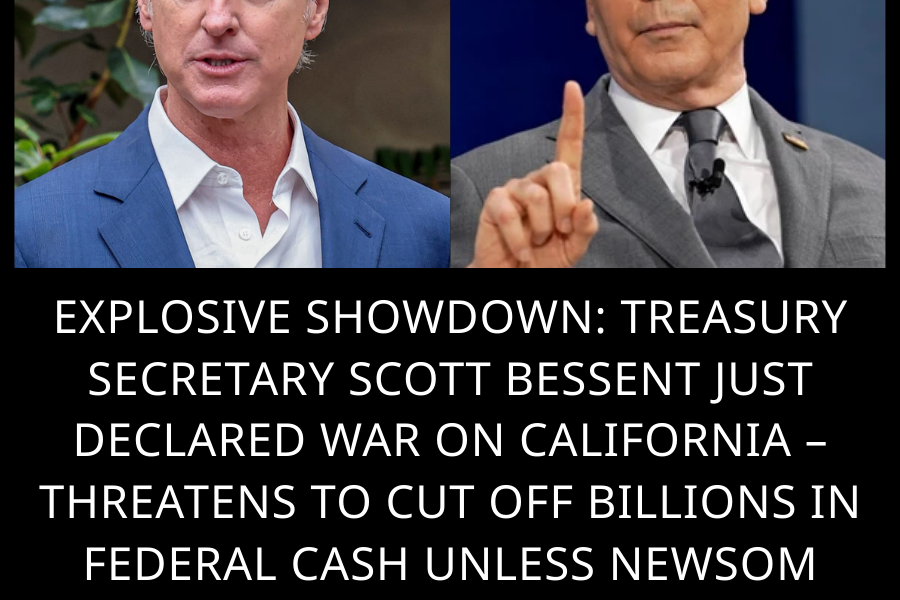
Scott Bessent: Treasury Secretary, Wall Street veteran, architect of the administration’s economic strategy. He speaks in the language of balance sheets, deficits, and fiscal responsibility. His argument is simple: the federal government gave states trillions in pandemic relief, and now it has a right—a duty—to ensure that money wasn’t wasted, stolen, or funneled into unsustainable programs that will eventually require another federal bailout.
Gavin Newsom: Governor of California, Democratic star, perpetual presidential speculation magnet. He governs the world’s fifth-largest economy, a state that often acts as a counterweight to federal policy. His argument is equally simple: California is not a colony of Washington. It has its own voters, its own priorities, its own constitutional sovereignty. The federal government cannot use funding as a weapon to force states into adopting policies they oppose.
The clash between them is not just a dispute over accounting. It is a constitutional crisis in miniature—a fight over the fundamental balance of power in the American federal system.
The Bessent Doctrine: Your Money, Our Rules
Bessent’s position is grounded in a principle that sounds reasonable to anyone who has ever balanced a checkbook: if the federal government gives states money, the federal government gets to set the terms.
The pandemic relief funds were unprecedented in scale—trillions of dollars flowing to states, cities, and counties with minimal oversight. The justification was urgency: COVID was spreading, economies were shutting down, money needed to move fast. But urgency is not a permanent excuse for opacity. Now, years later, Bessent is asking the question that should have been asked from the beginning: where did it all go?
His proposed guidelines would link future federal grants to state-level fiscal reforms and accountability standards. In plain English: if California wants federal money, California must prove it’s managing its own budget responsibly. No more endless deficits. No more borrowing from Peter to pay Paul. No more using one-time federal infusions to fund permanent state programs that will eventually collapse.
Supporters see this as basic stewardship. The Treasury Secretary is not just a banker; he is the guardian of the nation’s fiscal integrity. If California’s reckless spending eventually threatens the broader economy—and with a $3 trillion state GDP, it absolutely can—then the federal government has both the right and the responsibility to intervene.
The Newsom Counter: Sovereignty, Not Servitude
Newsom’s response is the kind of thing that gets standing ovations in Sacramento and howls of derision in conservative media: “This is a direct challenge to California’s authority and an intrusion on state sovereignty.”
He’s not wrong about the principle. The 10th Amendment reserves to the states all powers not explicitly delegated to the federal government. Budgeting, taxation, and spending priorities are classic state functions. When the federal government tries to dictate those functions through the power of the purse, it’s engaging in a form of coercive federalism—using money to accomplish what the Constitution does not authorize directly.
Newsom’s coalition of states (likely including New York, Illinois, and other blue strongholds) will argue that Bessent’s guidelines are not neutral accountability measures but political weapons designed to force liberal states to abandon their priorities. The pandemic funds are already distributed; trying to attach new conditions after the fact is, in their view, unconstitutional retroactive rulemaking.
And there’s the subtext that everyone understands: Newsom is a potential presidential candidate. Bessent works for Trump. Any action that weakens Newsom politically is automatically suspect. The line between policy and politics is, in this case, invisible.
The Stakes: What’s Actually on the Line?
This is not a theoretical debate. The outcome will determine:
1. Who Controls State Policy: If the federal government can condition grants on state tax reforms, it can effectively dictate state tax policy. Want federal highway money? Then cut your income tax rates. Want education funding? Then eliminate your sanctuary city policies. The power of the purse becomes a weapon of ideological enforcement.
2. The Future of Pandemic Accountability: Trillions of dollars flowed out of Washington with minimal oversight. Some of it was stolen. Some was wasted. Some was used for legitimate purposes that now look questionable. Bessent’s push for transparency is popular with voters who suspect the worst. But retroactive audits are legally complex and politically explosive.
3. The 2028 Presidential Race: Newsom is widely expected to run for president. A legal battle with the Trump administration over federal overreach is exactly the kind of fight that energizes his base and raises his national profile. Bessent, for his part, is positioning himself as the enforcer of fiscal discipline—a role that plays well with conservative voters who see California as a cautionary tale.
4. The Balance of Power: This case will eventually reach the Supreme Court. The current Court has shown sympathy to states’ rights in some contexts (see: recent rulings on federal regulatory power) but has also upheld broad federal authority in others. A ruling on the limits of conditional spending could reshape federalism for a generation.
The Comment Section: Where America Takes Sides
The reactions will be predictable but revealing:
The Bessent Supporters:
-
“California is a fiscal disaster. Someone has to stop them before they drag the whole country down.”
-
“If you take federal money, you play by federal rules. It’s that simple.”
-
“Newsom is just protecting his own political future. This has nothing to do with sovereignty.”
The Newsom Supporters:
-
“This is a political hit job. Plain and simple.”
-
“California sends more to Washington than it gets back. We’re subsidizing red states, and now they want to control our budget?”
-
“The 10th Amendment exists for a reason. Read it.”
The Confused Moderates:
-
“Can someone explain why we can’t just audit the spending without all the political drama?”
-
“Both sides have a point. Federal oversight is reasonable, but so is state sovereignty. Where’s the compromise?”
The Verdict: A Fight That Was Always Coming
This conflict was inevitable. The pandemic created an unprecedented flow of federal money to states, and that flow created an unprecedented dependency. Now that the emergency is over, the bill is coming due—both financially and constitutionally.
Bessent is asking the question that fiscal conservatives have been asking for decades: why should responsible taxpayers in responsible states subsidize irresponsible spending in irresponsible states? Newsom is giving the answer that progressive states have been giving for just as long: because we’re all in this together, and because Washington doesn’t get to dictate how we run our affairs.
The courts will eventually decide the legal question. But the political question—whether Americans want a strong federal government that enforces national standards or a decentralized system that respects state diversity—will be decided at the ballot box.
And in 2026, with control of Congress and the presidency on the line, that question is more urgent than ever. The battle between Bessent and Newsom is not just a dispute between two men. It is a preview of the defining conflict of the next decade: who governs America, and how?
The answer will shape the country for generations. And it starts now.