The Hegseth Question: Trump Just Threw His Defense Secretary Under the Bus—And It Might Be True
The war is in its fourth week. American service members are dead. Iranian cities have been hit. Lebanese civilians have been killed. Israeli airspace has been violated. The Middle East is on fire, and the President of the United States is sitting in Tennessee, at a roundtable, talking about who started it.
His answer is not what anyone expected.
Not: “Iran attacked first.”
Not: “We had no choice.”
Not: “Intelligence showed an imminent threat.”
Not even: “I made the call and I stand by it.”
No. What Donald Trump said was something else entirely. Something that sounds, on its face, like a man deflecting responsibility. Something that sounds like a president who doesn’t want to own the war he started.
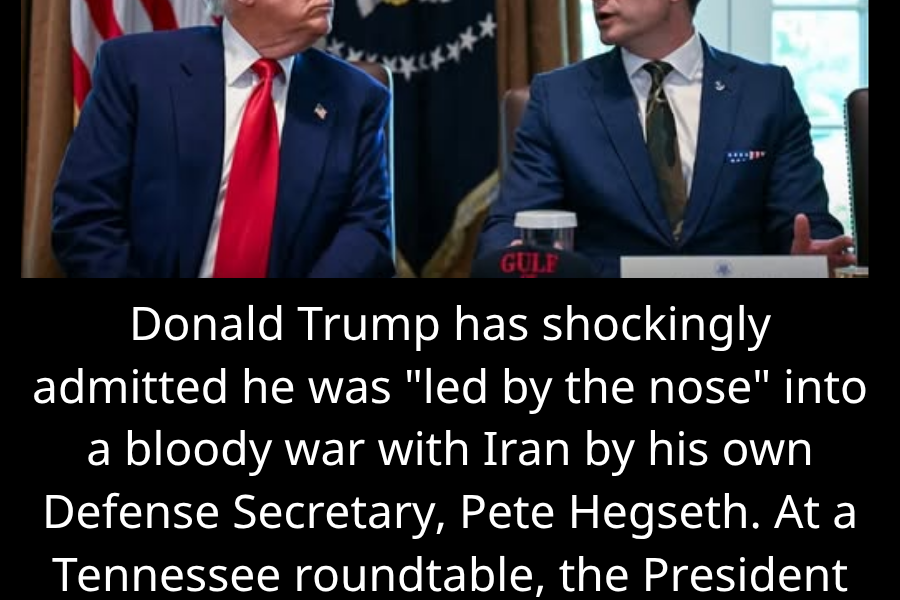
“Pete, I think you were the first one to speak up, and you said, ‘Let’s do it because you can’t let them have a nuclear weapon.'”
He’s pointing at Pete Hegseth. His Defense Secretary. The man who, by Trump’s own account, was the first to advocate for military intervention. The man who said “let’s do it.” The man who, if you believe the president, is the reason American bombs are falling on Iran and American soldiers are coming home in flag-draped caskets.
It’s a remarkable moment. A president, in public, in front of an audience, suggesting that his own Defense Secretary was the driving force behind a war that has already cost 13 American lives. It’s the kind of thing that would end a political career in a normal administration. But this is not a normal administration. And Pete Hegseth is not a normal Defense Secretary.
The question hanging over everything is simple: Is Trump telling the truth? Or is he rewriting history to protect himself while the body count is still climbing?
The Four-Week War
Let’s establish what we know.
The war began with U.S. strikes in late February. That’s not disputed. American bombs hit Iranian targets. Iranian forces responded. The conflict expanded. Lebanon got pulled in. Israel got pulled in. The entire region is now a war zone.
The numbers are stark: over 1,500 killed in Iran. 1,000 in Lebanon. 15 in Israel. 13 American service members. Thirteen families who will never see their sons and daughters again. Thirteen caskets draped in flags. Thirteen names to be read at memorial services for decades to come.
How did we get here? The administration has been giving conflicting accounts from the beginning. Some officials say Israel was preparing to strike regardless, and the U.S. was simply coordinating with an ally. Others say the Iranian nuclear threat had reached a point where action was unavoidable. Still others say the administration stumbled into a war it didn’t plan for and doesn’t know how to end.
Now Trump has added another layer. He says Hegseth was the one. The first one. The one who spoke up and said “let’s do it.”
It’s a convenient story. It puts the decision on the Defense Secretary, not the Commander-in-Chief. It allows Trump to position himself as someone who was talked into a war, not someone who started one. It creates distance between the president and the consequences.
But is it true?
The Hegseth Theory
Pete Hegseth is not a conventional Defense Secretary. He came to the Pentagon from Fox News. He was a commentator, a talk show host, a man whose expertise was in front of a camera, not behind a desk. His appointment was controversial from the start. Critics said he lacked the experience, the temperament, the depth of knowledge required for the job. Supporters said he would bring fresh thinking to a department that had grown stale and bureaucratic.
Now he’s at the center of a war. And according to the president who appointed him, he’s the one who pushed for it.
Is that plausible? Absolutely. Hegseth has been vocal about Iran for years. On his shows, in his writings, in his public appearances, he has argued that the Iranian regime is an existential threat to the United States, that diplomacy is a dead end, that the only way to stop the nuclear program is military action. He didn’t become Defense Secretary and suddenly discover a passion for peace. He came to the job with a worldview, and that worldview included war with Iran.
So it’s entirely possible that when the moment came, when the intelligence was on the table, when the options were being presented, Hegseth did exactly what Trump says he did: He spoke up first. He said “let’s do it.” He made the case for war.
But here’s the problem with Trump’s version of events: He’s the president. The decision was his. The responsibility is his. No matter who spoke first, no matter who made the case, the final call was made in the Oval Office. And the person who made it is the same person who is now sitting in Tennessee, pointing his finger at the man who works for him.
The Contradictions
The administration’s accounts of how the war began have been shifting since the first bombs fell.
One day it’s about Israel. The Israelis were going to strike anyway, the story goes, and the U.S. was just supporting an ally. The next day it’s about the nuclear threat. Intelligence showed Iran was closer than anyone thought, and waiting would have been catastrophic. The next day it’s about retaliation. Iran attacked first, and the U.S. was responding. The next day it’s about something else entirely.
Now it’s about Hegseth. He spoke up. He said let’s do it. The implication is clear: The president was reluctant. The president had to be persuaded. The president is not the one who wanted this war.
But then there’s the other part of Trump’s statement. The part about Iran’s retaliatory strikes being unexpected. That’s a direct contradiction of reports that internal warnings were issued and ignored. If the administration had intelligence that Iran would respond, if the Pentagon warned that strikes would lead to escalation, if the president was told what would happen and did it anyway, then “unexpected” is not the right word. “Chosen” is closer.
And then there’s the Monday deadline. Trump extended it by five days. A deadline for what? For Iran to capitulate? For negotiations to produce a miracle? For something to change? The extension suggests that the administration is not sure what comes next. That the war was easier to start than it is to end. That the plan, if there was a plan, has already been abandoned.
The 13
Thirteen American service members are dead.
Thirteen families have received the call. Thirteen front doors have been opened to uniformed officers. Thirteen funerals have been planned, or already held. Thirteen flags have been folded and presented to mothers, fathers, spouses, children.
Thirteen.
In the normal course of events, that number would dominate the news. The faces of the fallen would be on every screen. Their stories would be told. Their sacrifice would be honored. The country would come together in grief and resolve.
But in this war, in this administration, the 13 are almost an afterthought. They are mentioned in the reports. Their names appear in the casualty counts. But the debate is not about them. The debate is about who made the decision. About whether the president was warned. About whether the Defense Secretary spoke first. About the politics of it all.
Trump’s comment in Tennessee didn’t mention the 13. It didn’t mention the families. It didn’t mention the sacrifice. It was about Pete Hegseth. About who said what. About who is to blame.
That’s the thing about war when you’re not the one fighting it. It becomes abstract. It becomes a political problem. It becomes a question of messaging and responsibility and who gets credit or blame. The bodies are real. The families are real. The grief is real. But for the people who make the decisions, the dead are just numbers on a briefing paper. Thirteen. That’s the number.
The Israel Factor
The reports that Israel was preparing to strike regardless are important. If true, they change the nature of the conflict. This is not a war the U.S. started unilaterally. It’s a war the U.S. joined to support an ally. That’s different. That’s defensible. That’s something the American people might support.
But the administration hasn’t committed to that story. They’ve floated it. They’ve allowed it to circulate. They’ve never denied it. But they’ve never fully embraced it either. Because if Israel was going to strike anyway, then the U.S. didn’t have to. The U.S. could have let Israel handle it. The U.S. could have stayed out. The U.S. could have avoided the 13 dead service members.
So the story is useful for some purposes and damaging for others. It can be used to justify the war, but it can also be used to question why the U.S. is involved at all. That’s why the administration has kept it in the mix without fully endorsing it. It’s a card they can play when they need it and fold when they don’t.
Trump’s Hegseth story is another card. It’s a way to say “this wasn’t my idea.” It’s a way to distance himself from the consequences. It’s a way to survive a war that is not going well, that is not popular, that is costing American lives.
But cards get played. Stories get told. And eventually, the truth comes out. Or at least enough of the truth that the public can make its own judgment.
The Monday Deadline
Five days. That’s how long Trump gave Iran. Five days to do… what? To surrender? To negotiate? To agree to something that they’ve refused to agree to for years? Five days is not a long time. It’s not enough time for serious diplomacy. It’s not enough time for the kind of back-channel negotiations that might actually produce a breakthrough.
It’s a political deadline. It’s a way to say “I gave them a chance” before whatever comes next. It’s a way to manage the narrative. The war is not going according to plan. The administration is improvising. The Monday deadline is not a strategy. It’s a pause. A moment to figure out what to do next.
And while the administration figures it out, the war continues. The bombs keep falling. The rockets keep flying. The dead keep accumulating. And the families keep waiting for the knock on the door.
The Unanswered Question
Trump’s version of events raises more questions than it answers.
If Hegseth was the first to speak up, who was second? Who agreed? Who made the final decision? If the president was reluctant, why did he go along? If the warnings about retaliation were ignored, who ignored them? If the war was avoidable, why wasn’t it avoided?
These are not abstract questions. They are the questions that will be asked in the investigations that will follow this war. They are the questions that historians will ask. They are the questions that the families of the 13 will ask, if they haven’t already.
And there are no good answers. Not if the war was unnecessary. Not if the warnings were ignored. Not if the president is now blaming his own Defense Secretary for a war that he, as Commander-in-Chief, had the power to stop.
The Hegseth story may be true. He may have been the first to say “let’s do it.” But the president was the one who said “yes.” The president was the one who gave the order. The president was the one who could have said “no.” He didn’t. And now 13 American families are burying their children.
The Final Days
The Monday deadline is approaching. Five days. The war continues. The bombs continue to fall. The dead continue to accumulate. And the president is in Tennessee, telling a story about his Defense Secretary.
Maybe the story is true. Maybe Hegseth really was the first to speak up. Maybe he really did say “let’s do it.” Maybe he really did advocate for the war that is now consuming the region and costing American lives.
But the story doesn’t change the facts. The story doesn’t bring back the 13. The story doesn’t end the war. The story doesn’t give the families their sons and daughters. The story is just a story. And when the war is over, when the investigations are done, when the histories are written, no one will care who spoke first. They will care who made the decision. And that person is not Pete Hegseth.
It’s the man in Tennessee. The one who could have said no. The one who didn’t. The one who is now trying to make sure that when the history is written, his name is not the only one attached to the war.
But history doesn’t work that way. History knows who the Commander-in-Chief is. History knows who gives the orders. History knows who has the power to start wars and who has the power to stop them. And history will judge the man who had that power and used it to send 13 Americans to their deaths.
The war is in its fourth week. Thirteen American families are grieving. The Middle East is on fire. And the president is telling a story about his Defense Secretary.
Maybe it’s true. Maybe it’s not. But either way, the bodies are still there. The grief is still there. The war is still there. And the question that matters is not who spoke first. It’s who gave the order. And why.
That question will be answered. Not today. Not in Tennessee. Not in a roundtable discussion about who said what. But eventually. The truth has a way of coming out. And when it does, the story about Pete Hegseth will be just one more detail in a much larger tragedy.
The tragedy of a war that didn’t have to happen. Of warnings that were ignored. Of 13 Americans who died for a reason that no one in the administration seems able to explain.
The Monday deadline is coming. Five days. And then what? More war? More dead? More stories about who said what?
The families are waiting. The country is waiting. And somewhere in Washington, the truth is waiting to be told.