The Unthinkable Threshold: When an FBI Credibility Finding Reshapes a Presidency
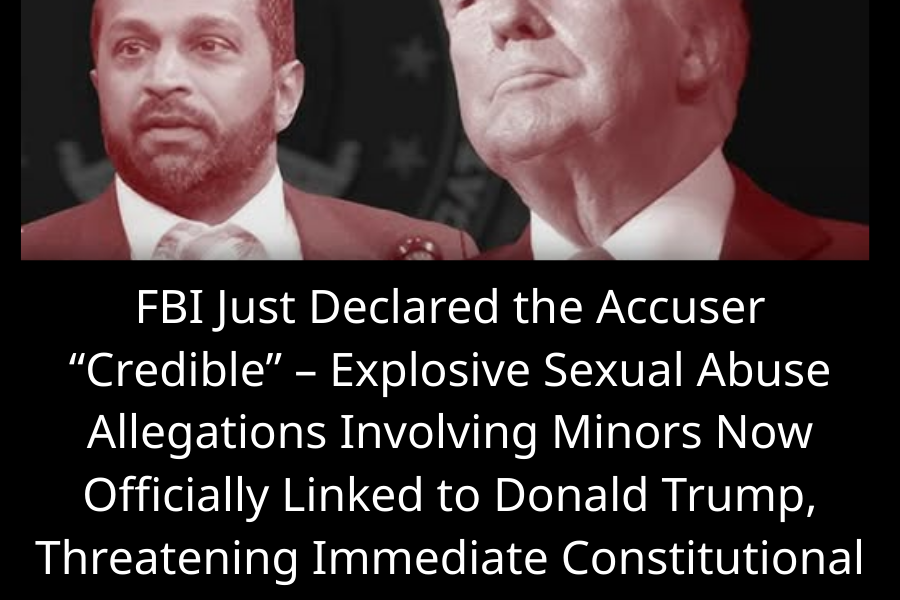
The Breaking Point: What “Credible” Actually Means
Let’s sit with the weight of that word for a moment: Credible.
Not “alleged.” Not “investigated.” Not “politically motivated.” The Federal Bureau of Investigation—the nation’s premier law enforcement agency, staffed by career agents who have spent decades separating truth from fiction—has officially deemed testimony against a sitting president of the United States credible.
In the lexicon of law enforcement, “credible” doesn’t mean “proven beyond a reasonable doubt.” It doesn’t mean “indictable.” But it means something profound: that the testimony bears the hallmarks of truth, that it’s consistent, that it’s corroborated, and that it passes the initial threshold of believability that justifies moving forward.
When that word is attached to allegations involving sexual abuse of minors, the ground doesn’t just shift. It opens.
This isn’t a campaign ad. This isn’t a partisan hit piece. This is the FBI—an institution Trump himself has spent years attacking as corrupt and weaponized—now placing its institutional credibility behind the proposition that these accusations cannot be dismissed.
Deconstructing the Bomb: What Changes Now
The post lays out three pillars of the crisis, each more devastating than the last:
1. The FBI Credibility Finding: This is the game-changer. Previous allegations against Trump—the Access Hollywood tape, the E. Jean Carroll civil judgment, the myriad accusations from women over decades—lived in the realm of politics and public opinion. They were dismissed by supporters as “fake news,” by opponents as proof of moral unfitness, but they never carried the official imprimatur of a federal investigative agency. Now they do. The FBI’s credibility finding transforms this from a political vulnerability into a potential criminal matter with constitutional implications.
2. The Trafficking Network Connection: The post specifies that the alleged abuses occurred “within the framework of well-known trafficking networks.” This is the detail that elevates the scandal beyond individual misconduct into the realm of organized criminal enterprise. If true, it suggests not just personal moral failure, but potential involvement with—or knowledge of—systems of exploitation that Congress has spent years investigating. The Epstein connections, the Maxwell trial, the ongoing inquiries into elite complicity—all of this suddenly has a new, terrifying focal point.
3. The Calls for Immediate Removal: This is where the constitutional crisis crystallizes. The 25th Amendment exists for moments exactly like this—when a president is unable to discharge the powers and duties of office. While typically invoked for physical or mental incapacity, its language is broad enough to encompass a catastrophic collapse of moral authority. Congressional leaders, public figures, and civil organizations are now demanding action. The question is no longer “Did he do it?” but “What do we do now that the FBI says he probably did?”
The Constitutional Abyss: Options and Obstacles
If the FBI’s finding is real—and we must emphasize that this post presents it as “breaking news” requiring verification—the nation faces a set of options, none of them easy.
1. The 25th Amendment Route: The Cabinet and Vice President can declare the president “unable to discharge the powers and duties of his office.” This has never been used for moral unfitness, but the amendment’s language is ambiguous enough to allow for it. The political reality: a Republican Cabinet and a Republican Vice President would have to turn on their own leader. In today’s GOP, that’s almost unimaginable. Almost.
2. Impeachment and Conviction: The House could impeach immediately—articles would likely charge “high crimes and misdemeanors” based on the new evidence. Conviction in the Senate would require a two-thirds majority, meaning at least 17 Republicans would have to vote with all Democrats. In the current political climate, that seems mathematically improbable. But if the evidence is as damning as the FBI’s credibility finding suggests, the pressure on Senate Republicans would be unprecedented.
3. Criminal Prosecution After Office: The more likely scenario: the investigation continues, evidence is gathered, and upon leaving office (whether in 2029 or earlier), Trump faces federal charges. This is the slow-walk to justice, the legal process grinding forward while the political process stalls. It satisfies the rule of law but does nothing to address the immediate moral crisis of a president deemed credible accused of crimes against children.
4. Nothing: The darkest option. Congress does nothing. The Cabinet does nothing. The president remains in office, the allegations hanging over every decision, every press conference, every international summit. The nation collectively agrees to look away, to treat the FBI’s finding as just another piece of partisan noise. This would shatter whatever remains of institutional trust.
The Public Reaction: A Nation Fracturing in Real Time
The post’s call to action—”Should Congress proceed with the immediate removal of Donald Trump following the FBI’s confirmation of credibility?”—isn’t a poll. It’s a Rorschach test.
For Trump’s opponents, this is the moment they’ve been waiting for: proof that their suspicions were justified, that the man they’ve always believed was unfit is finally exposed. The comments would be filled with righteous fury, demands for immediate action, and a sense of vindication.
For Trump’s supporters, this is the ultimate test of loyalty. The FBI—already mistrusted, already seen as part of the “deep state”—has now delivered the ultimate verdict. The response will be predictable: the FBI is corrupt, the allegations are fabricated, this is a coup attempt. The cognitive dissonance required to maintain this position in the face of an official credibility finding is staggering, but human beings are capable of staggering things when their identity is on the line.
For the undecided, the apolitical, the exhausted—this is the final straw. The moment when they stop following politics altogether, unable to process the gravity of what’s being alleged, retreating into private life and letting the system sort itself out.
The Unanswered Questions: What We Don’t Know
Before we accept this narrative as reality, we must acknowledge what’s missing:
-
Who is the accuser? Credibility depends on identity, motive, and corroboration.
-
What is the specific testimony? “Involving minors” covers a vast range of conduct, from inappropriate contact to systematic abuse.
-
What corroborating evidence exists? Credibility findings often rely on consistency, detail, and partial corroboration, not definitive proof.
-
When did this happen? Statutes of limitations may apply, though many have been extended for child abuse.
-
What does “credible” mean in this context? FBI credibility assessments are internal tools, not public verdicts. Their release is unprecedented.
The Verdict: A Nation at the Precipice
If this story is true—if the FBI has indeed deemed testimony against a sitting president credible, if that testimony involves child abuse, if it connects to trafficking networks—then we are not in a political crisis. We are in a constitutional and moral emergency with no modern precedent.
No president has ever faced this. Not Nixon at his lowest. Not Clinton during impeachment. Not even the darkest rumors about past administrations have been validated by the nation’s premier law enforcement agency while the president still held office.
The question at the end of the post—”Is this the end of the Trump presidency?”—has only one honest answer:
It should be.
Whether it will be depends on whether the institutions designed to check presidential power still function when tested beyond all imagining. Whether the Cabinet finds courage. Whether Congress finds integrity. Whether the public finds the strength to demand accountability from a leader they elevated.
The FBI has spoken. The nation now must answer. And the answer will define not just this presidency, but the very idea that anyone—even the most powerful person on earth—can be held accountable when the evidence demands it.
The White House hangs by a thread. But it’s not the White House that’s truly at risk. It’s the last fragile strand of belief that justice means something in America.