The Red Line in the Sand: Florida Just Did What No Other State Would
The bill is on his desk. That’s the moment. That’s the decision point. That’s the place where promises either become law or become campaign rhetoric that voters eventually forget.
Ron DeSantis has spent years building a reputation as the governor who doesn’t back down. The one who fought lockdowns. The one who took on the teachers unions. The one who turned Florida into the place where conservative policy goes to become reality, not just talking points.
But House Bill 1471 is different. It’s not about COVID. It’s not about education. It’s about something deeper, something that cuts to the very foundation of what America is supposed to be. It’s about whether foreign legal codes—codes that treat women as property, codes that demand death for apostates, codes that have no place in a constitutional republic—get any foothold in the American legal system.
The bill says no. Unequivocally. Unapologetically. No Sharia law in Florida courts. No taxpayer dollars flowing to organizations that promote it. No protection for students who advocate for designated terror groups. No exceptions. No “cultural sensitivity.” No bending to the demands of activists who have spent decades arguing that America should accommodate the very ideologies that seek to destroy it.
This is not a close call. This is not a gray area. This is a red line. And Florida just drew it.
The Sharia Clause
Let’s be precise about what the bill actually does, because the critics will try to muddy the waters. They will call it Islamophobic. They will call it discriminatory. They will call it a violation of religious freedom. They will say everything except what it actually says.
House Bill 1471 does two things. First, it makes clear that Florida courts cannot enforce foreign religious law when it conflicts with the U.S. Constitution or the Florida Constitution. That’s it. Courts cannot apply Sharia law. Cannot enforce rulings made under Sharia. Cannot defer to religious tribunals that operate under a legal code that treats men and women differently, that criminalizes apostasy, that has no concept of equal protection under the law.
Second, it gives the state the power to designate domestic and foreign terrorist organizations and cut off any taxpayer funding to groups tied to them. Schools that promote Sharia? No more vouchers. Organizations that funnel money to designated terror groups? No more contracts. College students who advocate for those groups? Immediate expulsion and out-of-state tuition rates.
This is not complicated. If your school teaches that women are property, you don’t get taxpayer money. If your organization supports terrorism, you don’t get state contracts. If you, as a student, use your time at a public university to advocate for groups that want to destroy the country, you lose the privilege of in-state tuition rates.
These are not unreasonable standards. These are the bare minimum of what any state should require of the institutions and individuals it funds. And the fact that Florida has to pass a law to make them explicit tells you how far the pendulum has swung in the other direction.
The Incompatibility Question
The bill’s supporters are not shy about the underlying argument. Radical Islam—the ideology that demands submission to religious law over civil law, that rejects the separation of church and state, that has no room for individual rights or democratic governance—is incompatible with Western freedom.
This is not a controversial statement. It is a statement of fact. The regimes that have attempted to implement Sharia as the law of the land—Iran, Saudi Arabia, the Taliban’s Afghanistan, ISIS’s caliphate—are not liberal democracies. They are theocracies. They execute homosexuals. They stone women for adultery. They behead apostates. They have no concept of freedom of speech, freedom of religion, or freedom of conscience.
The idea that such a legal code should have any place in American courts is absurd on its face. The idea that American taxpayers should fund schools that teach it is obscene. The idea that the state should have no power to cut off funding to organizations that support the people who want to impose it is a recipe for national suicide.
Florida is not saying Muslims cannot practice their religion. Florida is not saying Islamic institutions cannot exist. Florida is saying that when your “religion” includes a legal code that contradicts the Constitution, that legal code does not get enforced in our courts. And when your “schools” use our money to teach children that the Constitution is inferior to Sharia, that money stops flowing.
That is not discrimination. That is self-preservation.
The School Voucher Question
The bill targets a specific and largely unexamined problem: Islamic schools that promote Sharia have been receiving millions in taxpayer-funded school vouchers. The argument has always been that they are schools, that parents should have choice, that the government shouldn’t discriminate based on religious affiliation.
But what happens when the curriculum includes teaching that the Constitution is inferior to Sharia? What happens when girls are taught that their testimony is worth half that of a boy? What happens when children are told that apostates deserve death? What happens when the schools receiving taxpayer money are actively working to undermine the very principles that made the country worth living in?
Florida is saying: That’s enough. If you want taxpayer money, you teach American values. You teach that the Constitution is supreme. You teach that men and women are equal. You teach that religious freedom means the freedom to practice your faith, not the freedom to impose it on others. You teach that the country you live in is not an infidel state to be conquered but a republic to be cherished.
If you can’t do that, you don’t get the money. It’s that simple. And the fact that this is controversial—the fact that there are people who argue that Florida should continue funding schools that teach Sharia—is a measure of how far the political class has drifted from the people it claims to represent.
The Student Expulsion Provision
The bill’s provision on college students is the one that will generate the most controversy, and it’s the one that matters most. Students who are caught promoting designated terrorist organizations face immediate expulsion and loss of in-state tuition status.
The critics will call this a violation of free speech. They will argue that students have the right to advocate for whatever they want, that the First Amendment protects even the most odious speech, that the government cannot punish students for their political beliefs.
But there is a difference between political beliefs and material support for terrorist organizations. There is a difference between saying “I support the right of Palestinians to self-determination” and “I support Hamas.” There is a difference between criticizing American foreign policy and advocating for the violent overthrow of the American government.
The First Amendment has never protected the latter. The Supreme Court has repeatedly held that the government can restrict speech that incites violence, that supports designated terrorist organizations, that poses a clear and present danger to national security. Florida is not inventing new law. It is applying existing law to the university context.
And the loss of in-state tuition is not a punishment. It is the removal of a subsidy. If you are using your time at a public university to advocate for groups that want to destroy the country, why should the taxpayers of Florida subsidize your education? Why should the people who pay for your tuition be forced to fund the very activism that seeks to undermine their safety and their values?
They shouldn’t. And now, in Florida, they won’t.
The Hillary Cassel Moment
The bill’s sponsor, Rep. Hillary Cassel, put it as clearly as anyone could:
“American law first, no exceptions for doctrines that treat women as property, punish apostates, or seek to replace our republic with theocracy.”
That’s the core of it. That’s the principle that the bill’s opponents will try to obscure but cannot refute. American law first. Not Sharia. Not any foreign religious code. Not the dictates of a theocracy that has no place in a constitutional republic.
Cassel is not some fire-breathing conservative. She’s a Democrat. She’s a Jewish woman whose family fled persecution. She understands what happens when religious law replaces civil law. She understands what happens when the state enforces the dictates of a faith. She understands that the separation of church and state protects everyone—including Muslims who want to practice their faith without the state imposing a particular interpretation of it.
Her support for the bill is not a betrayal of her party. It is a recognition that some things are more important than party. That the survival of the American experiment is more important than the demands of activists who have spent decades trying to normalize the normalization of theocracy.
The Left-Wing Response
The response from the left has been predictable. Muslim advocacy groups are calling it Islamophobic. Civil liberties organizations are calling it a violation of religious freedom. Democratic politicians are issuing statements about discrimination and the importance of cultural sensitivity.
What they are not doing is defending Sharia. They are not saying that it should be enforceable in American courts. They are not saying that schools teaching it should continue to receive taxpayer money. They are not saying that students advocating for terrorist groups should keep their in-state tuition rates.
They can’t say those things. Because the positions are indefensible. So instead, they talk about “discrimination.” They talk about “free speech.” They talk about “religious freedom.” They change the subject. They hope that by calling the bill names, they can avoid engaging with what it actually does.
But the bill is clear. The principles are clear. And the people of Florida are not confused. They know the difference between religious freedom and theocratic imposition. They know the difference between free speech and material support for terrorism. They know the difference between a country that protects religious minorities and a country that forces everyone to live under the law of one religion.
The left’s arguments are not persuasive. They are evasive. And in Florida, evasive arguments don’t win.
The DeSantis Decision
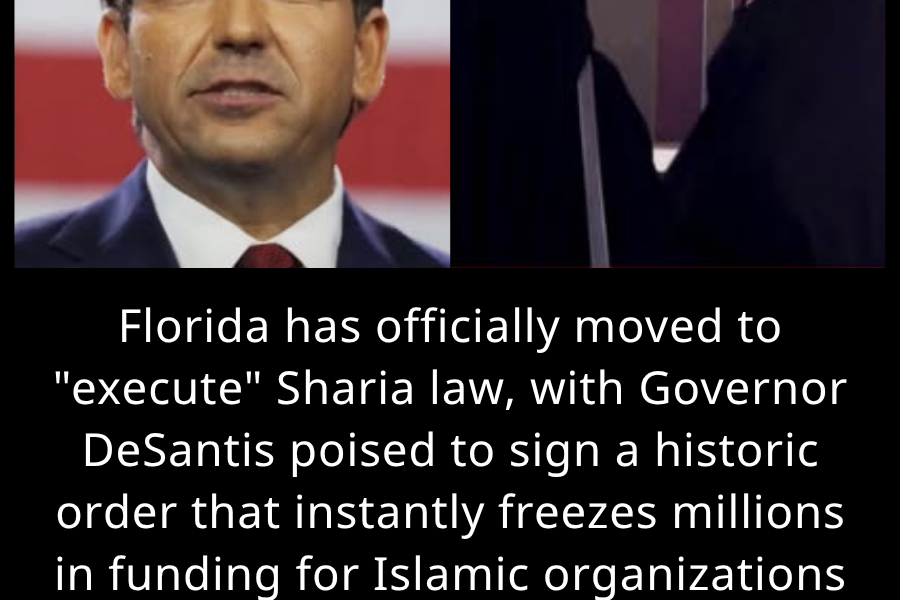
The bill is on DeSantis’s desk. Everyone expects him to sign it. He has spent his entire governorship building a reputation as the man who says yes to conservative policy and no to the forces that want to drag the country in another direction.
But signing this bill is not just another notch on the belt. It is a statement. It is a declaration that Florida will not be the place where Sharia gets a foothold. That Florida will not fund schools that teach the supremacy of religious law over the Constitution. That Florida will not subsidize the education of students who advocate for terrorist groups.
It is the kind of statement that will draw fire. The national media will attack. The activist groups will sue. The Democratic Party will use it as a fundraising tool. The critics will call him every name in the book.
But DeSantis has never cared about that. He has always understood that the approval of the national media is not a measure of success. That the anger of activist groups is often a sign that you’re doing something right. That the people who matter are the people of Florida, and the people of Florida want their state to be what it has always claimed to be: the place where freedom is defended, where the Constitution is supreme, where the forces of theocracy and terrorism find no quarter.
He will sign it. And when he does, Florida will become the first state in the country to take a stand this clear, this unequivocal, this uncompromising.
What Comes Next
The lawsuits will come. They always do. The ACLU will file something. CAIR will file something. The usual coalition of civil liberties groups will argue that the bill violates the First Amendment, the Establishment Clause, the Equal Protection Clause. They will ask for injunctions. They will try to stop the law from taking effect. They will fight every step of the way.
And they will lose. Not because the courts are conservative. Because the law is clear. The Constitution does not require states to enforce foreign religious codes. The First Amendment does not require taxpayers to fund schools that teach the supremacy of religious law over civil law. The Equal Protection Clause does not require states to subsidize the education of students who advocate for terrorist organizations.
The courts will uphold the bill. Not because the judges are political. Because the legal arguments for striking it down are weak. Because the principles behind it are sound. Because the idea that the state must fund the very forces that seek to destroy it is absurd on its face.
And when the courts uphold it, other states will follow. They will see that Florida did something that was politically difficult but legally sound. They will see that the sky did not fall. They will see that the people who screamed about discrimination and Islamophobia and the death of religious freedom were wrong. And they will pass their own versions. And the tide will turn.
The Red Line
This bill is not the end of anything. It is the beginning. It is the first state-level attempt to draw a clear red line between the American legal system and the forces that seek to replace it. It is the first time a state has said, in plain language, that foreign religious codes have no place in our courts, that taxpayer money will not fund the spread of theocracy, that students who advocate for terrorist groups do not get a subsidy from the people they seek to destroy.
More states will follow. The movement will grow. The fight will continue. But Florida is first. Florida is the line in the sand. Florida is the place where the political class finally said: enough.
DeSantis will sign the bill. The left will scream. The media will attack. The lawsuits will come.
And Florida will hold. Because the people of Florida know what is at stake. They know that the American experiment is fragile. That it requires defense. That the forces that seek to replace it will not stop because we ask nicely. That sometimes, the only answer to an ideology that has no respect for the rule of law is the rule of law itself, applied without apology, without exception, without hesitation.
The bill is on his desk. The pen is in his hand.
This is what it looks like when a state decides to defend itself. Not with violence. Not with fear. With law. With principle. With the simple, unshakeable conviction that the Constitution is supreme, that American law comes first, and that no foreign religious code will ever get a foothold in the land of the free.
Sign it. Let the fight come. Florida is ready.