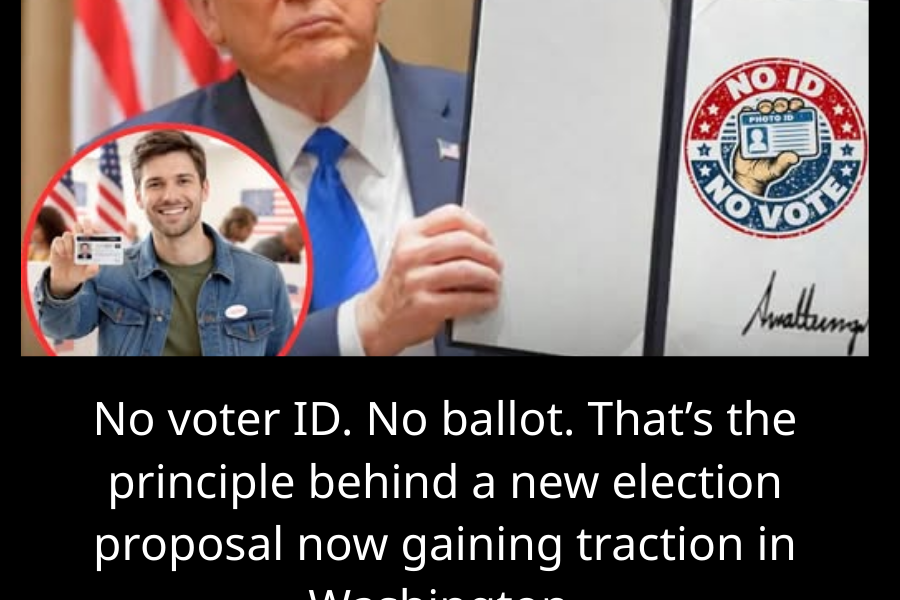
The MEGA Act: How Trump’s New Voting Rules Would Reshape American Elections
The Bill That Would Change Everything
Let’s start with what the MEGA Act actually does. Because the name—deliberately provocative, designed to evoke the “Make America Great Again” movement—is just the packaging. The contents are what matter.
Mandatory photo ID. Every voter in a federal election must present government-issued photo identification at the polls. No exceptions. No affidavits. No alternative verification methods.
Proof of citizenship at registration. A passport, birth certificate, or naturalization papers must be submitted when registering to vote. The current system, which relies on self-certification under penalty of perjury, would be replaced with documentary proof.
Stricter mail-in deadlines. Ballots must arrive by the close of polls on Election Day. No postmarks accepted. No grace periods. If it’s not in the box by 7 p.m., it doesn’t count.
The bill is sponsored by Rep. Bryan Steil (R-Wis.) and supported by Donald Trump. It would apply to all federal elections—presidential, Senate, and House—and would override state laws that currently govern these procedures. It is, in short, the most significant federal election reform since the Voting Rights Act of 1965.
The Case for the MEGA Act: Confidence Through Consistency
Supporters make arguments that resonate with millions of Americans who have spent years questioning the integrity of U.S. elections.
1. Voter ID is common sense. You need ID to buy alcohol, board a plane, or enter a federal building. Why shouldn’t you need it for the most fundamental act of citizenship? The idea that requiring ID is “voter suppression” is, in their view, an insult to the intelligence of voters who carry ID every day.
2. Proof of citizenship closes a loophole. The current registration system relies on an honor code. Non-citizens are theoretically prohibited from voting, but there’s no systematic way to catch them. Requiring documentary proof ensures that only citizens participate in citizen elections.
3. Mail-in deadlines prevent chaos. The 2020 election saw ballots arriving days or even weeks after Election Day, creating a window of uncertainty and suspicion. Requiring arrival by Election Day restores the traditional understanding: Election Day means Election Day.
4. Uniform standards create fairness. Currently, election rules vary wildly from state to state. What’s legal in Nevada may be illegal in Georgia. Federal elections should have federal standards, ensuring that every American votes under the same rules regardless of where they live.
5. Public confidence requires clarity. Millions of Americans don’t trust the current system. Whether that distrust is justified or not, it’s real—and it’s corrosive to democracy. Clear, consistent, verifiable rules can restore that trust.
The Case Against: Access vs. Security
Opponents see the MEGA Act as a solution in search of a problem—one that would disenfranchise millions of eligible voters.
1. Voter ID is a barrier. Millions of Americans don’t have government-issued photo ID. The elderly, the poor, rural residents, students, people of color—all are less likely to have the specific forms of ID required. Making ID mandatory means making voting harder for the people who already face the most obstacles.
2. Proof of citizenship is bureaucratic. Not everyone has a passport. Not everyone has easy access to their birth certificate. Low-income voters, homeless voters, disaster survivors, and others may struggle to produce the required documents. The result: fewer registrations, lower turnout, and a voting population that looks less like America.
3. Mail-in deadlines disenfranchise military and overseas voters. Ballots sent from Afghanistan or a naval vessel don’t always arrive quickly. The MEGA Act’s requirement would effectively disenfranchise the very people who sacrifice most for the country—a bitter irony given the bill’s supposed focus on “election integrity.”
4. The problem doesn’t exist. Multiple studies have shown that voter fraud is vanishingly rare. The 2020 election was the most secure in American history, according to officials from both parties. The MEGA Act solves a problem that doesn’t exist while creating new problems that do.
5. It’s partisan, not principled. The groups most affected by these requirements—young voters, voters of color, low-income voters—tend to vote Democratic. The bill’s supporters know this. That’s the point. The MEGA Act is not about integrity; it’s about advantage.
The Numbers: Who Would Be Affected?
The Brennan Center for Justice estimates that 21 million Americans lack government-issued photo ID. That’s 11% of eligible voters. Among African Americans, the number is 25%. Among Hispanics, 27%. Among voters over 65, 18%.
The proof-of-citizenship requirement would add another layer. Millions more lack easy access to birth certificates or passports. The combined effect would be a significant reduction in voter registration and turnout—disproportionately affecting Democratic-leaning groups.
The mail-in deadline would hit military voters hardest. In 2020, the Pentagon reported that 30% of military ballots arrived after Election Day—and were counted under state laws that accepted late arrivals. Under the MEGA Act, those votes would be thrown out.
The Constitutional Question: Can Congress Do This?
The Constitution gives states the power to set the “times, places, and manner” of elections—but Congress can override those rules at any time. The MEGA Act is explicitly authorized by Article I, Section 4.
But the Supreme Court would likely weigh in. The Voting Rights Act prohibits voting rules that discriminate on the basis of race. If the MEGA Act can be shown to have a disparate impact on minority voters, it could face constitutional challenge.
The current Court, with its conservative majority, might uphold the law. But the litigation would be lengthy, expensive, and divisive—exactly what the bill’s opponents want to avoid.
The Political Calculus: Why Now?
The MEGA Act is not just policy; it’s politics. With the 2026 midterms approaching, Republicans are betting that election security resonates with voters. They believe that the chaos of 2020, the controversies of 2024, and the ongoing distrust of mail-in voting have created an opening for federal action.
Democrats are betting the opposite: that voters will see the MEGA Act as a partisan power grab and punish Republicans at the polls. They’re already framing it as “Jim Crow 2.0” and mobilizing their base to oppose it.
The truth probably lies somewhere in between. Some voters genuinely worry about election integrity and support uniform standards. Others genuinely worry about access and oppose barriers. The question is which group turns out more.
The Verdict: A Fight That Defines the Future
The MEGA Act is not the last word on election reform. It is the opening salvo in a battle that will define American democracy for a generation.
At its core, the debate is about two competing visions of voting:
-
Vision One: Voting should be easy, accessible, and convenient. The goal is maximum participation, even if that means some risk of fraud. The system should accommodate voters, not the other way around.
-
Vision Two: Voting should be secure, verified, and consistent. The goal is maximum integrity, even if that means some inconvenience. Voters should meet clear standards, not the other way around.
Both visions have merit. Both have costs. The question is which one Americans prefer—and whether they trust the other side to implement it fairly.
The MEGA Act forces that choice. And whatever the outcome, the debate itself will shape how Americans think about their most fundamental right for years to come.