The Reservation That Broke America: When Normal Became Radical
She ordered a salad.
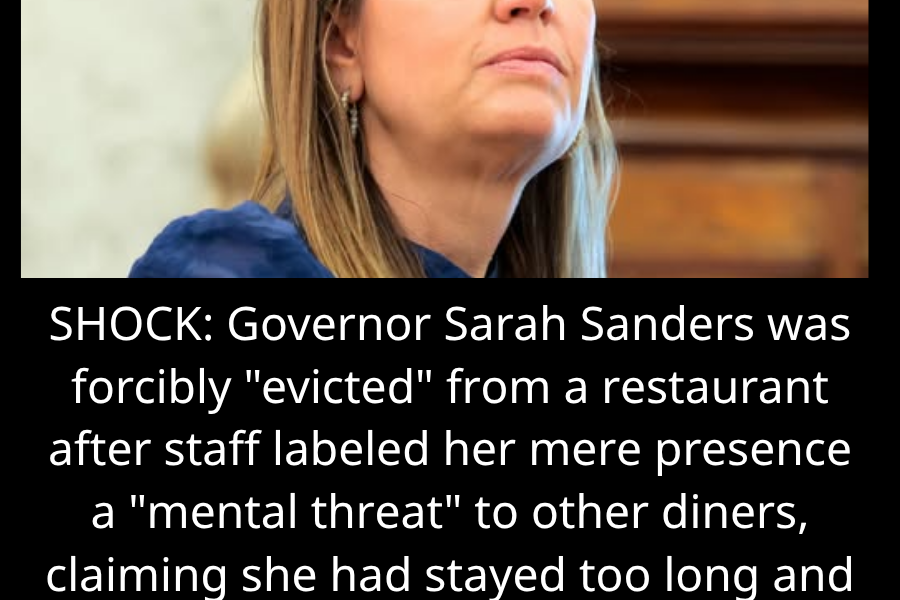
That’s not a metaphor. That’s not political theater. Governor Sarah Huckabee Sanders of Arkansas walked into a restaurant—a restaurant, a place where humans have been exchanging currency for cooked food since the invention of currency—ordered a salad, ate the salad, and was then asked to leave.
Not because she caused a scene. Not because she refused to pay. Not because she was rude to the staff.
Because her presence was making other patrons “uncomfortable.”
Read that again. A sitting governor. An American citizen. A woman eating a salad. Asked to leave a public establishment because her existence—her quiet, salad-eating, minding-her-own-business existence—was causing discomfort to strangers at nearby tables.
And when she told the story, she didn’t call for a boycott. She didn’t name the restaurant. She didn’t launch a war. She said something much simpler. Much quieter. And much, much more terrifying to the people who run the institutions:
“The battle in this country is no longer between the left versus the right. It’s the normal versus the crazy.”
That’s the line. That’s the one that’s going to haunt every restaurant owner, every corporate executive, every school board member, every person who has ever looked at someone across a table and thought: I don’t want you here because of who you voted for.
Because Sanders just did something remarkable. She reframed the entire conflict. She took it out of the realm of politics and put it where it belongs:
In the realm of behavior.
The Salad Test
Let’s establish what actually happened.
Sanders was in Virginia. She was dining with friends. She finished her meal. She paid her bill. She continued talking—something humans have been doing in restaurants since restaurants existed. At some point, the restaurant management approached her and asked her to leave.
The reason? She had been there too long. And her presence was making other customers uncomfortable.
Now, pause. Let’s play this out in a different context.
Imagine a governor of any party—let’s say a Democratic governor from a blue state—is dining in a restaurant in a red area. She’s there with friends. She finishes her meal. She stays a little longer. Management approaches and says: “You need to leave. Your presence is making our customers uncomfortable.”
What happens next?
The story becomes national news within hours. The governor holds a press conference. The restaurant issues a groveling apology. The term “MAGA restaurant” trends on Twitter. The owner is publicly shamed. The business is review-bombed. A fundraiser is launched for the governor’s “fighting for democracy” PAC.
That’s the world we live in. That’s the asymmetry Sanders was pointing to.
She didn’t do any of that. She told the story. She made her point. She moved on.
But the point stuck. Because everyone who has been paying attention knows exactly what she’s talking about.
The Comfort Standard
Here’s the real story buried under the “dining divide” headlines:
We have created a society where the standard for excluding someone from public life is not what they do but how they make you feel.
You don’t have to do anything wrong. You don’t have to threaten anyone. You don’t have to break any law. You just have to exist in a way that makes the right people uncomfortable. And suddenly, you’re the problem.
Sanders wasn’t asked to leave because she stayed too long. If that were the standard, half the restaurants in America would be empty by 9 PM. She was asked to leave because someone looked at her, recognized her, and decided that her politics made her unwelcome in a public space.
That’s not a restaurant policy. That’s a political test. And it’s being administered all over the country, every day, in ways both large and small.
The college student who gets shouted down for wearing a MAGA hat.
The church that gets protested for hosting a Republican speaker.
The school board meeting where parents are called “domestic terrorists” for questioning curriculum.
The workplace where a Biden sticker gets you quietly managed out.
The neighborhood where a Trump flag means you’re the subject of neighborhood gossip and side-eyes and “we just don’t feel comfortable having you at the block party.”
Sanders put a name to all of it: The crazy.
Not the policy disagreements. Not the ideological debates. Not the legitimate arguments about taxes or spending or foreign policy. The crazy. The willingness to exclude, to punish, to silence anyone who doesn’t pass the ideological purity test. The belief that discomfort is violence. The conviction that the mere presence of the other side is an act of aggression requiring a response.
That’s not politics. That’s pathology.
The Normal Coalition
Sanders says the battle is “normal versus crazy.” She’s right. But here’s what she knows that her critics don’t:
“Normal” is not a Republican coalition. It’s not a Democratic coalition. It’s not a MAGA coalition or a Resistance coalition. It’s the coalition of people who still believe that you can disagree with someone without wanting them fired, silenced, exiled, or canceled.
It’s the person who voted for Biden and thinks the restaurant owner was out of line.
It’s the person who voted for Trump and thinks the governor should have just left quietly.
It’s the person who didn’t vote at all and is exhausted by a culture that treats political affiliation like a criminal record.
These people are the majority. They are the quiet majority. They are the ones who don’t post on social media, who don’t go to protests, who don’t write angry letters to the editor. They just want to live their lives, raise their families, and eat their salads without being told that their existence is an act of political violence.
And they are watching. They are watching the people who run institutions—restaurants, universities, corporations, media companies—decide that the new standard for participation is total ideological conformity.
They are watching and waiting. And every time something like the Sanders restaurant incident happens, they move a little further away from the people who think politics is a reason to exile your fellow citizens from public life.
The Crazy Has a Pattern
Let’s be specific about what “the crazy” looks like. Because Sanders didn’t just throw out a vague term. She was describing something with clear, observable features.
The crazy demands purity. You cannot agree with the other side on anything. You cannot acknowledge good faith. You cannot concede a single point without being labeled a traitor.
The crazy personalizes everything. Policy disagreements become moral failings. Political opponents become enemies. People who vote differently become people who are fundamentally evil.
The crazy escalates. It doesn’t accept disagreement. It doesn’t tolerate coexistence. It doesn’t allow for the possibility that someone might have different values and still be a decent human being. It demands victory, not compromise.
The crazy institutionalizes itself. It doesn’t stay on Twitter. It gets written into HR policies. It becomes the standard for hiring, firing, promotion, and exclusion. It transforms every organization into a political battlefield.
The crazy eats its own. Anyone who deviates from the orthodoxy, even slightly, becomes the new target. There is no safe position. There is no center. There is only total alignment or total exile.
Sanders has watched this happen in her own party. She’s watched it happen in the other party. She’s watched it happen in the media, in the corporate world, in the culture at large. And she’s saying what everyone knows but is afraid to say:
This is not normal. This is not sustainable. And if we don’t push back, it will consume everything.
The Restaurant’s Real Problem
The restaurant that asked Sanders to leave probably thought they were making a safe decision. A few customers complained. The manager made a call. The problem went away.
Except it didn’t. Because the problem was never Sanders. The problem was the customers who couldn’t eat their dinner in the presence of someone with different politics. The problem was the culture that told them their discomfort was a legitimate reason to exclude a fellow citizen. The problem was the assumption that political space must be cleared of anyone who doesn’t share your views.
That restaurant is now famous. Not for its food. Not for its service. For being the place where a governor was asked to leave because her politics made people uncomfortable.
Is that the reputation any business wants? To be known as the place where political conformity is required for entry? To be the restaurant where your order is judged by your voter registration?
The crazy doesn’t think about that. The crazy only thinks about the immediate victory. The crazy only sees the person in front of them and wants them gone. The crazy doesn’t calculate the long-term cost of turning every space into a political battleground.
But the normal does. The normal is watching. And the normal is taking notes.
The Line Sanders Drew
Sanders didn’t say “Republicans are normal and Democrats are crazy.” She didn’t say “conservatives are virtuous and liberals are dangerous.” She said something much more precise and much more damning:
The battle is between normal and crazy.
That means there are crazy people on her side too. There are Republicans who want to exile, cancel, and punish anyone who doesn’t pass their purity test. There are people in her own party who think compromise is weakness and coexistence is surrender. There are voices on the right that are just as unhinged, just as unwilling to share space, just as eager to burn it all down as the voices on the left.
She’s calling them out too. She’s saying: I don’t want to be in your coalition. I don’t want to be in a coalition that thinks the answer to political disagreement is exclusion. I want to be in the coalition of people who can eat a salad without starting a war.
That’s a dangerous position. The crazy on both sides will hate her for it. The left will call her a fascist. The right will call her a RINO. The media will twist her words and take them out of context and pretend she said something she didn’t say.
But the normal will hear her. The normal knows exactly what she means. Because the normal has been living in a country where the crazy has taken over the institutions, the culture, the conversation. And the normal is tired of being told that their quiet, salad-eating, minding-their-own-business existence is an act of political aggression.
The Coming Realignment
Sanders is describing something bigger than a restaurant incident. She’s describing a realignment. A splitting of the country into two camps that have nothing to do with party registration.
On one side: the people who believe political disagreement is normal. Who believe you can share a country with people who vote differently. Who believe that public spaces should be open to all citizens, regardless of their politics.
On the other side: the people who believe politics is everything. Who believe that disagreement is violence. Who believe that the presence of the other side is an act of aggression requiring a response. Who believe that the only acceptable outcome is total victory and total silence from the losers.
That’s the battle. It’s not left versus right. It’s open versus closed. Tolerant versus puritanical. Normal versus crazy.
And the crazy has been winning. For years. The crazy has set the terms. The crazy has defined the boundaries. The crazy has made the rules.
But the crazy always overreaches. The crazy always takes it too far. The crazy always thinks that the next victory will be the last victory, that the next purge will finally clear the space of dissent, that the next exclusion will finally make everyone safe.
And then the crazy asks a governor to leave a restaurant because her presence makes people uncomfortable. And the normal looks at that and thinks: If this is what victory looks like, I want no part of it.
The Last Bite
Sanders finished her salad. She paid her bill. She left when asked.
She didn’t make a scene. She didn’t call the media. She didn’t turn it into a national incident. She went on with her night.
That’s the normal. That’s the quiet, ordinary, unremarkable response of someone who doesn’t think every interaction needs to be a war.
But later, when she told the story, she said something that will stick. Something that will be repeated in diners and coffee shops and living rooms across the country. Something that the people who asked her to leave probably didn’t anticipate when they decided to make their customers comfortable by removing a governor:
“The battle in this country is no longer between the left versus the right. It’s the normal versus the crazy.”
The crazy heard that and thought: She’s talking about them.
The normal heard it and thought: She’s talking about me.
And that’s the difference. That’s the divide. That’s the battle that’s coming.
The crazy thinks it’s winning. The normal is just starting to realize it’s been losing. And when the normal finally decides to fight back, the crazy will discover something it forgot:
There are more of us than there are of them. And we’re not asking for permission to eat our salads in peace.
We’re taking the table. And we’re not leaving.