The Kennedy Solution: When Congress Feels the Pain It Inflicts
The Bill That Should Have Existed All Along
Let’s start with the premise, because it’s so simple it’s almost shocking that it’s not already the law:
If Congress fails to keep the government open, members of Congress should not get paid.
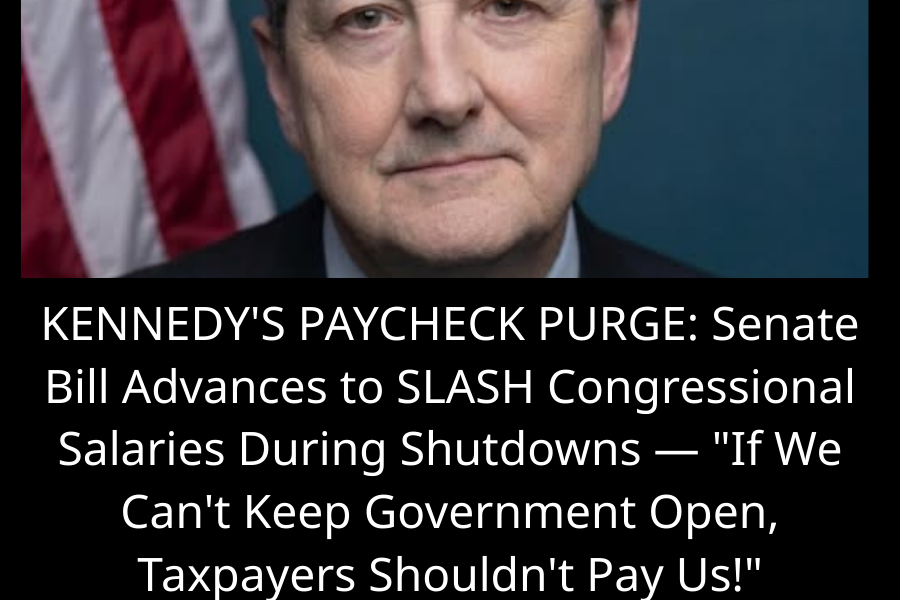
Senator John Kennedy (R-LA) has advanced legislation that would do exactly that—suspend congressional pay during a government shutdown. No more collecting a salary while federal workers go without. No more insulated elites watching the consequences unfold from their heated offices. No more “do as I say, not as I do” from the people who caused the crisis.
The bill has moved forward in the Senate. It’s gaining attention. And it’s forcing a question that every American should be asking: Why isn’t this already the rule?
The Logic: Simple, Fair, and Devastating
Kennedy’s argument is straightforward, and it’s the kind of thing that plays in a bar as well as it plays in a hearing room.
If you don’t do your job, you don’t get paid.
That’s how it works for everyone else. The TSA agent who doesn’t show up doesn’t get a paycheck. The construction worker who walks off the site doesn’t get paid. The teacher who stops teaching doesn’t get a salary. Why should members of Congress be any different?
Their job, at its most basic level, is to keep the government running. They pass budgets. They fund agencies. They ensure that the essential services Americans rely on continue without interruption. When they fail at that job—when they let political games override their basic responsibility—they should face the same consequences as anyone else who fails at their job.
The bill is designed to align incentives. Right now, there’s no cost to members for a shutdown. They get paid either way. They have health insurance either way. Their staffs might be furloughed, but they themselves are protected. The pain is all externalized—felt by federal workers, by contractors, by anyone who depends on government services.
Kennedy’s bill changes that. Suddenly, a shutdown has a price. Suddenly, the people causing the crisis feel the consequences. Suddenly, there’s a reason to compromise, to find a solution, to stop playing games with other people’s lives.
The Timing: Why This Matters Now
This bill is advancing at a moment when the country is once again staring down the barrel of a shutdown. The DHS funding fight, the TSA agents working without pay, the spring break travel chaos—all of it is happening because Congress can’t do its job.
The contrast could not be starker. Chuck Schumer collects his full salary while TSA agents with four kids go without. Nancy Pelosi’s bank account doesn’t notice a missed paycheck. The average federal worker is choosing between groceries and rent.
Kennedy’s bill is a direct response to that injustice. It says: if you’re going to make them suffer, you should suffer too.
The Politics: Who Supports It, Who Opposes It
The bill’s advancement in the Senate suggests it has bipartisan appeal—at least in principle. After all, who wants to be seen as defending the right of members of Congress to get paid while everyone else goes without?
But the real test will come when it actually threatens to become law. That’s when the opposition will emerge, probably quietly, probably through procedural maneuvers, probably with arguments about “unintended consequences” and “constitutional concerns.”
The arguments against it are predictable:
-
Separation of Powers: Congress controls its own pay. Letting the executive effectively cut off legislative salaries through a shutdown could be seen as a power grab.
-
Retroactive Pay: Members would eventually get their back pay when the shutdown ends, so the “pain” is temporary and mostly symbolic.
-
Wealth Disparity: Some members are wealthy enough that a missed paycheck doesn’t matter. The bill would hurt newer, less wealthy members more than entrenched incumbents.
-
Staff Impact: If members aren’t getting paid, they might be less willing to work during a shutdown, leaving essential functions even more understaffed.
These arguments have some merit. But they also miss the point. The goal is not to create perfect equality of suffering. It’s to change the incentives. Even a symbolic hit matters when it’s your own bank account. Even a temporary pause focuses the mind. Even wealthy members have egos, and being seen as part of a do-nothing Congress that can’t even keep itself paid is not a good look.
The Public Response: Overwhelming Support
The question at the end of the post—”Do you firmly support this?”—is almost rhetorical. Of course the public supports it. Of course Americans think members of Congress should feel the same pain they inflict.
The comments will be full of variations on the same theme:
-
“They should have to live under the same rules as everyone else.”
-
“If I don’t work, I don’t get paid. Why are they special?”
-
“This is common sense. It should have been law decades ago.”
-
“Make them feel what we feel. Then see how fast they compromise.”
The public understands something that Washington often forgets: accountability matters. When the powerful are insulated from consequences, they stop caring about the powerless. When the elite don’t feel the pain, they stop trying to end it.
Kennedy’s bill is a small step toward fixing that. It won’t solve everything. It won’t end partisan gridlock or magically produce compromise. But it will make one thing clear: if you cause a shutdown, you will share in the suffering.
The Bigger Picture: Trust in Institutions
The deeper issue here is trust. Americans don’t trust Congress because Congress has proven itself untrustworthy. Year after year, shutdown after shutdown, the message from Washington has been: we’re fine. You’re not. Deal with it.
That message has consequences. It breeds cynicism. It fuels populism. It makes people vote for outsiders, for disruptors, for anyone who promises to burn it all down.
Kennedy’s bill is a small attempt to rebuild that trust. It says: we hear you. We see the injustice. We’re going to do something about it.
Whether it passes or not, the message matters. Someone in Washington is finally acknowledging that the system is broken—and proposing a fix that hits the people who broke it.
The Verdict: A Bill That Should Pass Unanimously
There is no good argument against this bill. There are procedural concerns, constitutional quibbles, practical objections. But none of them outweigh the fundamental justice of the principle: if you don’t do your job, you don’t get paid.
The TSA agent with four kids understands that principle. The air traffic controller working without a paycheck understands it. The border patrol officer showing up anyway understands it. The only people who don’t understand it are the ones who have never had to live by it.
Kennedy’s bill would change that. It would make Congress live by the same rules as everyone else. It would align incentives with outcomes. It would send a message that the era of elite insulation is over.
Do I firmly support this? Absolutely. And so should every American who believes that the people who cause problems should share in the pain of solving them.
Pass the bill. Make them feel it. And maybe—just maybe—the next shutdown will end a lot faster.