The Alliance Reckoning: Lindsey Graham’s Blast at Europe Signals a Seismic Shift
The Phone Call That Changed Everything
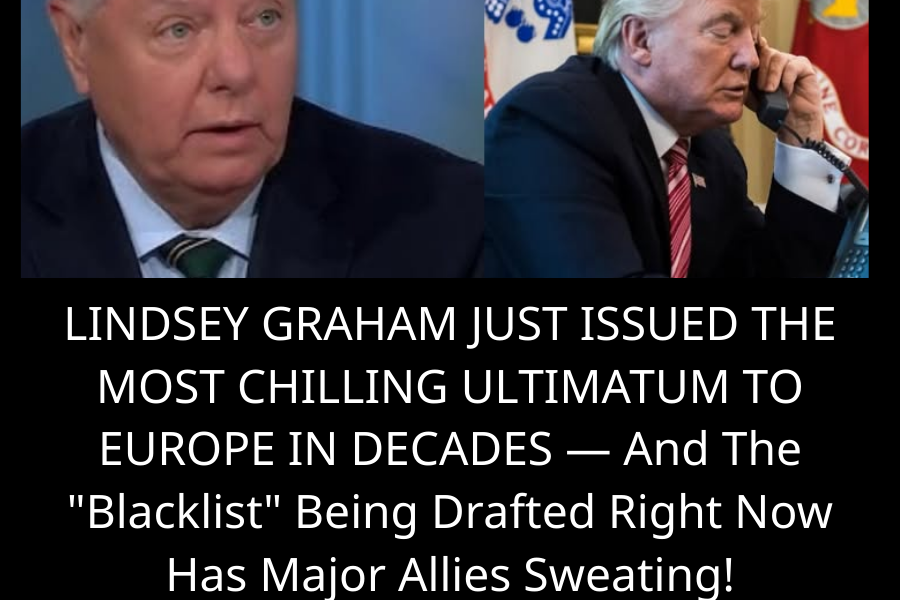
Let’s set the scene. A direct line between Senator Lindsey Graham and President Donald Trump. The topic: America’s European allies—the ones who have stood with us through NATO, through the Cold War, through decades of shared sacrifice—are now refusing to help secure the Strait of Hormuz.
Graham’s description of the call is chilling: “I have never heard him so angry in my life.”
And Graham shares that rage. Completely.
The stakes are not abstract. Iran threatened to close the Strait of Hormuz—the passageway for 20% of the world’s oil. A successful blockade would send energy prices into the stratosphere, cripple economies, and hand the ayatollahs a weapon more devastating than any missile. America acted, striking Iran’s Kharg Island oil terminal, crushing the threat before it could fully materialize.
And where were Europe’s navies? Where were the British, the French, the Germans? Where were the allies who have benefited from American protection for seventy years?
On the sidelines. Watching. Waiting. Letting America bleed alone.
The Graham Doctrine: “Beyond Offensive”
Graham’s statement is not diplomatic language. It is not the careful, calibrated rhetoric of a statesman trying to preserve alliances. It is the raw, unfiltered fury of a man who has spent his career defending those alliances, only to watch them crumble when tested.
“The arrogance of our allies to suggest that Iran with a nuclear weapon is of little concern and that military action to stop the ayatollah from acquiring a nuclear bomb is our problem not theirs is beyond offensive.”
Read that again. Beyond offensive. This is not a critique; it’s an indictment. Graham is saying that Europe has crossed a line from which there is no easy return.
The European approach to Iran has been decades of failure. The JCPOA—the nuclear deal that Obama championed and Europe celebrated—did not stop Iran’s nuclear program. It paused it, temporarily, while giving the regime billions in sanctions relief that funded terrorism across the region. When Trump withdrew, Europe complained. When Iran advanced its program, Europe wrung its hands. Now, when military action is required to prevent a nuclear-armed theocracy, Europe disappears.
The Strategic Reality: Who Needs the Strait?
Graham’s argument is grounded in a simple strategic reality: Europe needs the Strait of Hormuz far more than America does.
The United States is now a net oil exporter. We have energy independence. A disruption in the Strait would hurt us, yes, but it would not cripple us.
Europe, by contrast, is utterly dependent on imported energy. A sustained blockade would send its economies into a tailspin from which they might not recover. And yet, when America acts to keep the Strait open—to protect global energy supplies that Europe needs more than we do—the Europeans offer nothing.
This is not alliance. This is free-riding on an epic scale. This is Europe treating American blood and treasure as an infinite resource, to be spent protecting their interests while they preserve their own military capacity for… what? Peacekeeping missions? Photo ops?
The Rethink: Graham’s Admission
Perhaps the most significant line in Graham’s statement is the one that will haunt alliance advocates for years to come:
“I consider myself very forward-leaning on supporting alliances, however at a time of real testing like this, it makes me second guess the value of these alliances. I am certain I am not the only senator who feels this way.”
Lindsey Graham—the hawk, the interventionist, the man who has spent decades arguing for American engagement in the world—is saying aloud what many have thought privately: what is the point of allies who won’t fight?
This is not isolationism. This is not the America First movement’s rejection of globalism. This is a mainstream Republican senator, a defender of the alliance system, acknowledging that the system is broken. That the assumptions that guided American foreign policy for seventy years may no longer hold.
If Graham is rethinking alliances, the entire foreign policy establishment is in play.
The Trump Factor: Leadership That Delivers
Graham’s praise for Trump’s action is effusive: “necessary, bold and highly effective.”
The strikes on Kharg Island sent a message that the Trump administration has been sending since day one: America will not be threatened. America will not be blackmailed. America will act, unilaterally if necessary, to protect its interests and the stability of the global economy.
Trump’s decision to spare the oil infrastructure for now—while making clear that any interference in the Strait means consequences—is a classic Trump move. It’s calibrated escalation. It’s sending a message while leaving room for de-escalation. It’s the kind of strategic ambiguity that keeps adversaries guessing.
And it worked. Iran’s attempt to close the Strait was met with immediate, decisive force. The message to Tehran is clear: try it again, and the consequences will be catastrophic.
The European Betrayal: A Pattern of Failure
This is not an isolated incident. It is the latest in a long pattern of European abdication.
-
When Russia invaded Crimea, Europe dithered while America led.
-
When ISIS rose in Syria and Iraq, Europe contributed token forces while America did the heavy lifting.
-
When China challenged the international order, Europe continued trading while America pushed back.
-
Now, when Iran threatens global energy supplies, Europe sits on the sidelines.
At what point does a pattern become a principle? At what point do we stop being surprised and start adjusting our strategy accordingly?
Graham’s fury is not just about this moment. It’s about the accumulation of moments—decades of European free-riding, decades of American sacrifice, decades of allies who take our protection for granted while offering little in return.
The Way Forward: No More Free Rides
Graham’s message to Europe is clear: time to step up or step aside.
The “America First” approach to alliances is not isolationism. It’s reciprocity. It’s demanding that allies who benefit from American protection actually contribute to that protection. It’s recognizing that the post-World War II order, in which America bore the lion’s share of the burden while Europe rebuilt, is no longer sustainable.
Europe is wealthy. Europe is capable. Europe has militaries that, combined, rival America’s. The only thing Europe lacks is the will to use them. And that will, apparently, extends to letting America fight alone while they reap the benefits of our sacrifice.
Graham is right to be angry. Every American should be angry.
The Verdict: A Reckoning Long Overdue
Lindsey Graham’s blast at Europe is not just a statement. It’s a watershed. It marks the moment when even the most committed alliance advocates began to question whether the alliance is worth preserving.
The stakes could not be higher. Iran’s regime is dangerous, unstable, and determined to acquire nuclear weapons. The Strait of Hormuz is the jugular of the global economy. America acted decisively to protect both.
Europe did nothing.
If that pattern continues, the alliance will not survive. And based on Graham’s comments, the senators who will decide its fate are already rethinking their assumptions.
No more free rides. No more fair-weather friends. America First means America will protect its interests, with or without allies who refuse to fight. And if Europe wants to remain an ally, it will have to start acting like one.
The adults are back in charge. And the message to Tehran—and to Europe—is the same: don’t test us.