“Send Them Back”: The State of the Union Moment That Became a Constitutional Flashpoint
The Night the Chamber Became a Cage
February 2026. The House Chamber. The State of the Union. A ritual of American democracy where, for one night, the branches of government gather under gilded chandeliers to hear the president’s vision. Tradition demands decorum. History records the interruptions.
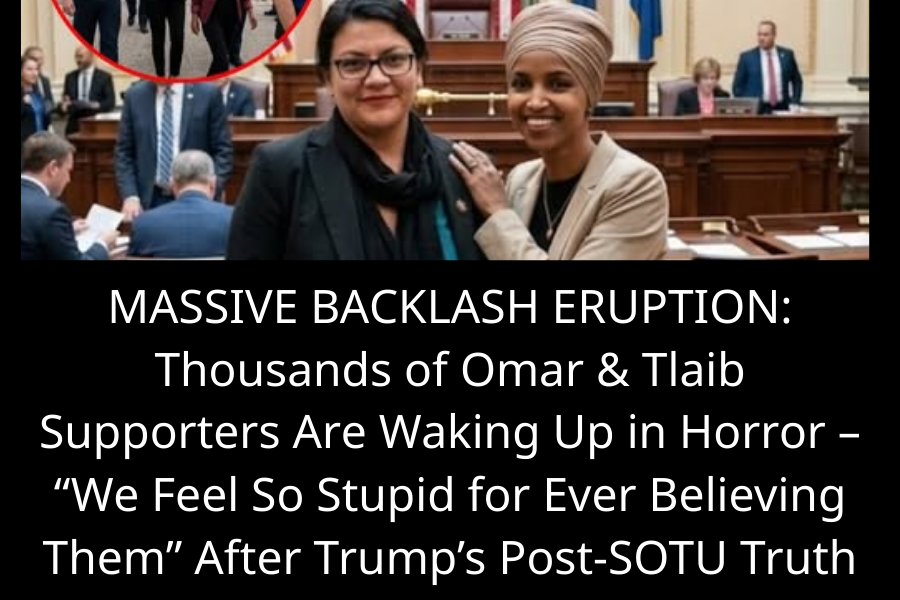
When President Donald Trump reached the section of his speech dedicated to immigration enforcement—celebrating the “ICE Cold Victory” in Minneapolis, praising the deployment of Tom Homan, touting the deportation numbers—the chamber fractured. From the Democratic side, voices rose in protest. Among them, two were unmistakable: Ilhan Omar of Minnesota and Rashida Tlaib of Michigan.
What followed was not a policy debate. It was a detonation.
Within hours, Trump took to Truth Social with a post that would eclipse the speech itself: a demand that the two representatives be “sent back from where they came.”
The words landed like a grenade in the middle of an already burning room. And suddenly, the State of the Union wasn’t about immigration policy or border security. It was about something far more fundamental: Who gets to be American?
The Constitutional Reality: Citizens, Not Guests
Before we analyze the politics, we must establish the facts—because the facts are not in dispute.
Ilhan Omar arrived in the United States as a refugee from Somalia in 1995, fleeing civil war. She became a naturalized U.S. citizen in 2000.
Rashida Tlaib was born in Detroit in 1976 to Palestinian immigrant parents. She is a natural-born U.S. citizen.
Both women were democratically elected to the United States Congress by the voters of their respective districts. They hold the same constitutional status as any member of that body: full citizenship, protected by the 14th Amendment, eligible for the highest offices in the land.
The president’s suggestion that they should be “sent back” is not just politically inflammatory. It is constitutionally impossible. There is no mechanism in American law to deport a naturalized or natural-born citizen. The very idea contradicts the foundational principle of birthright citizenship and the promise of naturalization that has defined American immigration for centuries.
Legal experts, as the summary notes, were quick to clarify this point. But in the arena of political rhetoric, constitutional clarity is often the first casualty.
The Critics: A Chorus of Condemnation
The reaction from Democratic leaders, civil rights organizations, and advocacy groups was swift and unified. The language was described in terms that have become distressingly familiar: “racially charged,” “inappropriate for a sitting president,” “a violation of the basic norms of civic discourse.”
But beneath the familiar outrage, a deeper critique emerged. This wasn’t just about two members of Congress. It was about the message sent to every immigrant, every naturalized citizen, every person of color who watches American politics and wonders whether their belonging is conditional.
When a president suggests that elected officials who displease him should be “sent back,” he is not just attacking individuals. He is attacking the principle that American citizenship is not a probationary status. He is implying that for some Americans—those who look, speak, or worship differently—full membership in the national community can be revoked based on political disagreement.
The critics argue that this is not merely rhetoric. It is a form of psychological violence that tells millions of Americans: You are never truly home here. You are always one political conflict away from being told to leave.
The Supporters: Decorum, Disruption, and the Politics of Confrontation
Trump’s supporters offer a different framing. In their view, the president’s remarks were not about citizenship status at all. They were about behavior and respect.
The State of the Union is a sacred civic ritual. To disrupt it with loud protests, they argue, is a breach of decorum that disrespects the office of the presidency and the institution of Congress. Omar and Tlaib, in this framing, were not exercising legitimate dissent; they were performing political theater designed to humiliate the president and energize their base.
The “send them back” comment, then, is seen not as a literal deportation demand, but as a rhetorical riposte—a way of saying: If you hate this country so much that you can’t even sit through its president’s speech without disrupting it, why are you here?
This framing ignores the constitutional reality, but it speaks to a powerful emotional current in American politics: the feeling among many Trump supporters that progressive Democrats, particularly those from marginalized backgrounds, are not loyal opposition but enemies within. The comment is less about law than about belonging. It says: You don’t share our values. You don’t respect our traditions. You are not really one of us.
The Larger Debate: Who Gets to Define “American”?
This incident is not an isolated moment. It is the latest eruption in a decades-long conflict over the very definition of American identity.
One vision sees America as a creedal nation, bound not by blood or religion but by commitment to constitutional principles. In this view, anyone who becomes a citizen—whether by birth or naturalization—is fully American, with all the rights and protections that status entails. Omar and Tlaib are not “Somalian” or “Palestinian” Americans; they are Americans, period. Their ancestry is irrelevant to their constitutional standing.
Another vision sees America as a cultural and ethnic nation, rooted in European traditions, Judeo-Christian values, and a particular historical experience. In this view, citizenship is a legal status, but full belonging requires something more—assimilation, loyalty tests, perhaps even ancestry. People who visibly challenge the dominant culture, who advocate for radically different policies, who maintain ties to their countries of origin, are never fully accepted. They are always, in some sense, “from somewhere else.”
Trump’s comment activates this second vision. It doesn’t matter that Omar and Tlaib are citizens. In the eyes of those who share this worldview, they are not really American. They are intruders who have somehow gained access to the levers of power and are now using that power to destroy the country from within.
The Polarization Spiral: Why This Moment Matters
The summary correctly notes that incidents like this dominate headlines because they reflect larger debates. But they also deepen those debates. Each eruption makes the next one more likely, more intense, more damaging.
For Trump’s opponents, this moment confirms everything they believe about him: that he is a racist, that he disrespects the rule of law, that he seeks to divide the country along ethnic and religious lines. His comment becomes evidence of a deeper rot in American politics.
For Trump’s supporters, the outrage of his critics confirms everything they believe: that the left is hypersensitive, that they weaponize accusations of racism to silence dissent, that they defend bad behavior by their own side while condemning any response as bigotry.
And for Omar and Tlaib themselves? They become symbols—martyrs to one side, villains to the other. Their humanity, their service, their status as elected representatives of the American people, gets lost in the symbolic war.
The Verdict: A Country Asking Itself an Uncomfortable Question
The State of the Union is supposed to be the night when Americans come together, if only for an hour, to hear their president and consider their shared future. In 2026, it became something else: a mirror reflecting a country that cannot agree on its own identity.
Trump’s comment—and the reaction to it—forces every American to answer a question they would rather avoid: What does it mean to be American? Is it a legal status, protected by the Constitution, available to anyone who meets the requirements? Or is it something more—a cultural identity, a set of values, a way of life that can be claimed by some but not others?
The answer determines whether Omar and Tlaib are simply members of Congress with whom one disagrees, or whether they are something else—foreigners in a foreign land, accidentally granted power they should never have.
Until America answers that question, moments like this will keep happening. And each time, the answer will seem further away.