The Goalkeeper’s Gamble: Trump, Iran’s Women, and the Geopolitics of a Silent Anthem
The Image That Traveled the World
Before we get to the politics, let’s freeze a single frame.
An Iranian women’s soccer team, standing in rigid formation on Australian soil. The stadium is silent, waiting for the familiar notes of their homeland’s anthem. But the music plays to empty lips. Not a single player sings. Their faces are masks of controlled defiance, eyes forward, jaws tight. They have just performed an act of breathtaking courage: a collective, non-verbal declaration that the regime they represent does not speak for them.
That image—eleven women risking everything by refusing to honor the symbols of their government—is now the backdrop for an extraordinary geopolitical intervention.
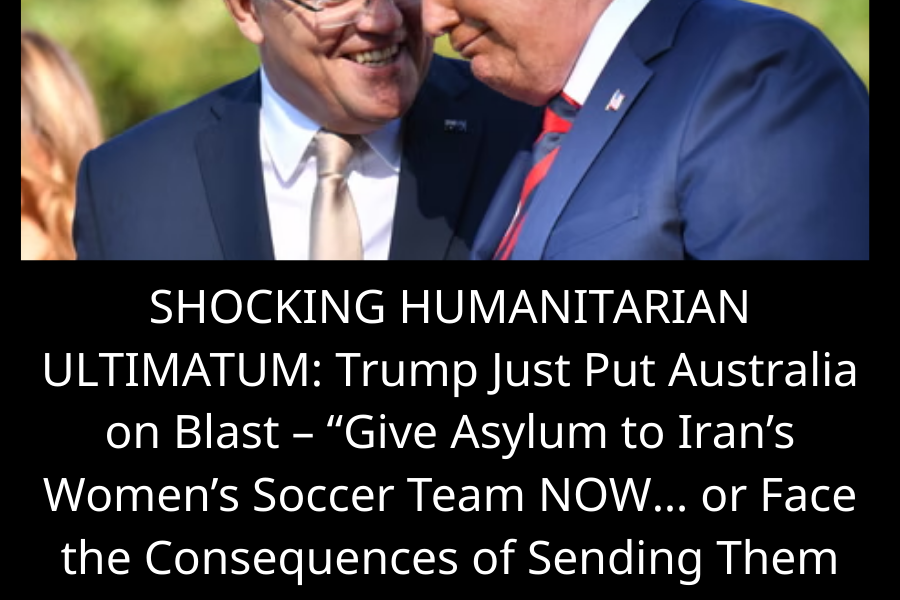
President Donald J. Trump has entered the arena. His message to Australian Prime Minister Anthony Albanese is direct, urgent, and characteristically Trumpian: grant these women asylum, or the United States will.
“The U.S. will take them if you won’t. Australia is making a terrible humanitarian mistake by allowing the Iran National Woman’s Soccer team to be forced back to Iran, where they will most likely be killed. Don’t do it, Mr. Prime Minister, give ASYLUM.”
It’s a statement that defies easy categorization. Is it humanitarian intervention? Political theater? A diplomatic grenade tossed at a key ally? Or all three, wrapped in the flag and delivered at volume?
Decoding the Silent Protest: What the Players Risked
To understand the weight of Trump’s intervention, you must first understand what these women actually did.
In the Islamic Republic of Iran, women’s sports exist in a constant state of negotiation with state power. Female athletes are expected to embody the regime’s values: modesty, obedience, loyalty. The national anthem is not just a song; it is a pledge of allegiance to the system that mandates hijab, enforces segregation, and criminalizes dissent.
Refusing to sing it—especially on foreign soil, under international gaze—is an act of profound personal and political risk. These women knew, as they stood in silence, that their careers, their families, and possibly their lives were now in jeopardy. They were broadcasting a message to the world that the regime could not control, but that message came with a price tag measured in freedom and safety.
Upon return to Iran, they would face interrogation, likely bans from competition, potentially imprisonment, and in the worst-case scenario, the kind of “disappearances” that have haunted Iranian dissidents for decades. The Iranian government does not forgive public embarrassment.
Trump’s Calculus: Why This, Why Now?
Trump’s intervention is not random. It is a strategic move on multiple chessboards simultaneously.
1. The Humanitarian High Ground: By positioning himself as the defender of endangered women athletes, Trump occupies moral territory usually claimed by progressives and human rights organizations. It’s a savvy rebranding—the “America First” president suddenly acting as the world’s asylum-giver. It complicates the narrative that his administration is indifferent to humanitarian crises.
2. The Pressure on Australia: The message is framed as an appeal, but the subtext is unmistakable: You’re about to send these women to their deaths. We’re watching. History is watching. This puts Prime Minister Albanese in an impossible position. Refusing asylum makes Australia complicit in potential tragedy. Granting it strains relations with Iran. Either way, Trump has made himself the protagonist in a story Australia would prefer to handle quietly.
3. The Iran Strategy: The Trump administration’s posture toward Iran has been defined by “maximum pressure”—sanctions, military posturing, and rhetorical warfare. This move is a new front in that campaign: soft-power humiliation. By publicly championing Iranian dissidents, Trump amplifies the regime’s greatest vulnerability—its brutal treatment of its own people, especially women. It’s a message to every Iranian watching: The American president sees you. He stands with you. Your government fears him.
4. The Domestic Politics: For a base that values strength and American exceptionalism, this is a perfect story. The president isn’t just talking tough; he’s offering safe harbor to the oppressed. It’s Reagan at the Berlin Wall, updated for the soccer pitch. It’s also a subtle rebuke to the “America alone” critique—here, America is the refuge.
The Australian Dilemma: Caught Between Allies
For Canberra, this is a nightmare scenario.
Prime Minister Albanese now faces a choice with no clean options:
-
Grant Asylum: This would be a humanitarian victory, but it would enrage Tehran, potentially trigger diplomatic retaliation, and set a precedent that could encourage more asylum seekers to use Australia as a gateway. It also means accepting Trump’s framing—that Australia needed his intervention to do the right thing.
-
Deny Asylum and Deport: This risks international condemnation and the moral weight of potentially sending women to imprisonment or death. It also hands Trump the cudgel: “I warned them. They didn’t listen.”
-
Delay and Negotiate: Try to find a third-country solution that spreads the responsibility. But time is short, and the women are in limbo.
The irony is thick: Australia, which has one of the world’s toughest immigration and asylum policies, is being lectured on humanitarian obligations by a president whose own border policies have been the subject of global criticism. But in politics, irony is irrelevant. Power is all that matters.
The Legal and Logistical Reality
Trump’s offer—”The U.S. will take them if you won’t”—sounds simple. It is not.
Granting asylum to the entire team would require:
-
Vetting: The U.S. cannot simply accept a group of foreign nationals without background checks, even in a humanitarian crisis. This takes time.
-
Legal Authority: The president has broad powers on humanitarian parole, but using them for a high-profile case like this invites scrutiny and potential legal challenge.
-
Logistics: Transport, housing, resettlement—these are not instantaneous. The women would need temporary refuge while their cases are processed.
-
Reciprocal Fallout: Iran would likely retaliate—perhaps by expelling diplomats, escalating in the region, or cracking down even harder on domestic dissent.
None of this is impossible. But it’s not a handshake deal. It’s a months-long process wrapped in geopolitics.
The Broader Message to Iran’s Women
Perhaps the most significant audience for Trump’s statement is not in Washington or Canberra, but in Tehran, Isfahan, and Shiraz.
Iranian women have been at the forefront of resistance to the regime for years. The “Woman, Life, Freedom” movement, sparked by the death of Mahsa Amini in 2022, has never truly died. It has been suppressed, but not extinguished.
When the American president publicly offers asylum to Iranian women athletes, it sends a signal to every woman in Iran who dreams of freedom: You are seen. You have allies. There is a way out.
This is soft power at its most potent—not bombs or sanctions, but the simple promise of refuge. It tells the regime that its brutality has witnesses, and that those witnesses have power.
The Verdict: A Masterstroke or a Mirage?
Trump’s intervention is, by any measure, a political masterstroke. It frames him as a humanitarian, pressures an ally, embarrasses an adversary, and speaks directly to a global audience of women fighting for freedom.
But masterstrokes require follow-through. If the women are returned to Iran and harmed, Trump’s words become hollow—a performance without substance. If Australia grants asylum, Trump can claim credit for forcing the issue. If the U.S. actually takes them, the administration must deliver on its promise swiftly and safely.
The Iranian Women’s Soccer Team did not ask to become symbols. They did not seek to be pawns in a geopolitical game. They simply stood in silence, refusing to sing for a regime they do not believe in. That act of courage has now ricocheted around the world, landing in the Oval Office and forcing a decision from a reluctant ally.
Whatever happens next, one thing is certain: the world is watching. And in that watching, the women have already won something the regime cannot take away. They have shown that Iran’s government does not speak for all its people. And that truth, once spoken, can never be unsung.