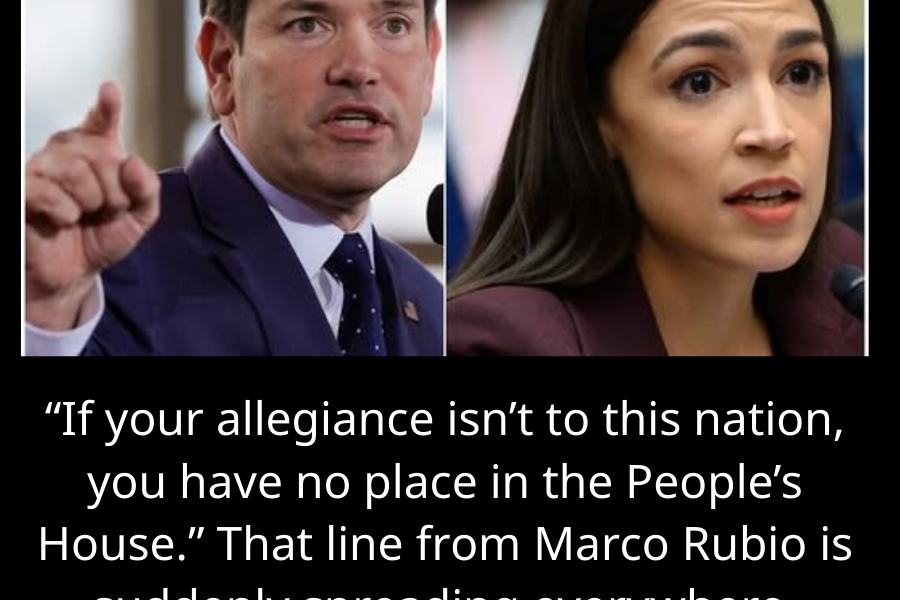
“No Flags But Ours”: Rubio’s Explosive Demand for Expulsion Shakes Congress
The Moment That Stopped C-SPAN
Let’s set the scene, because the imagery matters as much as the words.
The U.S. Senate floor. C-SPAN cameras rolling. Marco Rubio, Florida Republican, standing at his desk, voice rising, finger pointing—not at an empty chamber, but directly at the gallery where members of “the Squad” are reportedly watching.
“If your allegiance isn’t to this nation, you have no place in the People’s House!”
The words echo off the marble. Staffers freeze. Senators who were scrolling through phones look up. In the gallery, according to witnesses, members of the progressive caucus—Ilhan Omar, Rashida Tlaib, Alexandria Ocasio-Cortez—sit in stunned silence.
Rubio isn’t finished. He names them. Not by name, but by category: “The Squad.” He accuses them of “selling out America” to foreign interests. And then comes the demand that transforms a speech into a constitutional crisis:
“Fourteen naturalized lawmakers have shown us who they serve. It’s time to show them the door. Expel them. Now.”
The chamber erupts. Procedural rules are forgotten. Senators from both parties are on their feet, some cheering, some shouting objections. The presiding officer pounds the gavel. It doesn’t matter. The moment has already escaped the room.
The Rubio Doctrine: Allegiance as the Price of Admission
Rubio’s argument, stripped of the rhetorical flourishes, is simple and devastating: If you hold dual loyalties, you cannot hold a single office.
He doesn’t name the 14 specifically, but the target is clear: every naturalized citizen in Congress whose votes, statements, or affiliations have, in his view, demonstrated primary allegiance to something other than the United States.
The list, according to conservative media, includes:
-
Ilhan Omar (D-Minn.) – Somali-born, accused of downplaying 9/11, defending Somalia’s interests, and allegedly committing marriage fraud to enter the country.
-
Rashida Tlaib (D-Mich.) – Palestinian-American, accused of antisemitic rhetoric and defending Hamas after October 7.
-
Others whose votes on Israel, immigration, and foreign policy have drawn scrutiny.
Rubio’s constitutional argument rests on Article I, Section 5, which gives each house the power to “punish its Members for disorderly Behaviour, and, with the Concurrence of two thirds, expel a Member.” He argues that “disorderly behaviour” includes actions that demonstrate allegiance to foreign powers—voting against U.S. interests, defending foreign adversaries, and using office to advance the agendas of other nations.
The Constitutional Question: Can Congress Expel for Disloyalty?
The Constitution is clear on expulsion: it requires a two-thirds vote. It is not clear on what constitutes grounds for expulsion. Historically, it has been used for corruption, bribery, and treason—but treason is narrowly defined as “levying war against [the United States] or adhering to their Enemies, giving them Aid and Comfort.”
Does voting against Israel aid count as “aiding enemies”? Does criticizing U.S. foreign policy count as “adhering to enemies”? Does defending the rights of Palestinians count as treason?
Rubio’s critics will argue that he’s conflating policy disagreement with disloyalty—that questioning U.S. support for Israel is not the same as supporting Hamas, that defending immigrants is not the same as undermining the country. They will argue that Rubio is using the language of expulsion to silence political opposition.
Rubio’s supporters will argue that there is a line between disagreement and disloyalty, and that these members have crossed it repeatedly. When Omar refers to 9/11 as “some people did something,” when Tlaib chants “from the river to the sea,” when naturalized lawmakers use their offices to advance the interests of countries hostile to the United States—that is not policy. That is betrayal.
The Squad’s Response: Defiance and Victimhood
The response from the targeted members was predictably fierce.
AOC, speaking to reporters after Rubio’s speech: “This is what fascism looks like. They can’t win elections, so they try to expel their opponents. They can’t defeat our ideas, so they try to silence our voices.”
Ilhan Omar, in a statement: “Marco Rubio is the son of Cuban immigrants. Does he think his parents should be expelled too? This is about one thing and one thing only: silencing those of us who refuse to bow to the establishment.”
Rashida Tlaib, on social media: “They want us gone because we represent the future. We’re not going anywhere.”
The Squad’s defense is twofold: first, that the expulsion effort is unconstitutional and authoritarian; second, that it’s racist—an attack on naturalized citizens specifically, on immigrants generally, and on anyone who doesn’t fit the white, Christian, conservative mold of “real America.”
The Republican Divide: Unity or Caution?
Not all Republicans are rushing to join Rubio’s crusade.
Senate Minority Leader Mitch McConnell, in a carefully worded statement: “Expulsion is the most serious action the Senate can take. It should be reserved for the most serious offenses. I trust my colleagues to evaluate the evidence and make their own determinations.”
Translation: Let’s not start a war we might lose.
Senator Thom Tillis (R-N.C.), a key swing vote: “I need to see specific evidence of illegal conduct, not just policy disagreements. If there’s evidence of actual crimes—conspiring with foreign powers, accepting illegal payments, something prosecutable—then we can talk. But policy differences aren’t grounds for expulsion.”
The divide is real. Some Republicans see Rubio’s move as political genius—forcing Democrats to defend members who are genuinely unpopular in many districts. Others see it as a bridge too far—a dangerous precedent that could one day be used against them.
The Historical Precedent: Expulsion in American History
Only 20 members of Congress have ever been expelled. Fifteen were expelled in 1861 for supporting the Confederacy—the clearest case of “adhering to enemies” in American history. The others were expelled for corruption: bribery, fraud, and in one case, conviction for assault.
No member has ever been expelled for speech alone. No member has ever been expelled for policy disagreements. No member has ever been expelled for being a naturalized citizen.
Rubio’s proposal would break that precedent. It would establish that Congress can expel members whose views are deemed insufficiently patriotic. It would make every member’s voting record subject to a loyalty test.
Supporters say that’s exactly what’s needed. When members openly sympathize with terrorists, when they defend regimes that chant “Death to America,” when they use their offices to undermine U.S. allies—that’s not speech, it’s sabotage. And sabotage has consequences.
The Practical Reality: Two-Thirds Is a Fantasy
Even if Rubio’s motion were to proceed, the math is impossible.
Two-thirds of the Senate is 67 votes. There are 53 Republicans. To reach 67, Rubio would need every Republican plus 14 Democrats. Not a single Democrat will vote to expel Omar, Tlaib, or any other member of the Squad. It’s not going to happen.
So why do it?
Because this is not about winning a vote. It’s about winning an argument. It’s about putting every Democrat on record defending members who are, in the eyes of millions of Americans, clearly disloyal. It’s about forcing the country to watch as Democrats protect people who chant for intifada and dismiss 9/11.
Rubio knows the expulsion will fail. But the debate itself is the point. Every hour of C-SPAN coverage, every news cycle dominated by the question of loyalty, every Democratic defense of Omar and Tlaib—it all reinforces the message that the left has abandoned America.
The Verdict: A Political Earthquake With No Aftermath
Marco Rubio just did something unprecedented: he called for the expulsion of 14 sitting members of Congress based on their allegiance, not their crimes. He named naturalized citizens specifically. He drew a line in the sand and dared the country to cross it.
The expulsion will fail. The members will keep their seats. The debate will rage on.
But something has shifted. The question of loyalty—of whose interests elected officials actually serve—is now front and center in American politics. It’s not just about policy anymore. It’s about identity, allegiance, and the very definition of what it means to be American.
Rubio has forced a conversation the country has avoided for decades. And whether you agree with him or not, that conversation was inevitable. The only question now is where it leads.