The Blue Stain Theory: What If Your Right to Bear Arms Was Harder Than Your Right to Vote?
Scroll down. Keep scrolling. You’ll hit a comment eventually that stops you cold. It’s buried under 47 reactions, hidden beneath the usual keyboard warfare, but it’s there.
“In Michigan you have to prove who you are and pay a tax for a cpl, one of our most important rights. Why is there a fight against voter ID? If voting was held to the same standard as many gun purchases/ permits it would be secure.”
11 hours ago. 23 likes. Zero drama.
But this comment isn’t really about guns. And it’s not really about IDs.
It’s about the one question American politics has spent thirty years successfully gaslighting you into never asking:
What exactly are we so afraid of?
The Robinson Paradox
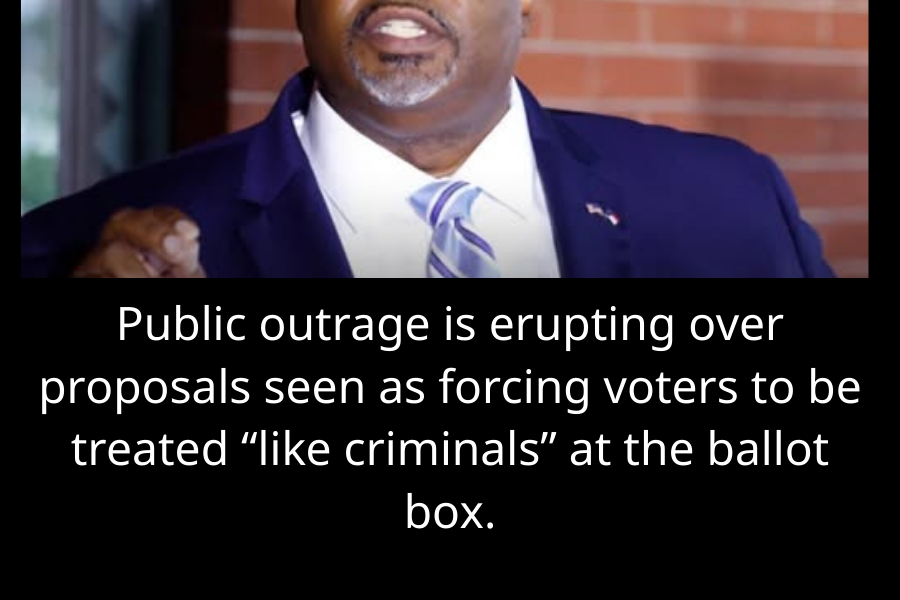
Let’s start with the headline that baited you here. Mark Robinson, Lieutenant Governor of North Carolina, once dropped a quote so spicy it lives rent-free in political discourse:
“If dead people and illegals were voting for Republicans, Democrats would not only want voter ID, they would also want fingerprints, an eye scan, and a DNA sample.”
The internet meme-ified it. The wording got tightened. The point got sharper.
But here’s what nobody talks about: Robinson wasn’t making an argument about fraud. He was making an argument about fear.
He was asking you to imagine a parallel America—a bizarro world where the corpses and the undocumented mysteriously always broke red. A world where every stolen election benefited the GOP.
Now ask yourself honestly: In that America, would Mitch McConnell be filibustering voter ID laws? Would Fox News run segments calling them “modern-day poll taxes”?
Or would we have facial recognition terminals at every precinct before you could say “election integrity”?
The question isn’t whether the roles could reverse. The question is why the reaction would be so different if they did.
The Thing You Have to Show
Chad Hall—the Michigan commenter—didn’t mean to drop a philosophical bomb. He was just frustrated.
He had to prove who he was to carry a firearm. Had to pay a tax. Had to wait. Had to justify to the state why he should be allowed to exercise a right explicitly protected by “shall not be infringed.”
And yet, for another right—one arguably more foundational to the entire American experiment—showing a piece of paper with your name on it is suddenly “Jim Crow 2.0.”
Let that dissonance sit with you for a second.
If you want a library card, you need ID.
If you want to buy Sudafed, you need ID.
If you want to board a plane, cash a check, or literally exist in the modern economy, you need ID.
But voting? The mechanism by which we decide who controls nuclear weapons, who sets tax policy, who appoints Supreme Court justices?
“That,” they tell us, “must remain accessible above all else.”
The question nobody wants to answer: Accessible to whom?
The Volunteer Army
Then comes John Thomas. His comment is short. Eight minutes old when you screenshot it. Probably thought nobody would notice.
“I would be willing to get my finger dipped in blue stain, eye scan, and DNA test to vote.”
He’s joking. Mostly.
But the joke reveals something uncomfortable about the people who do oppose voter ID. They frame the debate around “barriers” and “suppression.” They talk about the elderly, the poor, the marginalized who might struggle to obtain documentation.
What they don’t talk about is the army of people like John Thomas—ordinary citizens who would happily submit to a retina scan and a genetic profile just to cast a ballot, because they understand something the political class refuses to admit:
The inconvenience of proving who you are is a tax you pay for the legitimacy of the system.
And right now, 40% of the country doesn’t believe the system is legitimate.
You know what destroys democracy faster than a voter ID law? An election where half the population thinks the other half cheated.
The Passport Loophole
Jon Canete offers the solution the media won’t touch:
“People don’t need a voter id. A passport will do.”
He’s right. A passport is ID. A driver’s license is ID. A military ID is ID. A tribal ID is ID.
The fight was never about whether identification exists. It was about whether the requirement exists.
And this is where the logic collapses into pure tribal signaling.
If you’re a Democrat in 2024, opposing voter ID is a loyalty test. It signals that you care about turnout more than verification. It signals that you trust the current system because it elected your people.
If you’re a Republican, demanding voter ID is a loyalty test. It signals that you suspect fraud because your people keep losing. It signals that you trust the process only when you win.
Both sides are arguing about election security.
Neither side is arguing about election trust.
The Twins Get Paid
Then there’s Glenn. Glenn R Shackelford. Two hours old. Cryptic.
“I see the twins are getting paid again.”
Samantha Faine Beckett, three hours earlier: “You know it!”
What twins? Paid by whom?
This is the part of the comment section that terrifies the architects of our current discourse. Because buried under the policy debates, beneath the constitutional arguments, underneath the historical analogies to Jim Crow, there’s a growing number of Americans who believe the entire thing is a scripted performance.
They watch the talking points get distributed. They watch the outrage get manufactured. They watch the “twins”—the parallel commentators on opposite sides—earn their checks by generating conflict that keeps the algorithm engaged and the population divided.
And they laugh. Because what else can you do?
Glenn isn’t arguing about voter ID. He’s arguing that you’re arguing about voter ID while the real decisions get made in rooms with no cameras.
The Snow Shovel Standard
Gordon DeMoss closes the thread with a mic drop so quiet you almost miss it:
“Dont forget 2 forms of id to scoop snow lol”
He’s talking about something that happened in Chicago a few years back. The city required contractors to show two forms of ID and pass a background check to shovel snow for the city.
Two forms of ID.
To move snow.
And we’re having a national nervous breakdown about requiring one form of ID to decide the future of the republic.
The Question Nobody Will Answer
So let’s go back to Robinson’s hypothetical. That parallel universe where the corpses vote red.
Would the rules change?
Of course they would. Within a week. With bipartisan support. Wrapped in flags and called the “Save Our Democracy Act.”
And that’s the part that should keep you up at night.
Not whether voter ID is racist. Not whether fraud is real. Not whether the 1965 Voting Rights Act was the high watermark of civilization.
But why the rules depend entirely on who the rules hurt.
If election integrity is a principle, it shouldn’t flip with the electoral map. If voter access is a sacred value, it shouldn’t depend on which party benefits from the access.
The comments under that post—the ones about CPLs and passports and snow shovels and twins getting paid—they’re all pointing at the same uncomfortable truth:
We don’t have an election integrity crisis.
We don’t have a voter suppression crisis.
We have a legitimacy crisis.
And until we can answer why a country that requires ID to buy cold medicine can’t require ID to buy a future, the 40% who don’t trust the results won’t get smaller.
They’ll get louder.
And at some point, the people who laughed at the twins getting paid won’t be laughing anymore.
They’ll be doing something else.
Something that doesn’t require an ID at all.