The 76-Ton Message: Why Rubio’s Somalia Cutoff Is Long Overdue
The Scene That Should Make Every American Angry
Let’s visualize what happened, because numbers alone don’t capture the outrage.
76 tons of American food. Paid for by American taxpayers. Grown by American farmers. Shipped across the world at American expense. Destined for starving women and children in one of the most desperate places on Earth.
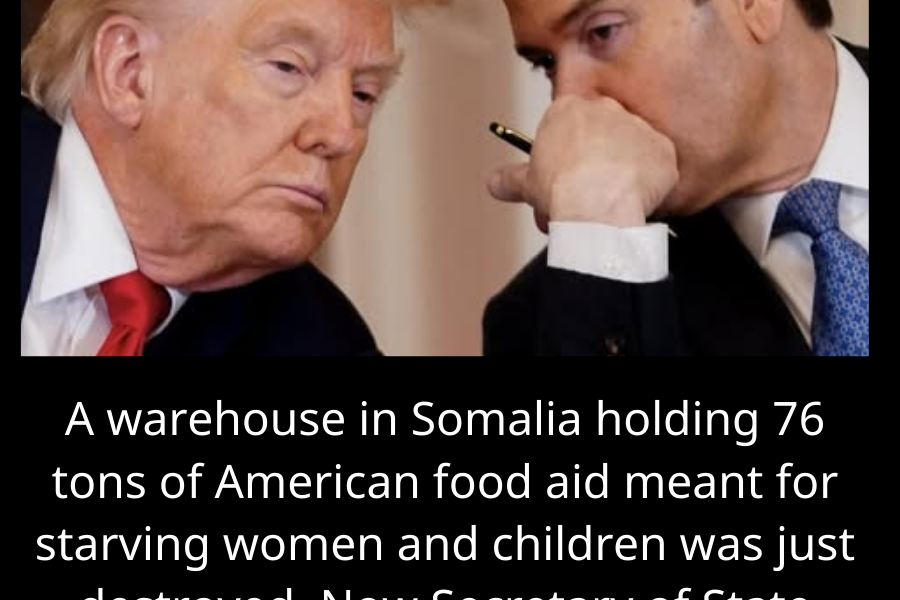
And then, in a moment of bureaucratic indifference or outright hostility, the Somali government demolished the warehouse where it was stored. Not redistributed. Not delivered. Destroyed. Wiped out. Gone.
The food that could have fed thousands is now rotting in a rubble pile. The money that could have helped American veterans, American families, American communities is now a pile of debris in a country that clearly doesn’t value it.
And the question every taxpayer should be asking is simple: Why did it take this long to stop?
Rubio’s Response: Accountability Arrives
Secretary of State Marco Rubio didn’t hesitate. His decision to permanently cut off U.S. aid to Somalia is the kind of swift, decisive action that has been missing from American foreign policy for decades.
No more warnings. No more diplomatic notes. No more “we’ll review our partnership” language that means nothing and changes nothing. Cut off. Permanent. Done.
The message is unmistakable: America’s generosity is not infinite. It is not unconditional. It is not a blank check for governments to do whatever they want with our resources. When you destroy aid meant for your own people, you forfeit the right to receive it.
This is not cruelty. This is basic accountability. Any parent understands it. Any business owner understands it. Any person who has ever given something of value only to see it wasted understands it. You don’t keep giving to someone who throws your gifts in the trash.
The Old System: Endless Handouts, No Consequences
For decades, American foreign aid operated on a simple principle: give and keep giving, no matter what.
Corrupt regimes stole aid? We gave more. Incompetent governments mismanaged resources? We gave more. Countries that publicly denounced America while privately taking our money? We gave more. The logic was that cutting off aid would hurt the people, not the governments—so we kept the spigot open while the governments laughed all the way to the bank.
Somalia is the perfect example of this failed approach. Year after year, American food and money flowed into a country with no functioning central government, rampant corruption, and active terrorist groups. Some of it reached the needy. Much of it didn’t. And now, with the warehouse demolition, we have proof that even when aid arrived safely, it could be destroyed on a whim.
The old system wasn’t just inefficient. It was actively harmful. It created dependency without accountability. It rewarded bad behavior. It taught recipient nations that America would keep paying no matter what they did.
Rubio’s decision breaks that cycle.
The Argument Against: What the Critics Will Say
The critics will have their talking points ready:
-
“Cutting off aid punishes the innocent, not the guilty.”
-
“Starving children will suffer because of a government’s mistake.”
-
“This is heartless and cruel.”
-
“America has a moral obligation to help the desperate.”
Let’s address each one directly.
“Punishing the innocent.” This assumes that continuing to send aid into a broken system actually helps the innocent. Does it? If the government destroys warehouses, if corruption steals shipments, if terrorists divert supplies—then the aid isn’t reaching the innocent anyway. It’s reaching the corrupt, the powerful, the connected. Cutting it off doesn’t change the outcome for the truly needy; it just stops enriching the people who exploit them.
“Starving children will suffer.” They’re already suffering. The aid wasn’t reaching them. The warehouse destruction proves that. The choice isn’t between aid and no aid; it’s between sending food into a black hole and demanding accountability before resuming support. Rubio is choosing the latter.
“Heartless and cruel.” What’s heartless is continuing a system that has failed for decades while pretending it’s compassionate. What’s cruel is watching aid get destroyed while the people who need it go hungry. Rubio’s decision is not cruelty; it’s the only honest response to a system that doesn’t work.
“Moral obligation.” America’s first moral obligation is to its own citizens—the taxpayers who fund this aid. They have a right to expect that their money will be used as intended. When it’s not, the obligation shifts: we are obligated to stop the waste, not perpetuate it.
The America First Principle: Why This Matters at Home
The broader argument here is one that resonates far beyond Somalia. It’s about where American money goes and who benefits.
Every dollar sent overseas is a dollar that could have been spent at home. On veterans sleeping on the streets. On crumbling infrastructure. On border security. On American families struggling to put food on their own tables. The billions spent on foreign aid are not free; they come out of the pockets of American workers.
The “America First” philosophy doesn’t mean abandoning the world. It means recognizing that charity begins at home. It means demanding that foreign aid serve American interests, not just American guilt. It means holding recipients accountable for results, not just promises.
Somalia’s warehouse destruction is a perfect case study. The aid wasn’t advancing American interests. It wasn’t building goodwill. It wasn’t even feeding the hungry. It was just… gone. Destroyed. Wasted.
Rubio’s decision to stop the waste is not just about Somalia. It’s about changing the entire mindset behind foreign aid. From unconditional to conditional. From endless to accountable. From “give because we feel guilty” to “give because it works.”
The Comment Section: Where America Speaks
The response to Rubio’s decision will be overwhelmingly positive among those who have been watching this disaster unfold:
-
“Finally! Someone in Washington with a backbone.”
-
“Send that food to our own hungry veterans instead.”
-
“Somalia just destroyed the last chance they’ll ever get.”
-
“This is what accountability looks like.”
-
“Now do every other country that’s been taking advantage of us.”
There will be critics, of course—the usual voices who believe America has an infinite obligation to the world, no matter how we’re treated. But they’re losing the argument. The public is tired of seeing their money wasted. They’re tired of being told that any criticism of foreign aid is heartless. They’re tired of watching warehouses get destroyed while their own communities struggle.
The Verdict: A Necessary Lesson in Accountability
Marco Rubio has done something rare in Washington: he’s taken a clear, decisive stand that puts American taxpayers first. The decision to permanently cut off aid to Somalia after the warehouse destruction is not just policy; it’s a principle.
The principle is simple: respect our generosity or lose it. Take our aid seriously or receive none at all. Treat American taxpayers with dignity or don’t expect their money.
Somalia made its choice. They chose to destroy 76 tons of food that could have saved lives. Now America makes its choice: we choose to stop sending food into a void.
The children who needed that food deserved better. But so did the American taxpayers who paid for it. Rubio’s decision honors both—by demanding that aid actually work, and by refusing to participate in a system that has clearly failed.
No more blank checks. No more ingratitude. No more waste.
Accountability starts now. And it starts in Somalia.