The De Niro Doctrine: When Hollywood Wages War with Words
The Man Behind the Microphone
Let’s start with who Robert De Niro is, because his biography is the subtext of every syllable.
Two Oscars. Raging Bull. Taxi Driver. The Godfather Part II. Goodfellas. Casino. The man is not just an actor; he’s an institution. He’s the face of American cinema’s golden age, the embodiment of gritty, uncompromising artistry. When he speaks, people listen—not because he’s a policy expert, but because he has spent fifty years earning the cultural authority to be heard.
And what he said about Donald Trump is not a critique. It’s not an analysis. It’s an excoriation—a verbal evisceration delivered with the same intensity he brought to his most iconic roles.
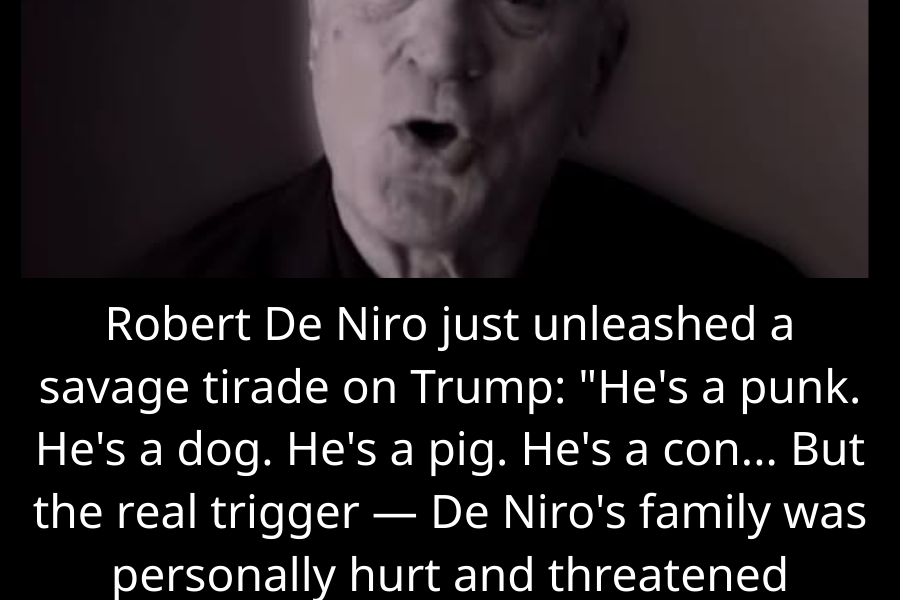
“He’s a punk. He’s a dog. He’s a pig. He’s a con. A bullshit artist. A mutt who does not know what he’s talking about. Doesn’t do his homework. Doesn’t care. Doesn’t pay his taxes. He’s an idiot.”
This is not the language of political debate. This is the language of a man who has run out of patience, who has abandoned any pretense of civility, who is speaking directly from the gut.
The Rhetoric: A Dissection of De Niro’s Fury
Let’s break down what De Niro actually did here, because the structure of his attack is as revealing as its content.
The Animal Metaphors: “Punk,” “dog,” “pig,” “mutt.” This is dehumanizing language—the kind of rhetoric usually reserved for enemies, not political opponents. By refusing to grant Trump human status, De Niro is signaling that he considers him beyond the pale of normal discourse.
The Professional Indictment: “Doesn’t do his homework. Doesn’t care. Doesn’t pay his taxes.” These are specific, actionable accusations. Whether true or not, they ground the emotional attack in claims about Trump’s character and competence.
The Final Verdict: “He’s an idiot.” After all the buildup, after all the metaphors and accusations, De Niro lands on the simplest possible conclusion. Not evil. Not dangerous. Stupid. In some ways, that’s the most devastating blow of all.
The Context: A History of Hostility
De Niro’s comments did not emerge from a vacuum. He has been one of Trump’s most consistent and vocal critics for nearly a decade.
At the 2018 Tony Awards, he erupted with a simple, profane message: “Fuck Trump.” The audience gasped, then applauded. The moment became legendary—a flashpoint in the culture war between Hollywood and the White House.
He has produced anti-Trump ads. He has campaigned for Democrats. He has used every platform available to him to voice his contempt. This latest outburst is not a departure; it’s a continuation. It’s the same message, delivered with the same fury, aimed at the same target.
The Reaction: Cheers and Condemnations
The responses to De Niro’s comments follow the familiar fault lines.
To his supporters, he’s a hero—a truth-teller who refuses to sanitize his contempt, who speaks for millions of Americans who feel the same way but lack his platform. They see his language not as excessive but as appropriate to the moment. When democracy itself is at stake, they argue, civility is a luxury we cannot afford.
To his critics, he’s an elitist—a wealthy celebrity who has never known a day of real struggle, lecturing the country from his penthouse. They see his language as proof that the left has lost its mind, that it can no longer engage in rational debate, that it has descended into pure hatred.
To the Trump camp, he’s a gift—a living embodiment of everything their base despises about Hollywood, about coastal elites, about the cultural establishment. Every time De Niro opens his mouth, Trump gains a thousand votes in the heartland.
The Question of Effectiveness: Does Any of This Matter?
The debate over De Niro’s comments inevitably raises a larger question: Does celebrity political speech actually change anything?
The evidence is mixed. Celebrities can mobilize their fans, raise awareness, and generate media coverage. But they can also alienate swing voters who see them as out of touch. A working-class voter in Ohio may not appreciate being told how to think by a man worth half a billion dollars.
De Niro’s language is so extreme that it’s unlikely to persuade anyone who isn’t already persuaded. His audience is the converted—people who already believe Trump is a threat, who already feel the same rage, who need someone to articulate what they cannot. For them, De Niro is not just an actor; he’s a proxy, a warrior doing battle on their behalf.
The Double Standard: When the Right Does It
Of course, De Niro is not alone in using extreme language. Trump himself has called his opponents “human scum,” “animals,” and “enemies of the people.” His supporters have embraced rhetoric that is often as brutal as anything De Niro has said.
The difference is one of power and platform. Trump’s words have consequences—they can incite violence, shape policy, and alter the course of history. De Niro’s words, however passionate, are just words. He doesn’t control the military. He doesn’t sign laws. He doesn’t command armies of followers who might act on his rhetoric.
This doesn’t excuse his excesses. But it does contextualize them. When the powerful attack, it’s different from when the powerless attack. De Niro may be rich and famous, but in the political arena, he’s just another citizen exercising his right to free speech.
The Verdict: A Symptom, Not a Cause
Robert De Niro’s tirade is not going to change anyone’s mind. It’s not going to swing an election or alter the course of history. What it does is reveal the depth of the divide.
Here is a man who has spent his life creating art, who has given the world countless hours of entertainment, who could be enjoying a quiet retirement. Instead, he’s out there, veins bulging, cursing the president with the fury of a man who believes his country is dying.
That fury is real. It is shared by millions. And it is mirrored by an equal and opposite fury on the other side.
De Niro’s words are not the problem. They are a symptom of the problem—a problem that has no easy solution, no off-ramp, no moment of national reconciliation. We are two nations, screaming at each other in languages the other cannot understand.
And until that changes, the De Niros and the Trumps will keep screaming. And the rest of us will keep choosing sides.