The SAVE Act Showdown: Schumer’s Stand and the Battle Over Ballots
The Fault Line in American Democracy
Let’s state the obvious: The SAVE Act has become the central battleground in America’s ongoing war over elections.
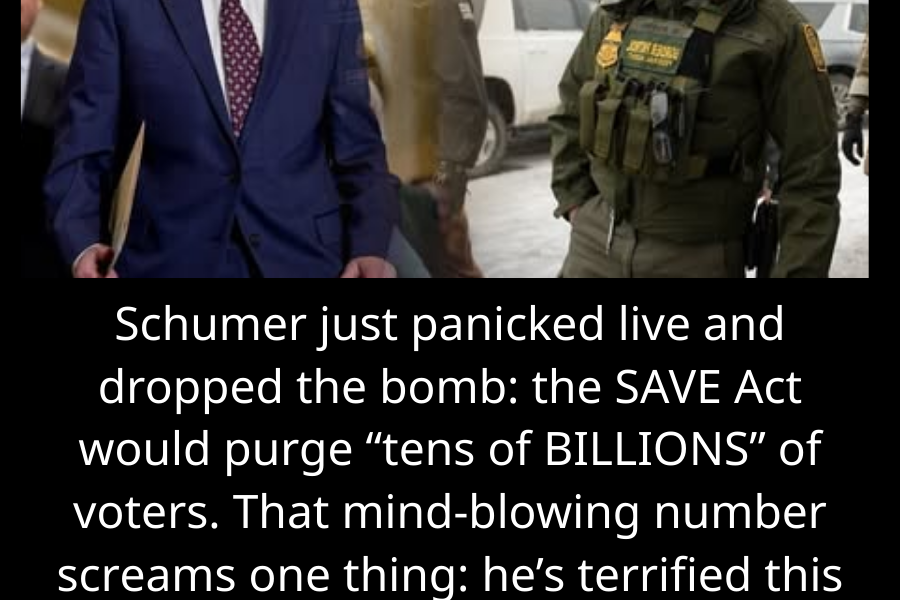
On one side: Chuck Schumer and most Democrats, arguing that requiring proof of citizenship to register to vote is an unnecessary barrier that will disenfranchise eligible voters.
On the other side: Republicans and election integrity advocates, arguing that verifying citizenship is common sense—the bare minimum to ensure that only Americans vote in American elections.
The debate has consumed Congress, dominated cable news, and divided the country along predictable lines. But beneath the familiar partisan trench warfare lies a deeper question: What does it mean to have confidence in an election?
Schumer’s Case: Protection or Obstruction?
Chuck Schumer’s opposition to the SAVE Act rests on several pillars:
1. The problem doesn’t exist. Non-citizen voting is already illegal and, by all accounts, vanishingly rare. Why create new barriers to solve a problem that isn’t real?
2. Documentation is a barrier. Millions of Americans don’t have easy access to birth certificates, passports, or naturalization papers. The poor, the elderly, the homeless, Native Americans on reservations, disaster survivors—all could be caught in the verification net.
3. The real goal is suppression. Schumer and his allies argue that the SAVE Act’s true purpose is not integrity but advantage—making it harder for Democratic-leaning groups to vote.
4. States already handle this. Election administration has always been a state responsibility. Federal intervention, especially one-size-fits-all mandates, ignores the diversity of American communities.
For Schumer, the SAVE Act is not a good-faith effort to improve elections. It’s a partisan power grab dressed up in the language of integrity.
The Supporters’ Case: Trust but Verify
Supporters of the SAVE Act see the issue completely differently:
1. Citizenship should matter. The most fundamental act of self-governance should be reserved for citizens. Verifying that is not discrimination—it’s definition.
2. The current system relies on honor. Voter registration forms ask registrants to check a box affirming citizenship. No verification. In an era of widespread distrust, honor systems are failing.
3. Documentation is accessible. Every citizen either has or can obtain the required documents. The idea that millions cannot prove their citizenship is, in this view, a myth propagated to justify a broken system.
4. Confidence requires verification. Millions of Americans don’t trust election outcomes. Clear, verifiable rules—applied consistently—can restore that trust.
For supporters, the SAVE Act is not about suppression. It’s about integrity. And anyone who opposes it is either naive about fraud or invested in a system that allows it.
The Numbers That Haunt the Debate
Both sides cite statistics that, depending on your priors, either prove their case or reveal their bias.
Critics point to: Estimates that 21 million Americans lack government-issued ID. Studies showing non-citizen voting is virtually non-existent. Historical evidence that voter ID laws disproportionately affect minority voters.
Supporters point to: Polls showing overwhelming public support for voter ID. Documented cases of non-citizens registering and voting. The simple math that even rare fraud can swing close elections.
The problem is that both sides are right about some things and wrong about others. Yes, non-citizen voting is rare—but it happens. Yes, most Americans have ID—but millions don’t. Yes, voter ID laws have a disparate impact—but so does election fraud.
The debate is not about facts. It’s about which facts matter more.
The Broader Context: Why This Fight Now?
The SAVE Act didn’t emerge from a vacuum. It’s the product of years of escalating conflict over election integrity.
-
2020: Trump’s claims of fraud, the “Stop the Steal” movement, the January 6 attack.
-
2021-2022: State-level voting law changes in Georgia, Texas, Florida, and elsewhere.
-
2024: Continued controversy over mail-in voting, ballot drop boxes, and election administration.
-
2026: The SAVE Act, the most significant federal election legislation in decades.
Each side sees the other’s actions as proof of bad faith. Republicans see Democratic opposition to verification as evidence they want fraud. Democrats see Republican demands for verification as evidence they want suppression.
The trust is gone. And without trust, every policy becomes a weapon.
The Political Stakes: What Happens Next?
The SAVE Act’s fate will likely be decided in the Senate, where it faces the 60-vote filibuster threshold.
Republicans have 53 seats. They need 7 Democrats to vote with them. So far, none have broken ranks. Schumer’s opposition is unified.
The options:
-
Negotiate a compromise. Perhaps automatic voter registration with back-end verification, or free IDs for all citizens, or targeted enforcement instead of universal requirements.
-
Kill the filibuster. Republicans could eliminate the 60-vote rule for election legislation, passing the SAVE Act with 51 votes. This would be a dramatic escalation with unpredictable consequences.
-
Accept defeat. The bill dies, and Republicans campaign on the issue in 2026, arguing that Democrats blocked election integrity.
Each option carries risks. Each will shape the political landscape for years.
The Public’s View: What Do Americans Want?
Polling consistently shows that overwhelming majorities of Americans support voter ID laws. The numbers are often 75-80%, including significant majorities of Democrats.
This creates a paradox: the policy is popular, but the politics are polarized. Most Americans want verification. But when verification becomes a partisan fight, they retreat to their corners.
The SAVE Act’s supporters hope this popularity will translate into pressure on Democrats. If voters want verification, and Democrats block it, Democrats pay a price.
The SAVE Act’s opponents hope that framing the issue as “voter suppression” will mobilize their base and offset any losses among moderates.
The Verdict: A Fight Without End
The SAVE Act will pass or fail. But the debate it represents will continue.
Because the underlying question—how do we know our elections are fair?—has no permanent answer. Every generation must answer it for itself, based on its circumstances, its fears, and its values.
For now, the answer is contested. One side says verification. The other says access. Both claim to defend democracy. Both see the other as a threat.
The SAVE Act is just the latest battlefield in a war that has no end in sight. And until Americans can agree on what “fair” means, the fighting will continue.