The Son’s Truth: Jesse Jackson Jr. Calls Out the Memorial Industrial Complex
The Scene: A Funeral, A Platform, A Reckoning
Let’s picture it. The packed sanctuary. The cameras. The row of former presidents—Obama, Clinton, Biden—each taking their turn at the podium, each offering their version of Jesse Jackson. The man they knew. The man they worked with. The man they now eulogize.
And then, the son steps forward.
Jesse Jackson Jr. doesn’t do what sons are supposed to do at funerals. He doesn’t thank the dignitaries. He doesn’t praise the speakers. He doesn’t pretend that the polished tributes just delivered have anything to do with the man he called father.
Instead, he delivers a line that cuts through the memorial pageantry like a blade:
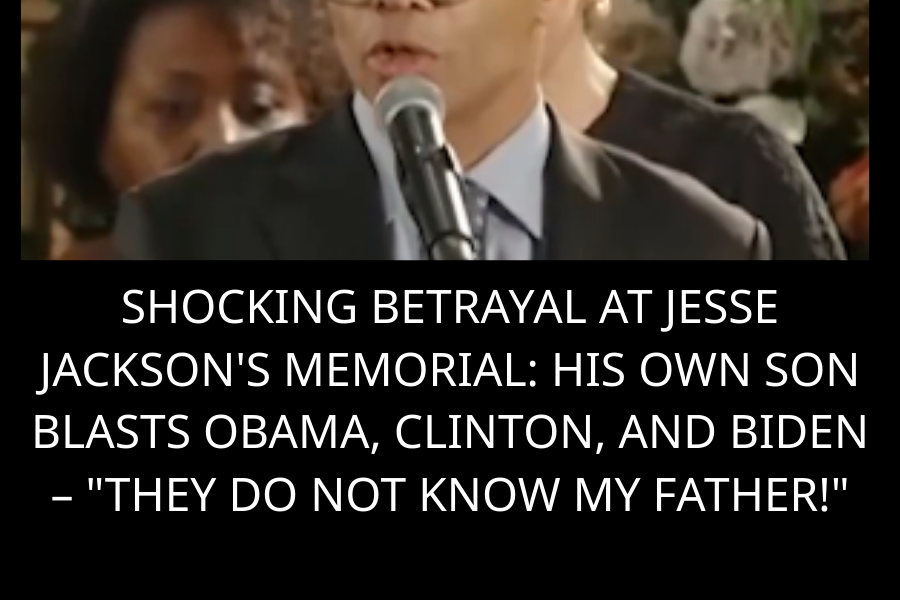
“I listened for several hours to three United States presidents who do not know Jesse Jackson.”
The room shifts. The cameras tighten. The former presidents, whatever their faces show, have just been told something undeniable: You don’t get to claim him. You don’t get to wrap him in your legacy. You don’t get to make him one of you. Because he was never one of you.
The Critique: Why the Presidents Didn’t Know Him
Jackson Jr. doesn’t stop at the accusation. He explains it.
His father maintained a “tense relationship with the political order”—not because of race, not because of party, but because the demands of his message “required not Democratic or Republican solutions, but demanded a consistent, prophetic voice that at no point in time ever sold us out as a people.”
This is the heart of it. Jesse Jackson was not a politician. He was a prophet. And prophets don’t fit in the neat categories of presidential memorials. They don’t validate the institutions they critique. They don’t become convenient symbols of progress for the very power structures they spent their lives challenging.
Obama, Clinton, Biden—they represent the political order. They are the men who made peace with the system, who rose within it, who governed it. Their eulogies, however sincere, could only ever be eulogies for the Jesse Jackson they could see—the civil rights leader, the presidential candidate, the Democratic ally.
They could not eulogize the Jesse Jackson who marched in Memphis, who stood with striking workers, who called out corporate Democrats as forcefully as he called out Republicans. They could not eulogize the man who refused to be co-opted, who never traded his movement for a seat at the table.
Because that Jesse Jackson, the real Jesse Jackson, was never theirs to claim.
The Prophetic Voice: What It Means to Never Sell Out
Jackson Jr.’s most devastating line is also his simplest: “at no point in time ever sold us out as a people.”
Think about what that means in the context of a memorial attended by three presidents. Every politician in that room has made compromises. Every one of them has traded principle for power at some point. That’s not an accusation; it’s the nature of politics. You can’t govern without deal-making, without coalition-building, without sometimes accepting half a loaf instead of the whole.
But Jesse Jackson was not a governor. He was not a legislator. He was a movement leader. His power came not from office but from the people who followed him, who trusted him, who believed that he would never trade their interests for his own.
And by that standard, the presidents in the room could not measure up. Not because they’re bad men, but because they play a different game. They are the ones who get eulogized by other presidents. Jackson was the one who made presidents possible—by marching, by organizing, by demanding that the political order finally, reluctantly, include the people it had excluded.
The Unspoken: Race, Power, and the Politics of Memorial
Jackson Jr. explicitly says his father’s tense relationship with the political order was “not because the presidents were white or black.” He’s heading off the obvious interpretation—that this is a racial critique. It’s not. Or at least, it’s not only that.
But race is in the room, whether spoken or not. Three white presidents eulogizing a Black icon. The history of the civil rights movement being shaped by the very institutions that resisted it. The tendency of power to absorb and neutralize its critics by embracing them in death.
Jackson Jr. is saying: don’t let that happen. Don’t let my father become a prop in your story. Don’t let your words smooth over the rough edges of his life. Don’t pretend that he was ever comfortable in your world, because he wasn’t, and that discomfort was the source of his power.
The Media Reaction: Discomfort and Deflection
The media will not know what to do with this moment. It’s too raw, too honest, too disruptive of the narrative they’ve already written. The story was supposed to be: Three Presidents Honor Civil Rights Icon. Instead, it’s: Son Says Presidents Didn’t Really Know Him.
The coverage will try to manage it. They’ll call it “grief speaking.” They’ll focus on Jackson Jr.’s tone rather than his substance. They’ll look for quotes from the presidents’ aides, smoothing things over, praising the son’s passion while gently dismissing his critique.
But the critique can’t be dismissed, because it’s true. The presidents didn’t know Jesse Jackson. Not really. Not the way his son knew him. Not the way the movement knew him. They knew a version—the public figure, the ally, the occasional critic. They didn’t know the man who refused to sell out, who kept the faith, who remained a prophet long after prophecy had gone out of fashion.
The Verdict: A Son’s Duty, A Nation’s Reckoning
Jesse Jackson Jr. did what sons are supposed to do at funerals: he told the truth about his father. He refused to let the memorial become a exercise in historical revisionism. He refused to let the political order claim a man who spent his life challenging it.
The presidents spoke. They said their pieces. They did what the occasion required.
But Jackson Jr. did something more. He reminded everyone in that room—and everyone watching—that some lives cannot be reduced to eulogies. That some voices cannot be absorbed into the consensus. That some leaders belong not to the political order, but to the people.
Jesse Jackson is gone. But his son made sure that the version of him that leaves that sanctuary is the real one—the prophet, the fighter, the man who never sold out.
And that is a eulogy no president could deliver.