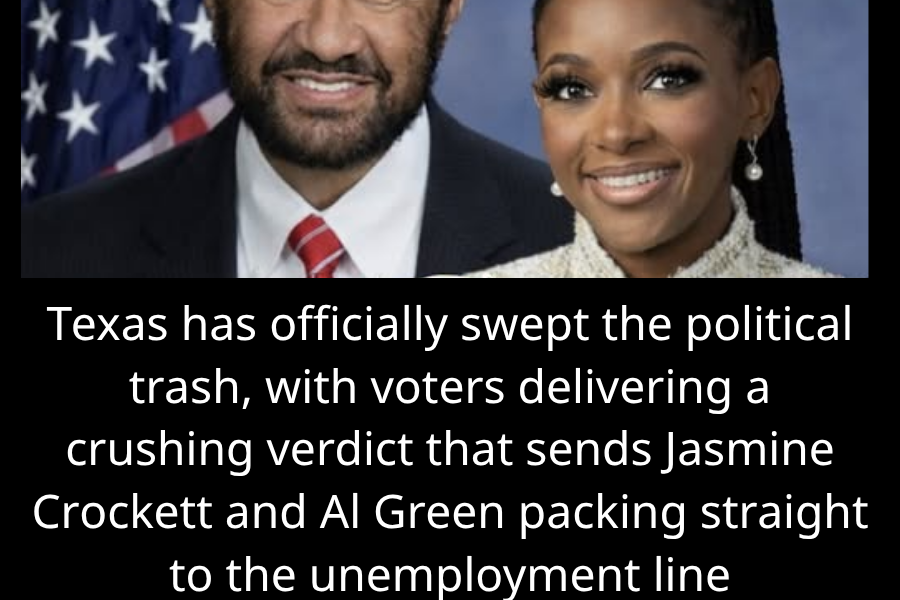
The Houston Massacre: How the Squad Just Lost Two of Its Loudest Voices
Let’s read the results slowly. Because this is the kind of political obituary that deserves to be savored.
Jasmine Crockett. Al Green. Two names that have dominated cable news chyrons, heated up hearing rooms, and provided endless fodder for the outrage machine on both sides. Two of the most recognizable, most quotable, most reliably controversial members of the progressive Squad.
Both just got told by their own voters: Pack your bags.
Not in a close race. Not in a nail-biter that came down to a recount. Not in the kind of loss that lets you blame turnout, or weather, or a fluke. In the kind of loss that sends a message so loud, so clear, so undeniable that even the most delusional political operative can’t spin it away.
Crockett and Green are done. They’re headed to the political trash heap. And the only question left is whether the rest of the Squad is paying attention.
The Viral Meltdown Era Is Over
Let’s be honest about what Crockett and Green were known for. It wasn’t legislation. It wasn’t constituent services. It wasn’t the kind of quiet, effective work that actually improves people’s lives and rarely makes the news.
They were known for the moments. The viral clips. The hearings that turned into circuses. The insults that were designed to generate outrage and fundraising emails in equal measure. The performances that played beautifully on social media but left the people who actually lived in their districts wondering: What exactly are you doing for us?
Crockett’s specialty was the confrontation. The hearing room smackdown. The kind of rhetorical violence that made her a hero to the progressive base and a cartoon villain to everyone else. She leaned into it. She built her brand on it. She became one of the faces of a new kind of politics—one where the goal wasn’t to govern but to go viral.
Green’s specialty was the spectacle. The floor speeches that were designed to be interrupted. The procedural stunts that were designed to be shut down. The moments of performative outrage that were designed to make the other side look bad and make himself look like a fighter.
It worked. For a while. It got them on television. It got them in the headlines. It got them the kind of national profile that most members of Congress would kill for. But somewhere along the way, something happened that they didn’t anticipate:
Their voters stopped being impressed.
The District Test
Here’s the thing about political performance art. It plays great in the national media. It generates clicks. It raises money from donors who will never set foot in your district. But at some point, the people who actually live in the district—the people who need roads fixed, schools funded, potholes filled—start asking questions.
What have you done for us lately? Not on cable news. Not on Twitter. Not in the hearing room. In the district. In the community. In the places where politics stops being entertainment and starts being about whether the trash gets picked up and the schools are safe and the jobs are coming back.
Crockett and Green apparently didn’t have a good answer. Or if they did, their voters didn’t believe it. Because when the ballots were counted, when the votes were tallied, when the only poll that actually matters closed for the night, the people of Houston and the surrounding districts sent a message that no amount of viral clips could overcome:
We’re done with the circus.
The Race-Baiting Circus
The phrase “race-baiting” gets thrown around a lot. Usually too much. Usually in ways that obscure more than they reveal. But in the case of Crockett and Green, it fits. Because a significant part of their political identity was built on the idea that any criticism of them, any opposition to them, any failure to support them was rooted in something darker than policy disagreement.
It was a strategy. A deliberate, calculated strategy. Paint your opponents as racists. Frame every fight as a battle between the forces of justice and the forces of bigotry. Make it impossible to oppose you without being branded as something worse than a political adversary.
It worked. For a while. It kept the base energized. It kept the donations flowing. It kept the national media treating them as victims rather than politicians who could be judged on their record.
But somewhere along the way, the people in their districts started noticing something: The accusations of racism weren’t actually solving any problems. The rhetoric wasn’t filling potholes. The performances weren’t making their lives better. And eventually, even the most loyal supporters started to wonder: If everything is racism, and racism is everywhere, and the fight against racism is the only thing you ever talk about—what exactly are you doing for us?
The answer, apparently, was not enough.
The Squad Is Shrinking
Remember when the Squad was going to take over Washington? Remember when the conventional wisdom was that the progressive wave was unstoppable, that the old guard was finished, that a new generation of fire-breathing reformers was going to remake the Democratic Party in their image?
That was then. This is now.
One by one, the Squad is being whittled down. Some have lost primaries. Some have faced near-death experiences. Some have watched their districts get redrawn in ways that make their seats less safe. Some have simply faded, their moment of national relevance passing as the news cycle moved on to the next sensation.
Crockett and Green are the latest casualties. But they won’t be the last. Because what happened in Houston is not an isolated event. It’s a pattern. A trend. A signal to every member of Congress who has built their career on performance rather than results:
The voters are paying attention. And they’re running out of patience.
The Humiliation of America
There’s a phrase in the coverage of Crockett and Green that keeps coming up: “humiliating America.” It’s strong language. But it captures something real about what these two represented.
When Americans watched Crockett turn a hearing into a personal attack. When they watched Green interrupt the State of the Union. When they saw the endless stream of clips designed to make the United States look like a country that couldn’t govern itself, that couldn’t conduct basic business without descending into chaos and personal insults—it wasn’t just embarrassing. It was humiliating.
Because the world was watching. Our allies were watching. Our adversaries were watching. And what they saw was a political culture that had degenerated into performance art, where the goal wasn’t to solve problems but to create content, where the loudest voices were rewarded and the most serious voices were ignored.
Crockett and Green were champions of that culture. They were its most visible proponents. And now, their voters have said: No more.
The Common Sense Victory
The headline calls this a “huge victory for common sense.” That’s not hyperbole. It’s the simplest way to describe what happened.
Common sense says that members of Congress should be judged on what they accomplish, not how many viral moments they generate. Common sense says that representation should be about the people you serve, not the national profile you build. Common sense says that when a politician spends more time on cable news than in their district, something has gone wrong.
Crockett and Green failed the common sense test. Their voters knew it. And when given the chance to say so, they said it in the most definitive way possible.
This is not a Democratic loss or a Republican victory. It’s a victory for anyone who believes that politics should be about something more than performance. It’s a victory for anyone who is tired of turning on the news and seeing the same faces, the same fights, the same circus, while the real problems facing the country go unaddressed.
It’s a victory for the people of Houston, who decided they wanted something better. And it’s a warning to every politician in America who thinks that going viral is the same as getting things done.
The Political Trash Heap
“Political trash heap” is a harsh phrase. But it’s where failed politicians go. And make no mistake: Crockett and Green failed.
They failed the people they were supposed to represent. They failed to translate their national fame into local results. They failed to convince their own voters that their performances were worth more than the quiet, boring work of governing.
The trash heap is not a place for people who lost close races. It’s not a place for people who fought hard and came up just short. It’s a place for people who forgot what the job was supposed to be about. Who confused being famous with being effective. Who thought that the cameras were the point.
Crockett and Green are headed there now. And the only question is whether they’ll be joined by others who made the same mistake.
The Drama Queens Exit
“Buh-bye to the drama queens.” That’s the phrase that closes the headline. It’s dismissive. It’s contemptuous. It’s exactly the tone that Crockett and Green used against their opponents for years.
There’s a poetry to it. The politics of humiliation, turned back on its creators. The drama that they injected into every hearing, every floor speech, every public appearance—now being used to escort them out the door.
Will anyone miss them? The headline says no. And it’s probably right.
Because the people who loved Crockett and Green loved them for the drama. For the fights. For the moments of confrontation that made them feel like someone was finally fighting back. But the people who loved them weren’t the people in their districts. They were the people who watched from afar, who donated to their campaigns, who retweeted their clips. The people who would never have to call their office for help with a passport or a veterans’ benefit or a small business loan.
The people who actually lived in the districts? They had a different relationship with their representatives. And when given the chance to decide whether the drama was worth it, they decided it wasn’t.
America Gets Stronger
The last line of the headline is the most important: “America is getting stronger every day.”
It sounds like a slogan. But it’s actually a truth. A country where the loudest, most divisive voices are rewarded is a country that is getting weaker. A country where political performance is valued over political results is a country that is losing its ability to solve problems. A country where the people who treat governance as entertainment are the ones who rise to the top is a country that is slowly, inexorably, decaying from the inside.
Crockett and Green were symptoms of that decay. They were the logical endpoint of a political culture that rewards outrage over accomplishment, confrontation over cooperation, spectacle over substance. Their rise was a sign that something had gone wrong. Their fall is a sign that something might be getting right.
America is not getting stronger because two failed politicians lost their primaries. America is getting stronger because the voters sent a message that the old way of doing things—the viral clips, the hearing room circuses, the race-baiting, the drama—is no longer acceptable. That message will echo beyond Houston. It will reach every member of Congress who thought that being famous was the same as being effective.
And maybe, just maybe, it will make them think twice before turning the next hearing into a circus. Before choosing the viral moment over the quiet work. Before forgetting that the people they represent are not audiences to be entertained but citizens to be served.
The Last Word
Jasmine Crockett and Al Green are done. Their careers in Congress are over. Their names will fade from the headlines. The viral clips will be forgotten, replaced by the next outrage, the next performance, the next politician who mistakes being loud for being effective.
But the lesson of their defeat will last. Because the voters of Houston did something that voters in districts across the country have been wanting to do for years. They looked at the circus that their representatives had created, and they said: We’re done.
Not because the circus wasn’t entertaining. Not because the viral moments weren’t satisfying. But because entertainment is not the same as governance. And satisfaction is not the same as results.
The drama queens are gone. The circus is packing up. And somewhere in America, a politician who was thinking about turning a hearing into a spectacle is looking at the results from Houston and thinking: Maybe I should focus on the potholes instead.
That’s how America gets stronger. Not with a bang. Not with a viral moment. With a primary. With a vote. With the quiet, definitive judgment of the people who know best.
Good riddance to the clowns. And good luck to the next generation of politicians who understand that the job is not about being famous. It’s about being effective. The voters have spoken. Let’s hope the rest of Congress is listening.