The New Khamenei’s First Words: A Defiant Declaration of War
The Voice Without a Face: A Successor Speaks from the Shadows
Let’s start with the strange absence at the heart of this story: no video. no image. just words read by a presenter.
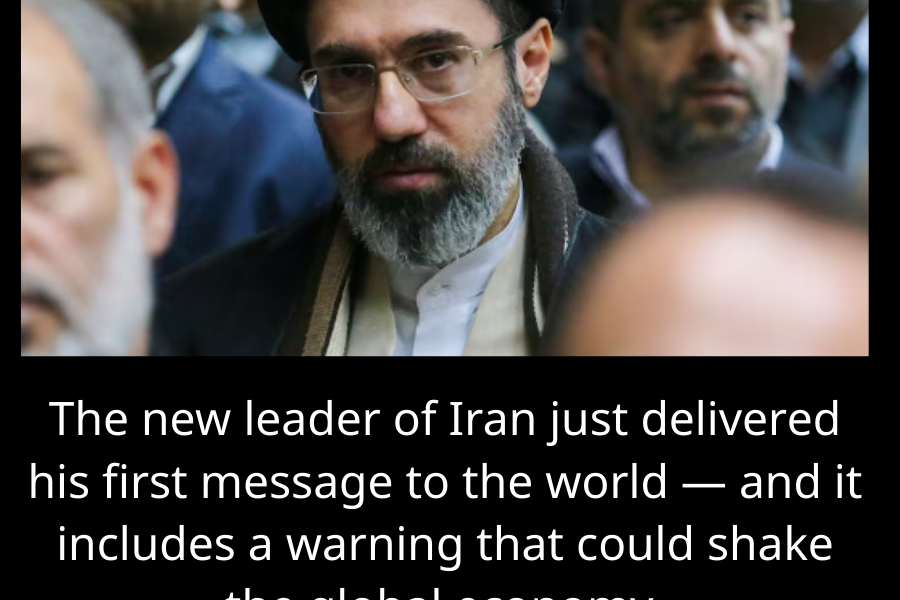
Mojtaba Khamenei, the son who inherited his father’s throne, delivered his first address to the Iranian people through a disembodied voice on state television. The explanation—that he was “lightly wounded” in the strike that killed his father—raises as many questions as it answers. How lightly? Why no proof of life? Why the distance between the leader and the led?
The regime wants us to believe that succession is smooth, that control is absolute, that the father’s death was a setback but not a catastrophe. The absence of visual confirmation suggests otherwise. It suggests a leadership in hiding, a supreme leader who cannot show his face, a government that rules from the shadows because the light has become too dangerous.
And yet the words themselves are pure defiance. “We will not neglect avenging the blood of your martyrs.” “Make the enemy regret.” “The lever of blocking the Strait of Hormuz must continue to be used.” This is not the language of a regime preparing to negotiate. This is the language of a regime preparing for a long war.
The Strait of Hormuz: The World’s Most Dangerous Chokepoint
The strategic importance of the Strait cannot be overstated. 20% of global oil production passes through this narrow waterway, squeezed between Iran and Oman. It is the jugular of the global economy. And Iran has just announced it will keep it shut.
The immediate consequence: two tankers ablaze in the Iraqi port of Basra. Ships engulfed in fireballs that lit up the night sky. A crew member killed. Three more ships struck in the Gulf. A Thai bulk carrier set ablaze by the Revolutionary Guards for the crime of “disobeying orders.”
This is not a blockade in the traditional sense—ships stopping, inspections, delays. This is active warfare against commercial shipping. This is the regime treating civilian vessels as military targets. This is the definition of state-sponsored terrorism applied to global trade.
The International Energy Agency calls it “the biggest disruption to global energy supplies in history.” That is not hyperbole. That is a factual description of a crisis that will ripple through every economy on earth.
The Trump Doctrine: “We Won” But the War Continues
President Trump’s messaging has been characteristically contradictory. At a rally in Hebron, Kentucky: “You never like to say too early you won. We won. In the first hour it was over.”
But then: “We don’t want to leave early, do we? We got to finish the job.”
And then: “The United States profited from higher oil prices.”
And then: “My priority is stopping Iran from obtaining a nuclear weapon.”
The confusion is understandable. Trump is trying to balance multiple audiences: the voters who want to hear that the war is won, the markets that need to hear that prices will stabilize, the military that needs clear objectives, and the allies who need to know America’s commitment is real.
But clarity matters in war. When the president says “we won” while the enemy is still fighting, while ships are still burning, while the Strait remains closed, it creates a dangerous gap between perception and reality. The enemy hears “we won” and thinks they are complacent. The troops hear “we won” and wonder why we’re still here. The markets hear “we won” and then see oil at $100 a barrel and think he’s lying.
The Regional Spillover: War Without Borders
The conflict is no longer contained to Iran. The drones reported over Kuwait, Iraq, the UAE, Bahrain, and Oman confirm what strategists have long feared: Iran’s reach extends far beyond its borders.
Hezbollah’s rocket barrage into Israel—the largest of the war—is another escalation. Israel’s strikes on Beirut are the inevitable response. The cycle of violence is expanding, drawing in more actors, creating more fronts, making a negotiated settlement increasingly impossible.
Lebanon, already collapsing, now faces a renewed war with Israel. The Gulf states, which had hoped to normalize relations with Israel and move past the Iranian threat, find themselves directly in the crosshairs. The region is fragmenting along sectarian lines, with Iran’s proxies activating across multiple theaters.
The Oil Shock: $100 and Climbing
The immediate economic consequence is obvious: oil at $100 a barrel and climbing. Analysts warn that without the Strait, prices could reach $200. The coordinated release of 400 million barrels from strategic reserves—the largest intervention in history—will provide only temporary relief. Three weeks of supply, drawn down over months, cannot replace the permanent loss of 20% of global production.
For American consumers, this means higher gas prices, higher heating costs, higher prices on everything that moves by truck or ship. For the global economy, it means inflation, recession, and the kind of stagflation that plagued the 1970s.
Trump’s claim that the U.S. “profits” from higher oil prices is technically true—the U.S. is a net oil exporter—but economically misleading. The U.S. is also the world’s largest oil consumer. What we gain in export revenue, we lose multiples of in economic disruption. Higher oil prices are not a win; they are a tax on every American who drives to work, heats their home, or buys food that traveled to the store.
The Iranian People: Trapped Between Regime and War
Inside Iran, the situation is complex. The regime’s security forces are everywhere, more visible than before. People are afraid to come out. But supermarkets are open. Life continues, however tenuously.
The U.S. and Israel have called on Iranians to rise up. Some Iranians want change. Some celebrated the death of the elder Khamenei, whose forces killed thousands of protesters just over a year ago. But there is no organized opposition while the country is under attack. Nationalism, even under a hated regime, is a powerful force when the bombs are falling.
The regime knows this. It is counting on it. It is using the war to consolidate power, to distract from its failures, to position itself as the defender of the nation against foreign aggression. The strategy may work—at least for now.
The Strategy: Economic Shock as a Weapon
Iran’s strategy is becoming clear: prolong the economic pain until the U.S. blinks. Cut off oil. Drive up prices. Create global inflation. Make the war too expensive for the American public to support.
The Revolutionary Guards spokesperson’s warning—”prepare for oil prices of $200 a barrel”—is not just rhetoric. It is a statement of intent. Iran believes it can outlast the U.S., that American voters will tire of high prices before the regime tires of war.
This is a dangerous gamble. It assumes that the U.S. will not escalate further, that Israel will not strike nuclear facilities, that the Gulf states will not join the fight. It assumes that the regime’s internal control will hold. It assumes that the world will not find alternatives to Hormuz.
But it is not an irrational gamble. The regime has survived for 45 years through a combination of brutality, patience, and the exploitation of its enemies’ weaknesses. It believes it can do so again.
The Verdict: A War Without End in Sight
The first words of Mojtaba Khamenei as Supreme Leader are not words of peace. They are not words of negotiation. They are words of war—defiant, uncompromising, and directed at the global economy as much as at the United States.
The Strait of Hormuz is closed. Ships are burning. Oil is spiking. Drones are flying. Hezbollah is firing. Israel is striking. The war is expanding, not contracting.
Trump says “we won.” But the enemy is still fighting. And until the enemy stops fighting, until the Strait reopens, until the oil flows again, the war is not won. It is just beginning.
The coming months will test whether America has the will to finish what it started. Whether the administration has a plan beyond “we won.” Whether the alliance with Israel and the Gulf states can hold. Whether the Iranian people will rise or submit.
And for the rest of the world, the question is simpler: how high will prices go, and how long can we survive?
The answer is not yet written. But the first chapter, dictated from the shadows by a wounded successor, suggests a long and bloody story ahead.