The Tucker Takedown: When the King’s Loyalist Becomes the King’s Critic
The Moment That Shook the Movement
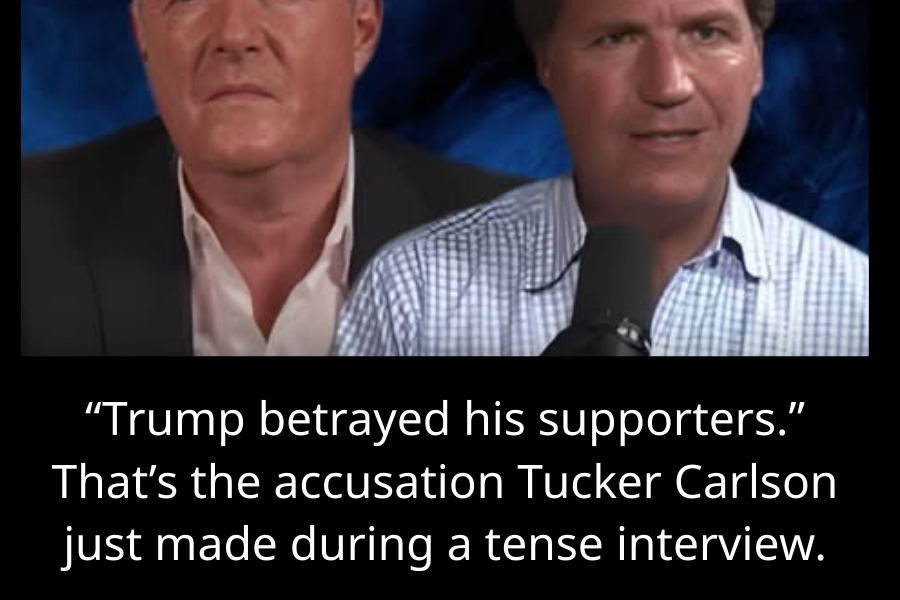
Let’s start with the image: Tucker Carlson, the man who arguably did more than anyone outside of Trump himself to build the MAGA movement, sitting across from Piers Morgan, delivering a verdict that cuts to the bone:
“It’s a betrayal. It’s heartbreaking to see this. It’s so wounding, it hurts.”
Not policy disagreement. Not “I would have done it differently.” Betrayal. The word lovers use when they’ve been cheated on. The word soldiers use when their commander abandons them. The word true believers use when their prophet turns out to be just another politician.
Carlson didn’t stop there. He took aim at the very coalition that elected Trump:
“The only people who support this war are those born between 1946–1964 who watch a lot of Fox News.”
Baby Boomers. Fox News viewers. The core of the Republican base. Carlson just threw a grenade into the middle of his own party’s tent.
The War in Question: What Carlson Is Actually Opposing
To understand Carlson’s betrayal charge, we need to understand which war he’s talking about.
The conflict with Iran has escalated dramatically since the killing of the elder Khamenei. Tankers are burning in the Gulf. Oil prices are spiking. Drones are flying over multiple countries. Hezbollah is firing rockets into Israel. American troops are in harm’s way.
For Carlson, this is the nightmare he’s spent years warning about: endless war in the Middle East, sold as necessary, justified by establishment talking points, and supported by the very people who claimed to oppose it.
Trump ran in 2016 as the anti-war candidate. He promised to bring troops home, to stop nation-building, to avoid new entanglements. His base believed him. And now, watching American forces engaged in a widening conflict with no clear exit strategy, they feel duped.
Carlson is giving voice to that betrayal. He’s saying what millions of Trump supporters are thinking but are afraid to say: We didn’t vote for this.
The Generational Attack: Boomers vs. Everyone Else
Carlson’s claim about who supports the war is deliberately provocative.
“The only people who support this war are those born between 1946–1964 who watch a lot of Fox News.”
This is a direct shot at the Baby Boomer generation—the same generation that supported the Iraq War, that watched Desert Storm on CNN, that has never met a Middle East conflict they didn’t like. And it’s a shot at Fox News, the network that gave Carlson his platform and that now, in his telling, has become a propaganda arm for the very establishment it claims to oppose.
The generational divide Carlson is highlighting is real. Polling consistently shows that younger conservatives are far more skeptical of foreign intervention than their parents and grandparents. They grew up watching the wars in Iraq and Afghanistan drag on for decades with no clear victory. They’re not interested in repeating those mistakes.
By framing this as a generational conflict, Carlson is trying to pry apart the Trump coalition—to separate the anti-war populists from the neoconservative hawks who have found a home in the MAGA movement. It’s a risky strategy, but it’s also a necessary one if he wants to build a new movement on the ashes of the old.
The Fox News Factor: Biting the Hand That Fed Him
Carlson’s mention of Fox News is particularly pointed. He spent years as the network’s biggest star, shaping conservative opinion on everything from immigration to foreign policy. Now he’s accusing the network of supporting a war he opposes.
This is not just policy disagreement. It’s personal. Carlson knows how Fox works. He knows who controls the message. He knows that the network’s owner, Rupert Murdoch, has always been more comfortable with establishment Republicans than with populist insurgents.
By calling out Fox viewers specifically, Carlson is trying to reach over the heads of the network’s leadership directly to its audience. He’s saying: They’re lying to you. They’re selling you a war you don’t want. Wake up.
Whether that message breaks through remains to be seen. Fox News still commands the loyalty of millions of older conservatives. Carlson’s audience has followed him to his new platforms, but it’s not the same scale.
The Trump Dilemma: Loyalty vs. Principle
The most painful part of Carlson’s critique is the personal dimension. He’s not just opposing a policy; he’s mourning a relationship.
Trump was supposed to be different. He was supposed to drain the swamp, end the wars, put America first. And for a while, it seemed like he might. He pulled troops from Syria and Afghanistan. He talked about bringing soldiers home. He resisted the neoconservative urge to intervene everywhere.
Now, with Iran, he’s doing exactly what he promised not to do. And Carlson feels betrayed.
This is the dilemma at the heart of the Trump movement: What happens when Trump stops being Trump? What happens when the outsider becomes the insider, when the disruptor becomes the establishment, when the anti-war candidate starts a war?
Carlson’s answer is clear: it’s a betrayal. And it’s heartbreaking.
The Supporters’ Response: Divided Loyalties
The reaction to Carlson’s comments has been predictably split.
The Anti-War Right: Carlson’s people. They’ve been waiting for someone to say this. They’ve been watching the escalation with growing alarm and wondering why no one in conservative media is asking hard questions. Carlson is their voice.
The Pro-Trump Loyalists: Trump’s people. They’ll defend the president no matter what. If Trump says the war is necessary, it’s necessary. Carlson is just jealous, or bitter, or trying to stay relevant. They’ll attack him as a traitor to the movement.
The Establishment Hawks: The people Carlson targeted. They’ll dismiss him as an isolationist, a Putin apologist, a conspiracy theorist. They’ll argue that the war with Iran is necessary to protect Israel, to secure oil supplies, to project American strength.
The Confused: The millions of conservatives who don’t know what to think. They trusted Trump. They trusted Carlson. Now the two are at odds, and they have to choose.
The Historical Parallel: What Happens When Movements Fracture
This moment has parallels in political history.
In 1968, the Democratic coalition shattered over Vietnam. Anti-war Democrats couldn’t reconcile with the party establishment. The result was chaos, defeat, and a realignment that took a generation to sort out.
In 2003, the conservative movement fractured over Iraq. Paleoconservatives like Pat Buchanan opposed the war while neoconservatives championed it. The movement survived, but the wounds never fully healed.
Now it’s happening again. The Trump coalition, which was always an uneasy alliance of populists, nationalists, and traditional conservatives, is splitting over Iran. And Tucker Carlson is leading the charge on one side.
The question is whether the movement can survive the split. And if not, which faction emerges dominant.
The Verdict: A Warning That Can’t Be Ignored
Tucker Carlson’s comments are not just another hot take. They’re a warning shot across the bow of the Trump administration and the Republican Party.
If Carlson is right—if the base really is turning against this war—then Trump faces a political disaster. His coalition was built on trust. Once that trust is broken, it can’t be easily restored.
If Carlson is wrong—if most Trump supporters still trust the president more than any commentator—then he’s just another voice in the wilderness, doomed to irrelevance.
But Carlson has been right before. He saw the populist wave before anyone else. He understood the immigration issue before it became central. He predicted the collapse of trust in institutions. Dismissing him now would be a mistake.
The war with Iran is not going away. The questions Carlson is raising are not going away. And the betrayal he’s describing—whether real or perceived—is now part of the political landscape.
Trump can ignore Carlson. He can attack him. He can try to rally his base around the flag. But he can’t make the questions disappear. And as long as those questions remain, the movement will be divided.
That’s the wound Carlson is talking about. And it’s not going to heal anytime soon.