The Wasserman Schultz Doctrine: When Voter ID Becomes a Partisan Weapon
The Accusation: A Direct Charge of Voter Suppression
Let’s start with what Debbie Wasserman Schultz actually said, because it’s the kind of statement that either reveals a hidden truth or exposes a paranoid fantasy—depending entirely on where you sit.
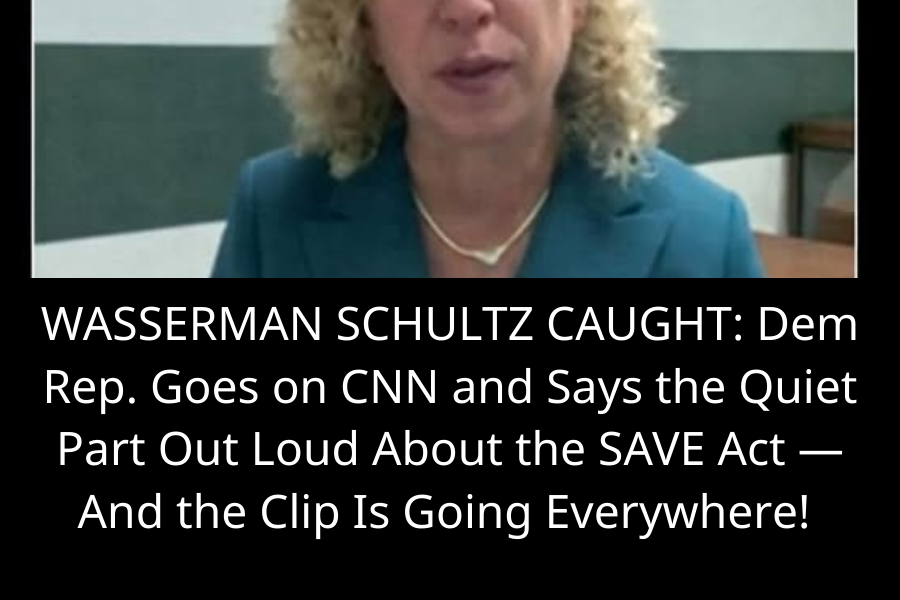
Speaking on CNN, the Florida Democrat made a direct, unqualified accusation about the SAVE America Act and Republican voting policies:
“This is about one thing, ensuring that it is much harder for people who are unlikely to go to the polls and vote for Republicans, and making it much harder for them to cast their ballot.”
In her telling, voter ID laws, restrictions on mail-in voting, and limits on ballot access are not about election integrity. They are not about preventing fraud. They are about suppression—deliberate, targeted efforts to keep Democratic-leaning voters away from the polls.
She pointed to Florida’s 20-year history of no-excuse vote-by-mail as proof that expanded access works without fraud. She accused Republicans of wanting to return to “one day” voting with what she called a “doctor’s note” requirement. She tied the entire effort to Donald Trump’s influence and the broader Republican redistricting strategy.
The message is clear: this is not about integrity. It’s about power.
The SAVE America Act: What It Actually Does
To evaluate Wasserman Schultz’s claims, we need to understand what the SAVE America Act actually proposes.
While details vary by version, the core elements typically include:
-
Voter ID requirements: Federal elections would require government-issued photo identification to vote.
-
Mail-in voting restrictions: Limits on who can vote by mail and how ballots are returned.
-
Voter roll maintenance: Requirements to regularly update voter rolls, removing ineligible voters.
-
Election Day uniformity: Pressures toward single-day voting rather than extended early voting periods.
Supporters argue these are common-sense measures to ensure that only eligible citizens vote, and that each person votes only once. They point to studies showing that voter fraud, while rare, does occur, and that public confidence in elections requires robust safeguards.
Opponents argue that these measures solve a problem that barely exists while creating new barriers for elderly, minority, low-income, and young voters—groups that tend to vote Democratic.
The Evidence: Does Voter ID Suppress Turnout?
The academic evidence on voter ID laws is mixed and contested.
Studies showing minimal impact: Some research suggests that voter ID laws have little to no effect on turnout, because most people already have ID and those who don’t can get one with minimal effort. The famous study by the Government Accountability Office found that Kansas and Tennessee’s voter ID laws reduced turnout by 2-3%, but other studies have found smaller or negligible effects.
Studies showing disproportionate impact: Other research shows that minority, elderly, and low-income voters are less likely to have the required ID and face greater barriers to obtaining it. A 2017 study found that Black and Hispanic voters were disproportionately affected by strict ID laws.
The fraud question: Actual instances of in-person voter fraud are extremely rare—far rarer than lightning strikes or shark attacks. But supporters argue that even rare fraud undermines confidence, and that the mere possibility justifies preventive measures.
The debate is not really about the data. It’s about what level of risk is acceptable and what level of burden is justified.
The Partisan Divide: Why This Issue Cuts So Deep
Wasserman Schultz’s accusation—that these laws are designed to hurt Democrats—reflects a broader belief on the left that Republican voting restrictions are a form of political warfare.
The evidence for this belief:
-
Targeted demographics: The groups most affected by ID laws—minorities, the poor, the young, the elderly—tend to vote Democratic.
-
Republican admissions: Occasionally, Republican officials have admitted that voter ID laws help their party. A Pennsylvania Republican famously said that voter ID would “allow Governor Romney to win the state.”
-
Geographic patterns: Strict ID laws are almost always passed in Republican-controlled states, often after Democratic electoral gains.
-
The fraud rationale: The lack of widespread fraud suggests that the stated justification doesn’t match the scale of the solution.
On the other side, Republicans argue that they genuinely believe election integrity is at risk, that the left opposes ID laws because they benefit from fraud, and that the “suppression” narrative is a smokescreen to prevent common-sense safeguards.
The Florida Example: A Case Study in Contradiction
Wasserman Schultz pointed to Florida’s 20-year history of no-excuse vote-by-mail as proof that expanded access works. And she’s right—Florida has conducted millions of mail-in votes with vanishingly few cases of fraud.
But Florida is also a state with strict voter ID requirements for in-person voting. It requires photo identification, and voters without ID must cast provisional ballots that are counted only if their signature matches. Florida has both expanded mail access and strict in-person ID.
The Florida example suggests that the two approaches are not mutually exclusive. You can have widespread mail voting and robust ID requirements. The question is where you draw the line.
The “Doctor’s Note” Charge: Rhetoric or Reality?
Wasserman Schultz’s claim that Republicans want to require “a doctor’s note” to vote by mail is a rhetorical flourish, not a description of any actual legislation. But it reflects a genuine concern: that restrictions on mail voting will make it harder for people with disabilities, health issues, or work schedules that prevent in-person voting.
The move to limit mail voting is driven by Trump’s false claims about 2020 election fraud. Despite no evidence of widespread mail fraud, the belief that mail voting is insecure has become Republican orthodoxy. The result is a push to return to pre-pandemic voting patterns—which would almost certainly reduce turnout among groups that came to rely on mail ballots.
The Verdict: A Debate About Trust
At its core, the voter ID debate is not about IDs. It’s about trust.
Democrats do not trust Republicans to write voting laws in good faith. They see every restriction as a thinly veiled attempt to suppress Democratic votes. They point to history—to poll taxes, literacy tests, and Jim Crow—as evidence that voting restrictions are always about power, never about integrity.
Republicans do not trust Democrats to run secure elections. They see every expansion of voting access as an invitation to fraud. They point to close elections, to allegations of irregularities, to the simple fact that fraud is possible even if rare—as evidence that safeguards are necessary.
Wasserman Schultz’s statement is a perfect expression of the Democratic view. She doesn’t believe the SAVE America Act is about integrity. She believes it’s about preventing people from voting for Democrats.
Whether she’s right or wrong depends entirely on whether you trust the people writing the laws. And in 2026, after everything that’s happened, trust is in very short supply.