The Uncomfortable Interview: When a Protester Explained Why Black People Weren’t There
Let’s start with the scene.
A “No Kings” protest. Nationwide demonstrations against the Trump administration. Thousands of people in the streets, chanting, carrying signs, making their voices heard. The cameras are rolling. The energy is high. The message is clear: resistance.
Except for one thing. One thing that the cameras usually avoid, that the coverage usually edits out, that the organizers usually explain away with carefully crafted statements about diversity and inclusion.
There aren’t many Black people here.
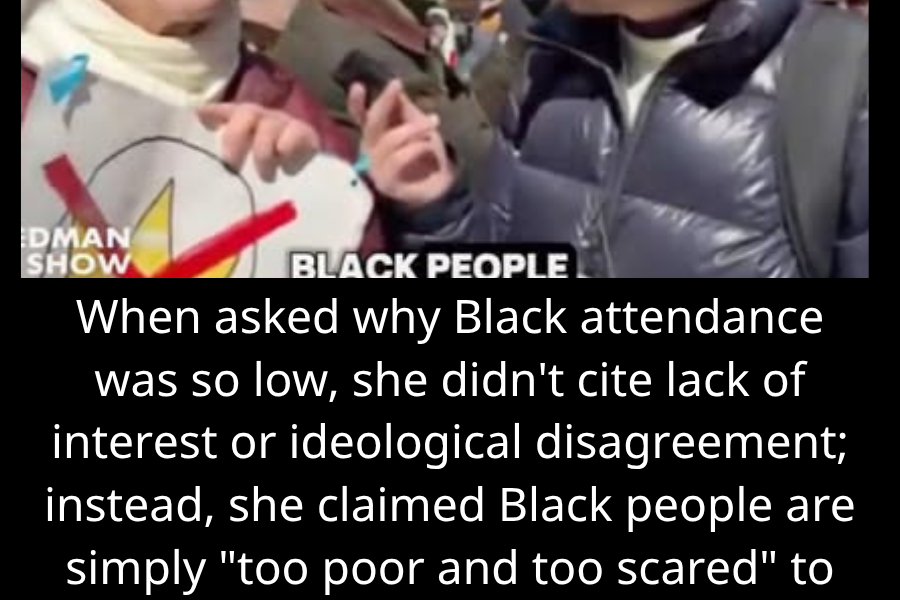
The interviewer notices. She asks the question. Not a hostile question. Not a gotcha question. A simple, honest question that anyone looking at the crowd would ask: Why do you think there’s not a lot of Black people here?
And then the white protester in the frame does something remarkable. She tells the truth. Not the polished, focus-grouped, media-trained truth that organizers would want her to tell. The raw, unfiltered, accidentally revealing truth that exposes the gap between what the protest claims to represent and who actually shows up.
“Because a lot of them are afraid of being arrested. And they don’t wanna get arrested. They can’t afford it. They can’t afford the lawyers. They can’t afford the time off from work. And they’re afraid.”
The interviewer presses. Asks if Black people are less likely to protest because they’re afraid of getting arrested. The protester doubles down. Says Black people know they’ll get arrested more than white people.
Then the interviewer pivots to voter ID laws. Asks if that suppresses the Black vote. And the protester, who has been defending the protest, defending the cause, defending the resistance, says something that the organizers would never allow in a press release:
“Yeah, because a lot of Black people don’t have IDs. They don’t drive. They don’t have cars. They use public transportation.”
The interview goes off the rails. Not because the protester said something outrageous. Because she said something honest. Something that the left has spent years trying to deny. Something that the Democratic Party has built its voter turnout strategy around.
She said, without meaning to, that Black people are not showing up to anti-Trump protests because they have jobs, families, responsibilities. That they cannot afford to get arrested because they cannot afford the consequences. That they don’t have IDs because they don’t drive. That they don’t drive because they take the bus. That they take the bus because that’s what people who can’t afford cars do.
She said all of this while standing in a crowd of mostly white protesters who had the time, the money, and the privilege to spend a day demonstrating against a president they don’t like. She said it without irony. She said it without realizing that she had just explained why the resistance movement is not the diverse, inclusive, representative movement it claims to be.
The Fear That Doesn’t Get Talked About
The protester said Black people are afraid to get arrested. She is right. Black people have good reason to be afraid of the criminal justice system. They know, from centuries of experience, that an arrest for a white protester is often a minor inconvenience. An arrest for a Black protester can be a life-altering event.
The white protester who gets arrested at a demonstration will likely be released quickly. She will likely have access to legal representation. She will likely not lose her job because her employer is sympathetic to the cause. She will likely face minimal consequences. She can afford to get arrested. That is privilege.
The Black person who considers joining that same demonstration knows that the calculus is different. The risk of violence is higher. The likelihood of being held longer is greater. The access to legal representation is less certain. The job may not be waiting when they get out. The consequences are not abstract. They are real. They are serious. They are potentially devastating.
The protester said this out loud. She said that Black people are afraid to get arrested because they can’t afford it. She was not being condescending. She was not being paternalistic. She was being honest about a reality that the organizers of these protests prefer to ignore.
The resistance movement wants to be seen as the voice of the oppressed. But the oppressed are not in the streets. They are at work. They are at home. They are taking the bus. They are doing the things that people who cannot afford to get arrested do. And the white protesters who fill the streets do not understand why. Or they do not want to understand. Or they understand and do not want to say it out loud.
This protester said it out loud. And the interview went off the rails.
The ID Problem
Then came the voter ID question. The interviewer asked about laws that require identification to vote. She expected the protester to give the standard Democratic answer: voter ID laws suppress the Black vote. It’s racism. It’s Jim Crow. It’s an attack on democracy.
The protester agreed. But then she explained why. And her explanation was not the one the Democratic Party wants to hear.
“Because a lot of Black people don’t have IDs. They don’t drive. They don’t have cars. They use public transportation.”
She said that Black people don’t have IDs because they don’t drive. She said they don’t drive because they don’t have cars. She said they use public transportation. She described a world where car ownership is not universal, where driving is not a given, where the basic document that most Americans take for granted is not something that everyone has.
She was describing poverty. She was describing a reality that exists in every major American city, where a significant portion of the population does not own a car, does not have a driver’s license, does not carry a state-issued ID because they have never needed one. She was describing the people the Democratic Party claims to represent.
And in describing them, she inadvertently made the case for voter ID laws. Because if Black people don’t have IDs because they don’t drive, then requiring an ID to vote would indeed suppress their vote. That is what the Democrats have been saying for years. But they have never said why. They have never said that the reason Black people don’t have IDs is that they are too poor to own cars. They have never said that the voter ID debate is really about poverty, about transportation, about the basic infrastructure of American life that leaves some people behind.
The protester said it. She said that Black people don’t have IDs because they take the bus. She said it without realizing that she was admitting that the Democratic Party’s voter base is dependent on a system that does not require its citizens to have basic identification. She said it without realizing that she was explaining why the left fights so hard against a requirement that seems so simple to everyone else.
She said it. And the interview went further off the rails.
The Privilege of Protest
There is a reason the “No Kings” protests are mostly white. There is a reason the resistance movement looks the way it does. There is a reason the crowds that show up to oppose Trump are not representative of the diverse coalition that the Democratic Party claims to lead.
The reason is privilege. The white protesters have the privilege of time. They have jobs that allow them to take a day off. They have money that allows them to afford the risk of arrest. They have lawyers or access to lawyers. They have a criminal justice system that treats them more leniently than it treats Black people. They have the privilege of protesting without fear.
Black people do not have that privilege. They have jobs that do not allow them to take a day off. They have families that depend on their income. They have criminal justice systems that treat them harshly. They have lawyers that they cannot afford. They have fear that is not abstract. They have consequences that are not hypothetical.
The protester said this. She said that Black people are afraid to get arrested because they can’t afford it. She said they can’t afford the lawyers. She said they can’t afford the time off from work. She described a world where getting arrested is not a badge of honor but a financial catastrophe. She described a world where the risk is too high and the reward is too uncertain.
She described the difference between those who can afford to resist and those who cannot. She described privilege without using the word. She described the gap between the movement’s rhetoric and its reality. She described why the streets are full of white faces and why the organizers prefer not to talk about it.
She described it. And the interview went completely off the rails.
The Honesty No One Wants
The interviewer did not know what to do. She had asked a simple question. She had expected a simple answer. She had expected the protester to say something about systemic racism, about voter suppression, about the legacy of Jim Crow. She had expected the standard talking points that make liberals feel good about themselves and their cause.
Instead, she got honesty. Raw, unfiltered, uncomfortable honesty. Honesty about fear. Honesty about poverty. Honesty about the fact that Black people are not showing up to these protests because they have real problems that cannot be solved by chanting in the streets.
The interviewer tried to steer the conversation back to safer ground. She asked about voter ID laws. She expected the protester to say that such laws are racist. Instead, the protester said that Black people don’t have IDs because they don’t drive. She said that Black people take the bus. She said that Black people are poor. She said the quiet part out loud.
The interviewer did not know how to respond. She did not know how to process the honesty. She did not know how to turn the protester’s words into a sound bite that would fit the narrative. She did not know how to make this interview work for the cause.
Because the cause does not want honesty. The cause wants the story it tells itself. The cause wants the narrative of a diverse, inclusive, representative movement rising up against tyranny. The cause does not want to hear that the people it claims to represent are at home, taking the bus, working their jobs, living their lives, and staying as far away from the streets as possible.
The protester gave honesty. And the cause could not handle it.
The Aftermath
The video will be shared. It will be dissected. It will be used by the right to mock the left. It will be used by the left to distance themselves from the protester. It will be used by everyone to make their own points about race, privilege, and protest in America.
But the truth will remain. The truth that the protester spoke without meaning to. The truth that Black people are not showing up to these protests because they cannot afford to. The truth that Black people have real fears, real constraints, real lives that do not allow them the luxury of performative resistance. The truth that the movement that claims to represent the oppressed is led by those who have the privilege to pretend.
The protester will probably never say anything like this again. She will be coached. She will be trained. She will learn the talking points. She will learn to say the things that the movement wants her to say. She will learn to avoid the honesty that made this interview so uncomfortable.
But the video will remain. The truth will remain. The image of a white protester explaining why Black people are not in the streets will remain. And it will haunt the resistance movement for as long as it pretends to be something it is not.
The Last Word
The interviewer asked why there weren’t many Black people at the protest. The protester answered. She said Black people are afraid. She said they can’t afford lawyers. She said they can’t afford time off from work. She said they don’t have IDs. She said they don’t drive. She said they take the bus.
She described a world that the resistance movement does not want to see. A world where the people who are most affected by the policies the movement opposes are also the people who cannot afford to show up. A world where the cost of resistance is too high for those who have the most to lose. A world where privilege determines who gets to be in the streets and who stays home.
She described that world. And the interview went off the rails. Because the movement does not want to see that world. The movement wants to see itself as the voice of the voiceless, the champion of the oppressed, the resistance that will save democracy. The movement does not want to see that the voiceless are not in the streets. The oppressed are not in the streets. The people who will save democracy are at home, working their jobs, raising their families, and taking the bus.
The protester said this. She said it without meaning to. She said it without realizing what she was doing. She said it because she was being honest. And honesty, it turns out, is the one thing the resistance cannot handle.
The video will be shared. The mockery will be swift. The movement will distance itself. The protester will learn to keep her mouth shut. But the truth will remain. And the next time someone asks why there aren’t many Black people at the protest, the answer will be the same.
They can’t afford to be there. They’re taking the bus. They’re working. They’re living. And they’re not coming.