The Whoopi Conundrum: When a Comparison Becomes a Catastrophe
The Statement That Stopped the Show
Let’s start with what Whoopi Goldberg actually said, because the context matters as much as the content.
On a recent episode of The View, the conversation turned to the situation in Iran—the protests, the crackdowns, the women risking their lives for basic freedoms. Co-host Alyssa Farah Griffin made what seemed like an uncontroversial point: whatever America’s problems, they are not comparable to living under the Iranian regime.
Then Whoopi stepped in.
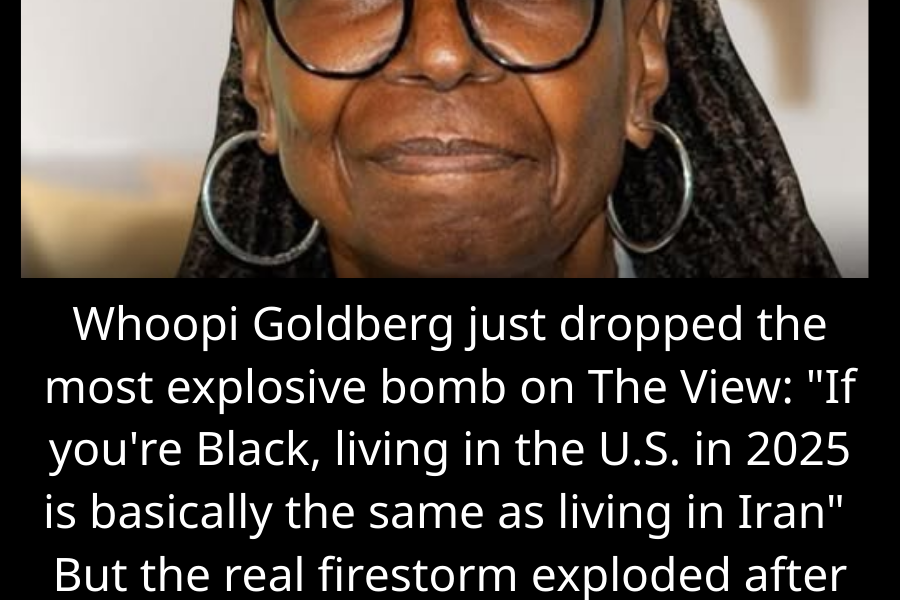
“If you’re Black, living in the U.S. in 2025 is basically the same as living in Iran.”
The room shifted. Griffin pushed back, pointing to the very real differences—freedom of speech, freedom of assembly, the ability to vote, the absence of religious police. But Whoopi doubled down, arguing that the constant fear of violence, the threat of police brutality, the everyday experience of being targeted for your identity—these create a parallel experience of oppression.
The segment ended. The internet exploded. And America was once again divided over a question that seems to have no answer: Can we compare different forms of suffering?
The Argument: What Whoopi Was Trying to Say
Let’s try to understand Whoopi’s point before we judge it. Because buried beneath the inflammatory rhetoric is an argument that many Black Americans actually make.
The Experience of Fear: Whoopi wasn’t comparing the legal structures of the U.S. and Iran. She was comparing the emotional experience of being a member of a targeted group. In Iran, if you’re a woman or a religious minority, you live with the knowledge that the state can harm you at any moment. In America, if you’re Black, she argues, you live with the same knowledge—that a traffic stop can turn fatal, that a knock on the door can be the last thing you hear, that your children are not safe simply by virtue of being children.
The Failure of Protection: Both societies, in her view, have failed to protect certain citizens. In Iran, the state actively persecutes. In America, the state passively allows persecution through inaction, through biased policing, through a justice system that treats Black lives as disposable. The mechanism differs, but the outcome—living in fear—is the same.
The Psychological Toll: Whoopi was speaking to the cumulative weight of living in a body that society has marked for suspicion. The microaggressions, the macro-aggressions, the constant vigilance, the exhaustion of always being “on”—these are not abstract concepts. They are daily realities for millions of Americans. And in her view, they create a lived experience that is, in its essence, comparable to living under an oppressive regime.
The Backlash: Why the Comparison Infuriates
The reaction was swift and predictable. But the intensity of the backlash suggests that Whoopi touched something deeper than a simple factual error.
Minimizing Actual Tyranny: Iran executes its citizens. It hangs women for refusing to wear the hijab. It imprisons journalists and tortures protesters. To compare that to the American experience—however flawed, however unjust—is, for many, an obscenity. It trivializes the suffering of those who actually live under theocracy.
Ignoring Progress: America has made enormous strides in racial justice, however incomplete. From the Civil Rights Act to the Voting Rights Act to the election of a Black president, the trajectory has been toward greater inclusion. Iran’s trajectory has been toward greater repression. To equate the two is to erase that progress.
The “Whataboutism” Trap: Critics argue that Whoopi’s comparison is a form of deflection—an attempt to change the subject from Iran’s horrors to America’s flaws. It’s the kind of moral equivalence that allows regimes like Iran to claim that their critics are hypocrites. “You criticize us,” they can say, “but your own country is just as bad.” Whoopi just handed them the quote.
The Insult to Black Americans: Many Black Americans themselves reject the comparison. They know the difference between a society where they can protest, vote, and speak freely, and a society where they would be executed for doing so. They know that the fight for justice in America is possible because America allows that fight. To claim that their struggle is equivalent to living under theocracy is, for some, to diminish the very hope that sustains the struggle.
The Nuance: Fear vs. Freedom
Let’s try to hold two truths simultaneously.
Truth One: The experience of many Black Americans includes a level of fear and trauma that is incomprehensible to those who don’t share it. The knowledge that your child could be killed for playing with a toy in a park, that you could be murdered for jogging while Black, that the people sworn to protect you might instead harm you—this is a real and legitimate source of suffering. It is not “the same” as a traffic ticket or a bad day at work. It is a fundamental breach of the social contract.
Truth Two: The United States, for all its flaws, is not Iran. Americans can organize, protest, vote, and speak against injustice without being executed. The very fact that Whoopi can say what she said on national television without being arrested, tortured, or killed is proof of that difference. Iran’s regime does not permit such dissent. The comparison, in that sense, is not just inaccurate; it’s a category error.
The question is whether the feeling of oppression can be compared even when the reality of oppression differs. Whoopi was speaking to feeling. Her critics are speaking to reality. Both are valid. Neither is complete.
The Political Context: Why This Matters Now
This debate is not happening in a vacuum. It comes at a moment when:
-
Iran is in the headlines due to the ongoing conflict, the death of the elder Khamenei, and the brutal crackdown on protests.
-
Race relations in America remain deeply fraught, with debates over policing, education, and representation continuing to divide the country.
-
The View is a cultural lightning rod, where every statement is amplified and dissected.
Whoopi’s comments are not just a philosophical argument; they are a political intervention at a moment of maximum tension. By comparing American racism to Iranian theocracy, she is implicitly arguing that the U.S. has no moral standing to criticize Iran—a position that aligns with the progressive left’s skepticism of American exceptionalism.
For her critics, this is not just wrong; it’s dangerous. It undermines the case for American leadership, weakens the alliance against Iran, and gives comfort to those who would see the U.S. as just another oppressive state.
The Verdict: A Debate Without Resolution
The question at the end of the segment—“Is this a fair comparison of systemic fear, or does it minimize the human rights crisis in Iran?”—is not one that can be definitively answered. It depends entirely on what you value.
If you value lived experience, if you believe that the subjective feeling of oppression is what matters most, then Whoopi’s comparison has merit. The fear of violence, the knowledge that the state may harm you, the exhaustion of constant vigilance—these are real, and they are shared across vastly different contexts.
If you value objective conditions, if you believe that the legal and political structure of a society is what determines whether it is oppressive, then Whoopi’s comparison is not just wrong but offensive. Iran’s regime kills people for speaking. America’s allows them to speak. That difference is not minor; it is fundamental.
The tragedy is that both sides are right in their own way. And as long as America remains a place where Black families live in fear, and Iran remains a place where anyone who speaks out lives in terror, the debate over which is “worse” will continue—unresolved, unresolvable, and utterly exhausting.
Whoopi said what she said. The internet did what it does. And the rest of us are left to wonder: Can we ever compare suffering without diminishing it?