Fetterman’s Fire Alarm: When a Democrat Calls Out His Own Party on Iran
The Senator Who Refuses to Fall in Line
Let’s set the stage, because the protagonist matters.
John Fetterman. The 6’8″ tattooed former mayor of Braddock, Pennsylvania. The hoodie-wearing, car-crashing, stroke-surviving Democrat who won a critical Senate seat in the blood-red year of 2022 by promising to be different. Not a progressive purist. Not a centrist sellout. Just… Fetterman. Authentic, unvarnished, and increasingly willing to say things that make his own party cringe.
This time, the target isn’t a Republican. It’s his own House caucus.
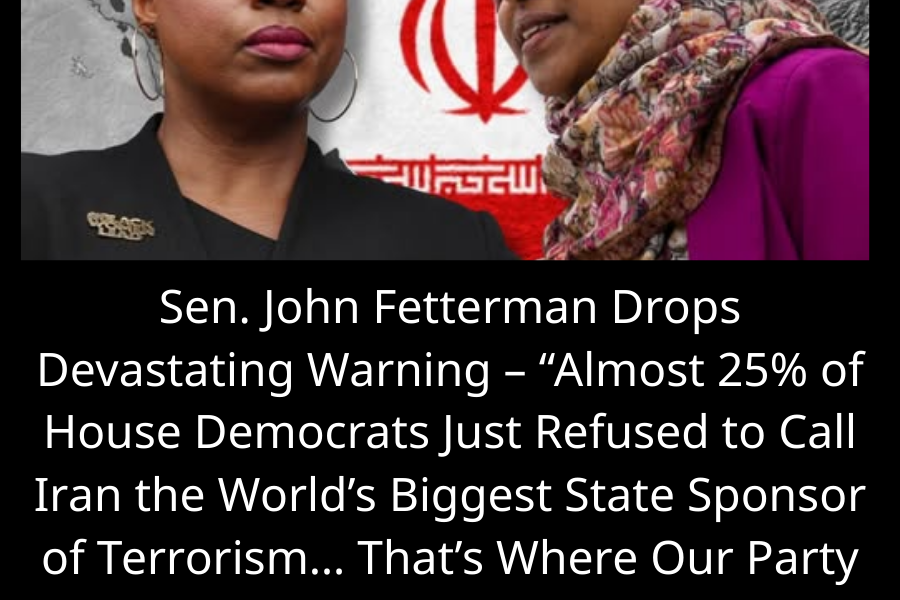
“That’s almost 25 percent of Democrats in the House that can’t just call Iran the world’s biggest terrorism underwriter…. That’s where our party’s been heading.”
The numbers are stark: dozens of House Democrats, including the entire “Squad,” voted against a resolution declaring Iran the “largest state sponsor of terrorism.” Not a controversial statement by any objective measure—Iran’s track record of funding Hamas, Hezbollah, the Houthis, and other proxies is as close to a consensus fact as exists in foreign policy. And yet, nearly a quarter of House Democrats said: No.
Fetterman didn’t just notice. He sounded the alarm. And in doing so, he opened a new front in the Democratic civil war—one fought over the very definition of reality.
The Vote That Exposed the Divide
Let’s be clear about what happened and what it means.
The resolution in question was straightforward: a declaration that Iran is the world’s leading state sponsor of terrorism. This is not a policy proposal. It’s not a call for war. It’s a statement of fact—the kind of thing that normally passes 400-0, with both parties racing to see who can condemn Iran more loudly.
Instead, dozens of Democrats voted no.
Why? The explanations vary:
-
The Squad’s Position: For members like Ilhan Omar, Rashida Tlaib, and Alexandria Ocasio-Cortez, the vote was likely about resisting any resolution that could be used to justify further confrontation with Iran or support for Israel. In their worldview, “terrorism” is a loaded term often weaponized against Palestinians and their allies. Voting no was a statement of solidarity with those they see as victims of American and Israeli aggression.
-
The Broader Progressive Argument: Some progressives argue that singling out Iran ignores the terrorism sponsored by other nations—including, implicitly, the United States and its allies. They see the resolution as hypocritical and selectively applied.
-
The Procedural Dodge: Some Democrats may have voted no due to concerns about the resolution’s language or its potential use as a pretext for military action. But procedural objections rarely explain a unified “no” from an entire ideological faction.
Whatever the individual reasons, the collective signal was unmistakable: a significant chunk of the Democratic Party is no longer comfortable with the basic framework of American foreign policy that has existed since 1979. They are not just questioning tactics; they are questioning the foundational assumptions about who the enemies are.
Fetterman’s Diagnosis: A Party Losing Its Bearings
Fetterman’s response is notable for its frustration, not its fury. He doesn’t call his colleagues traitors or idiots. He doesn’t accuse them of being Iranian stooges. He simply states a fact: That’s where our party’s been heading.
This is the voice of a man watching his political home drift into waters he never signed up to navigate.
What Fetterman Understands:
-
Electoral Reality: In Pennsylvania, where Fetterman has to face voters, calling Iran a terrorist state is not a controversial position. It’s baseline common sense. When 25% of his party’s House members can’t agree to that, they become a liability in swing districts and purple states.
-
Moral Clarity: Fetterman’s politics are rooted in a kind of blue-collar, no-nonsense moralism. Iran funds groups that murder civilians. That’s terrorism. Refusing to call it that isn’t sophistication; it’s intellectual cowardice dressed up as nuance.
-
The Danger of Factionalism: When a party’s most vocal faction becomes so ideologically rigid that it can’t agree on basic facts, the party loses the ability to govern. It becomes a collection of warring tribes rather than a coalition capable of winning elections and passing legislation.
The Squad’s Counter-Narrative: Refusing the “Terrorism” Frame
To understand why the Squad voted no, you have to understand their alternative worldview.
In their framing:
-
The term “terrorism” is applied selectively to enemies of the United States and Israel, while allies like Saudi Arabia commit similar acts with impunity.
-
Iran’s actions are often reactions to American and Israeli aggression, including sanctions, assassinations, and military pressure.
-
Voting for such a resolution legitimizes a foreign policy framework that has led to endless war, civilian casualties, and regional destabilization.
-
The real “state sponsors of terrorism” include the United States itself, if you define terrorism as the killing of civilians for political purposes.
This is not a fringe position in progressive circles. It’s a coherent, if controversial, critique of American foreign policy. But to voters like Fetterman’s constituents, it sounds like moral relativism at best, and outright hostility to American interests at worst.
The Electoral Implication: A Gift to Republicans
The political fallout is predictable and already underway.
Every time a Squad member votes against a resolution condemning Iran, Republican campaigns get a new ad. “Your Democrat representative refuses to call Iran a terrorist state. She stands with the enemies of America.” It’s simple, it’s powerful, and it works.
Fetterman understands this. He’s not just criticizing his colleagues; he’s trying to protect his party from itself. He’s saying: You’re making us all unelectable. You’re handing them the weapons to destroy us.
The irony is that the Squad’s votes are often principled, rooted in a genuine alternative vision. But principles don’t win elections if they can’t be explained to voters in a 30-second ad. And “Iran is not the biggest state sponsor of terrorism” is not a message that fits on a bumper sticker.
The Verdict: A Party at War With Itself
John Fetterman just told his party the truth. The question is whether anyone will listen.
The Democratic Party faces a choice it has been avoiding for a decade: Can it contain its progressive wing without destroying itself? Can it win national elections while a significant minority of its House members vote against basic foreign policy consensus?
The Squad sees itself as the moral conscience of the party, pushing it away from imperialism and toward justice. Fetterman sees them as an electoral anchor, dragging the entire ticket down.
Both are right. And that’s the tragedy.
Until Democrats resolve this tension—until they decide whether they are a center-left coalition or a progressive vanguard—they will continue to lose ground with the very voters Fetterman represents. The ones who don’t care about foreign policy nuance. The ones who just know that Iran is bad, and that their representative should be able to say so.
Fetterman’s “dire assessment” isn’t hyperbole. It’s a warning. And if his party ignores it, they won’t just lose the next election. They’ll lose the ability to ever win again.