The Stone That Broke the Foundation: Barbara Rose Johns Replaces Robert E. Lee in the Capitol’s Soul
WASHINGTON D.C. — The change wasn’t just in the stone. It was in the gravity.
For 111 years, the statue of Confederate General Robert E. Lee stood in the National Statuary Hall—a space in the U.S. Capitol where each state donates two figures of “historic renown.” Lee’s presence was a geological fact of American politics: a monument to a lost cause, literally embedded in the foundation of the Union he fought to destroy.
On Tuesday, that gravity shifted.
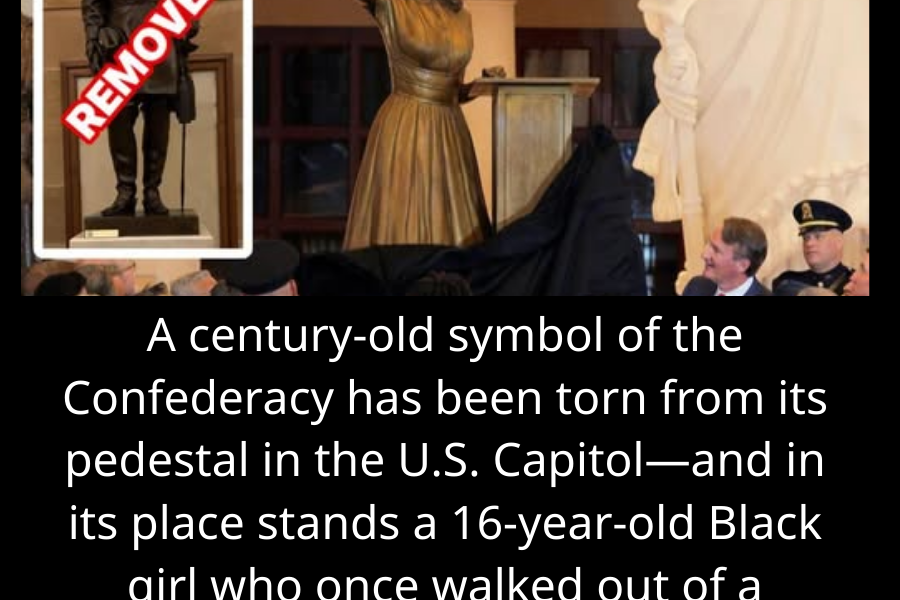
Virginia formally replaced Lee with a statue of Barbara Rose Johns—a 16-year-old Black girl in a simple dress and bobby socks, holding a book. The swap is not an update. It is a cosmic correction. It exchanges the bronze image of a man who fought to preserve a system of bondage for the stone likeness of a teenager who helped dismantle its legacy.
This is not merely swapping one historical figure for another. This is the Capitol telling a new story about where American courage actually comes from.
The Action: Not a Protest, A Strategic Strike
The facts are breathtaking in their simplicity. In 1951, at the all-Black Robert R. Moton High School in Farmville, Virginia, students endured a hellscape of neglect: tar-paper shacks for overflow classrooms, leaking roofs, second-hand textbooks, no science lab, no gym, no cafeteria.
Barbara Rose Johns, an 11th grader, didn’t just complain. She engineered.
She organized a meeting of the school’s student leaders under the guise of a dance committee. She laid out a plan for a strike. On April 23, 1951, she tricked the principal into leaving campus with a report of truants at the train station. She then called an assembly and led the entire student body—450 strong—out on a walkout, carrying signs reading “WE WANT A NEW SCHOOL” and “DOWN WITH TAR-PAPER SHACKS.”
This was not a spontaneous adolescent outburst. It was a meticulous, non-violent campaign led by a teenage girl. She contacted the NAACP, which agreed to take the case only if the students sued for integration, not just equal facilities. Johns convinced her terrified peers and their families to agree. That lawsuit, Davis v. County School Board of Prince Edward County, became one of the five cases consolidated into Brown v. Board of Education.
Lee commanded armies. Johns mobilized a student body and, in doing so, helped mobilize the law of the land.
The Symbolic Calculus: From Lost Cause to Found Conscience
The Statuary Hall collection has long been a petri dish of American myth-making. For over a century, Virginia’s choices—George Washington and Robert E. Lee—presented a tidy, conflicted thesis: the Father of the Union alongside the lion of its rebellion.
The inclusion of Lee was always a political act of revisionism, a nod to the “Lost Cause” narrative that sought to recast a war over slavery as a noble fight for states’ rights. His presence silently endorsed the idea that defiance of the federal government for the purpose of preserving white supremacy was worthy of national homage.
Johns’ statue eviscerates that narrative. It declares that the true Virginia heroism of the 20th century wasn’t found on a battlefield defending a slaveholding past, but in a schoolyard fighting for an equitable future. It shifts the locus of courage from the general on horseback to the girl with a textbook.
“This is a profound re-mythologizing of the American identity,” says Dr. Annette Gordon-Reed, historian and author of The Hemingses of Monticello. “For generations, the Capitol’s art told a story of power consolidated and defended, often by men in uniform. Barbara Johns represents a different, more democratic power: the moral authority of the oppressed, the strategic brilliance of the young, the courage to demand that a nation live up to its own words. Her statue isn’t just a new face; it’s a new lens.”
The Stone-Cold Details: What You See
The statue, carved by sculptor Steven Weitzman, shows Johns as she was: young, determined, ordinary and extraordinary all at once. She holds a book, representing both the education she was denied and the legal tome of Brown v. Board. Her gaze is not toward the heavens, but forward, focused, as if looking at a principal or a lawyer or a future she intends to claim.
She is permanently frozen in the moment before the shout, before the march—in the quiet, decisive instant where conviction turns into action. It is a monument not to a victory lap, but to the courage to begin.
The Ripple: Beyond the Capitol Dome
This replacement is part of a larger, painful, and necessary national recalibration. It follows the removal of Confederate monuments in city squares, the renaming of military bases, and the intense debate over which legacies we physically venerate.
The opposition will frame it as “erasing history.” But that argument misses the point. History isn’t being erased; it’s being re-centered. Lee is still taught in textbooks. But he no longer gets the honor of a place in the people’s hall, representing the soul of Virginia. That honor now belongs to a girl who changed history with a plan, a boldness, and a profound belief in justice.
The true power of Barbara Rose Johns’ statue lies in its quiet, unanswerable question to every visitor, especially every schoolchild who sees it:
What is the true face of American strength? The general who fought to divide, or the child who led us toward a more perfect union?
The stone has now answered. The foundation, at long last, is being repaired.