The Unlikely Truce: How Chaos Forced a Call and What It Reveals
The Phone Call That Broke the Fever
In the scorched-earth theater of modern American politics, some events are so dissonant they force the narrative to a halt. This was one of them.
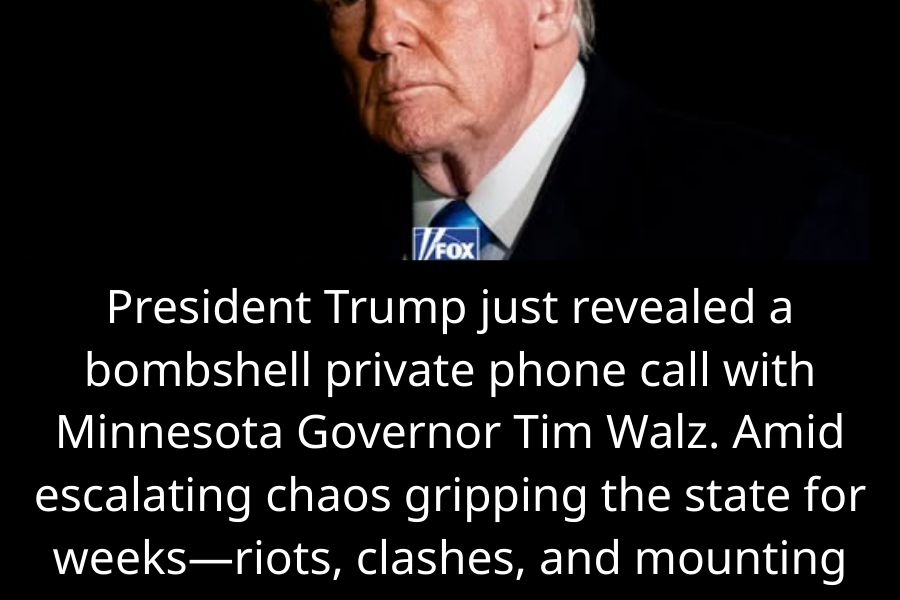
President Donald Trump, on his Truth Social pulpit, announcing a “very good call” with Governor Tim Walz—the same man he has spent weeks publicly eviscerating as weak, irresponsible, and an inciter of chaos. The same governor who, just days prior, invoked Anne Frank and the Holocaust to condemn the actions of Trump’s federal agents. The same state that has been a rolling crisis of protests, shootings, and mutual recrimination for a month.
And the catalyst? According to Trump, a call from Walz himself, requesting to “work together.”
Whether the call originated from Walz’s office or, as commenter Johnny Nolasco suspects, was initiated by Trump, is almost irrelevant. The public admission of the call is the strategic event. It is a white flag disguised as a handshake, a moment of raw political calculus breaking through the wall of performative outrage. It’s the point in the action movie where the hero and the rogue cop, after trading punches, realize the real villain is still out there.
Decoding the “Similar Wavelength”: A Symphony of Subtext
The language in Trump’s post and Walz’s subsequent statement is a masterpiece of political code, each side claiming victory and projecting strength to their respective bases.
Trump’s Narrative: The Strongman’s Offer of Order.
Trump’s framing is classic consolidation of power. He magnanimously accepts the call for help. He dispatches his enforcer, Tom Homan—a man whose name in immigration circles carries the weight of a hammer. The commenters get it immediately: “I’m sending in Tom Homan’ is equivalent to saying, ‘just wait until your dad comes home.’” Trump’s message to his base is clear: The chaos proved I was right. Their leader buckled. My guy is now in charge. He focuses the mission neatly: “any and all Criminals.” It’s simple, potent, and diverts attention from the systemic critique to a manhunt.
Walz’s Narrative: The Statesman Securing Concessions.
Walz’s office, in its rebuttal, performs a different kind of alchemy. They frame the call as “productive” because they secured two critical, face-saving concessions:
-
An “impartial investigation” into the shootings (specifically naming the state’s Bureau of Criminal Apprehension).
-
A reduction in the number of federal agents and a promise of more “coordinated” action.
For Walz, this is damage control spun as diplomatic victory. After weeks of being portrayed as powerless against a federal juggernaut, he can claim he got Trump to dial back the presence and grant the state investigative authority. He reminds everyone that Minnesota already cooperates on detainers, subtly arguing the heavy-handed surge was never needed.
The “Similar Wavelength” is this: Both men needed the violence to stop. For Trump, the unending images of chaos in Minnesota undermine his “law and order” brand. For Walz, the crisis was consuming his governorship and his city. They found a wavelength of mutual exhaustion and political necessity.
The Homan Deployment: The Chess Move in a Checkers Game
Sending Tom Homan isn’t just adding another bureaucrat. It’s a political and tactical escalation with a velvet glove.
-
Symbolism: Homan is the architect of the Trump-era immigration enforcement playbook. His presence is a statement of federal sovereignty. He doesn’t negotiate with local DAs; he executes policy.
-
Centralized Control: As the commenter Tammy Hayes noted, “Trump’s playing Chess.” Homan reports directly to the Oval Office. This cuts through DHS chain-of-command and potential internal dissent. He is the President’s personal avatar on the ground, giving Trump direct, deniable control over the next phase.
-
The Fraud Nexus: The White House statement explicitly links Homan to “coordinating… on the ongoing fraud investigations.” This is the master-stroke. It ties the immigration enforcement directly to the multi-billion dollar welfare fraud scandal plaguing the state. It reframes the entire federal presence: not as random raids, but as a targeted, financial-crime operation. This is a far more politically palatable justification, even for some moderates.
The Public’s Reaction: Cynicism, Relief, and the “Snake Story”
The comment section is a microcosm of the national psyche:
-
The Triumphalists (Stuart Renton, Carmen Trejo): See this as the inevitable victory of strength over posturing. The big fish turned toward the boat.
-
The Cynics (Gerri Lyn Jamison, Kevin Slaton): Suspect Walz is acting out of fear, not principle. Slaton’s reference to “the snake story” is telling—Aesop’s fable where a snake bites the man who showed it kindness, a conservative warning against trusting opponents.
-
The Pragmatists (Joe Miller, Mr-moturi Moturi): Express a weary hope that cooperation, however begrudging, might finally yield solutions. “When unrest drags on, cooperation beats grandstanding.”
-
The Realists (Sharon Brown, Darol Smith): Sense the unseen pressures—likely the specter of federal investigations into the fraud scandal and Walz’s own political mortality.
The Verdict: A Temporary Ceasefire in a Permanent War
This is not peace. It is a tactical pause.
Trump gains operational control, a chance to recalibrate the mission under Homan with a less visibly militarized footprint, and the PR win of a Democratic governor “coming to the table.”
Walz gains a reduction in the incendiary federal presence, a claim to independent investigation, and a chance to stop the bleeding in Minneapolis streets and in his polling.
But the fundamental conflicts are unresolved. The deep disagreements over immigration enforcement, federal power, and the role of protest remain. The 8th Circuit has still empowered ICE. The community’s trauma is not healed. The fraud investigations are still a looming threat.
The “very good call” is the sound of two politicians, backed into corners of their own making, realizing that the continued explosion benefits no one but their most extreme opponents. They have chosen to manage the crisis together, temporarily, so they can each survive to fight the larger war another day.
It’s not the end of the story. It’s the end of an act. The next scene belongs to Tom Homan, the streets of Minneapolis, and the uneasy, negotiated silence that now hangs over it all. A silence that feels less like peace, and more like the moment everyone holds their breath to see what breaks first.