The Ghost in the Hearing Room: On Whiteness, Guilt, and the Unsaid in American Politics
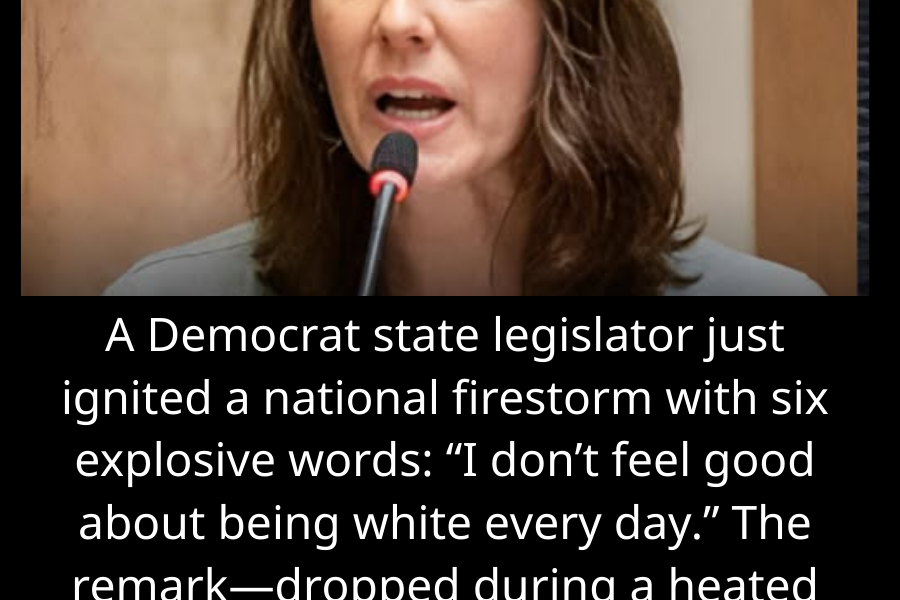
STATE CAPITOL — The syntax of the scandal is simple: a single, jarring sentence spoken in the fluorescent-lit chamber of a public hearing. “I don’t feel good about being white every day.”
The Democrat state lawmaker who said it was likely aiming for a kind of raw, confessional empathy—an attempt to articulate the psychic weight of acknowledging racial privilege and historical injustice in a country built on both. Instead, she handed her opponents a perfectly framed cultural artifact. The video clip, stripped of context and hurtled through the digital outrage machine, becomes proof positive of everything the right alleges about the modern left: that it traffics in racial guilt, promotes self-flagellation, and sees identity not as a fact but as a moral condition.
This isn’t a story about one lawmaker’s poorly worded sincerity. It’s a story about why that particular phrasing detonates, and what the explosion reveals about America’s unreconciled grammar of race.
Deconstructing the Detonation: Why “I don’t feel good about being white” Lands as a Grenade
The backlash isn’t merely partisan. It taps into deep, often inarticulate anxieties.
For Critics, the phrase confirms a terrifying syllogism:
-
The left believes whiteness is inherently problematic.
-
DEI initiatives are the policy arm of that belief.
-
Therefore, DEI is not about “equity” but about the systemic moral demotion of white people.
It frames whiteness not as a neutral demographic fact, but as a source of shame. In doing so, it seemingly validates the core grievance of the anti-“woke” movement: that progressive politics has shifted from seeking equality to engineering a hierarchy of victimhood where white people, regardless of individual circumstance, are permanently assigned the role of oppressor. It sounds less like social policy and more like secular penance.
The Lawmaker’s Probable Intent (The Unsaid Context):
In the fuller, un-clipped context of a DEI hearing, she was almost certainly trying to express something more nuanced: a daily, conscious reckoning with the unearned advantages and historical baggage attached to her racial identity in an unequal society. She was likely attempting to model the “privilege awareness” that DEI training advocates: the uncomfortable, personal work of acknowledging systemic bias you benefit from.
But in politics, nuance is a luxury, and intent is irrelevant next to reception. The soundbite became a Rorschach test.
The Two Americas Hearing the Same Sentence
In one America, the comment is a brave, if clumsy, admission of moral clarity. It acknowledges that in a nation stained by slavery, segregation, and ongoing disparity, simply ignoring one’s racial identity is a privilege in itself. To “feel good” about whiteness, in this view, would require ignoring history and current reality. The discomfort is a sign of ethical engagement, not self-hatred. Supporters hear an ally signaling, “I carry the weight of this too.”
In the other America, the comment is a pathological statement. It represents the ultimate victory of critical race theory’s most caricatured interpretation—that individuals are reduced to their racial category, assigned eternal guilt or innocence, and told to organize their emotions accordingly. It feels like a demand for a kind of ideological loyalty oath based on skin color. Critics hear not empathy, but a declaration of racial betrayal and a soft bigotry of low expectations for her own group.
“This controversy is about the collision of two fundamentally different languages of moral accounting,” explains Dr. Elijah Graham, a sociologist who studies political rhetoric. “One language, rooted in progressive activism, is collective and historical. It says: ‘You inherit a position in a story of harm, and ethical living requires acknowledging that.’ The other language, rooted in classic liberalism and modern conservatism, is individual and presentist. It says: ‘You are responsible for your own actions and feelings, not the actions of historical people who share your skin tone.’ When the lawmaker used the collective-historical language (‘being white’), she was heard by the individual-presentist ear as saying ‘I am guilty for what I am.’ The translation was impossible, and so the conflict was inevitable.”
The Larger Stage: DEI as the Battlefield
The lawmaker’s comment didn’t happen in a vacuum. It happened during a defense of DEI policies, which have become the central cultural-political battleground of the 2020s. The remark instantly becomes ammunition in the larger war.
-
For opponents, it’s entered into evidence as Exhibit A: See? DEI makes people hate themselves based on race. It’s state-sponsored racial divisiveness.
-
For proponents, the furious backlash is Exhibit A of the very defensiveness and fragility that makes DEI necessary: The mere mention of racial discomfort triggers a denialist meltdown, proving the system’s resistance to introspection.
The “national debate” it fuels is, in reality, two separate, parallel monologues about:
-
What the problem is: Is it systemic racism, or is it the obsessive focus on race?
-
What solutions are legitimate: Is it targeted policies (DEI) to rectify inequity, or is it a return to strict colorblind individualism?
The Unanswerable Question at the Heart of It
The firestorm points to a question America has never cleanly answered: In a society striving for equality, what is the emotionally correct way for a white person to be white?
Is it to feel neutral? Is it to feel proud? Is it to feel responsible? Is it to feel ashamed? The lawmaker ventured an answer from one cultural script and was met with fury from a different cultural audience.
Her real transgression may not have been her politics, but her public emotional disclosure. She broke a cardinal rule: she voiced the quiet, messy, internal conflict that many wrestle with privately. In today’s politics, internal conflict is a weakness to be weaponized, not a shared human condition to be explored.
The backlash, therefore, is less about her and more about policing the boundaries of acceptable racial discourse. It’s a warning shot: Speak about whiteness only in certain, approved ways—or become the story. And in becoming the story, she has inadvertently proven just how difficult, and how necessary, that honest conversation continues to be.