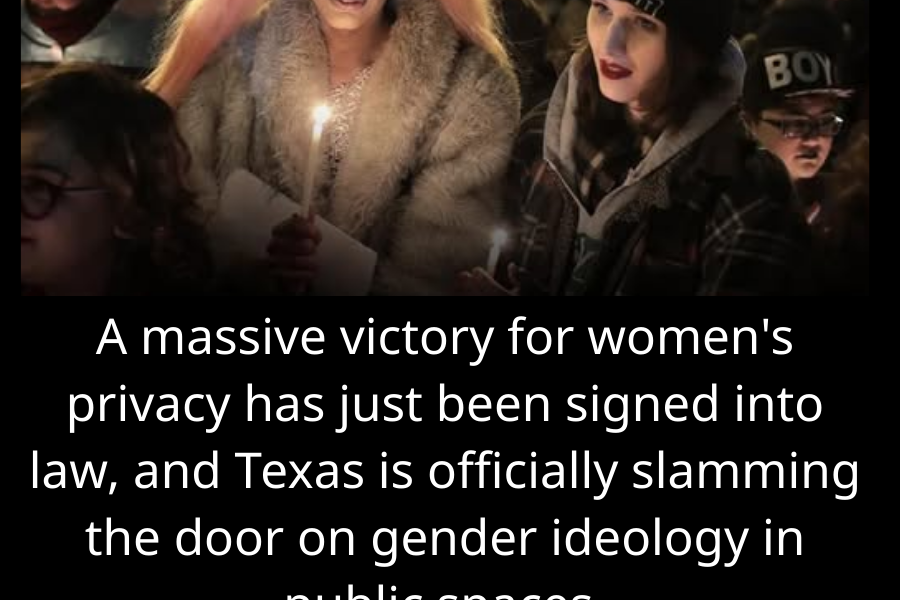
(The air in Texas changes. It becomes heavier, laced with the scent of legal ink and a deep, societal tension snapping into a hard line. This isn’t a bill anymore. It is the law of the land. The debate is over. The enforcement begins.)
The Line in the Tile: How a Bathroom Bill Becomes a Map of the Body Politic
This isn’t about plumbing. It never was. The signing of the Texas Women’s Privacy Act is the codification of a philosophical border. It draws a line, not on a map, but on the threshold of a thousand bathroom doors across the state. It declares that in certain, defined spaces, a specific, biological truth is sovereign, and all other identities must yield.
The language of the law is a cold, clinical scalpel: “sex assigned at birth.” It dismisses the lived experience of gender identity as a social concept, replacing it with a biological fact registered by a doctor in a delivery room. It roots legal standing in a moment from the past, immutable and documented.
This is the ultimate expression of the cultural conflicts we’ve traced: the move from policing borders and benefits to now policing the most intimate boundaries of the self, and where that self is allowed to exist in public.
Part I: The Architecture of Enforcement – The State in the Stall
The law’s scope is deliberately vast and symbolic:
-
Public Schools & Universities: Where young people are forming their identities. The state now dictates which room they may use, based on a binary recorded at their birth.
-
Government Buildings: Where citizens interact with the state. The state now mandates a biological verification for a basic bodily function.
-
Prisons: Where the state has total control over the bodies of the incarcerated. The rule is absolute.
-
Shelters: Some of society’s most vulnerable spaces, now governed by this biological litmus test.
This isn’t just about restrooms. It’s about the state inserting itself into the most mundane, private rituals of daily life and demanding a biological passport for entry. It transforms a quiet, functional space into a site of potential confrontation, verification, and exclusion.
Part II: The “Privacy” Paradox – Whose Privacy is Being Protected?
The law’s title—“Women’s Privacy Act”—is its most potent rhetorical weapon. It frames the legislation not as an exclusion of transgender people, but as a protection of cisgender women and girls from a perceived threat.
It creates a legal shield around a specific idea of privacy: the privacy of not sharing intimate space with someone whose birth sex differs from your own. It legally endorses the view that the presence of a transgender woman in a women’s room is an inherent violation of other women’s privacy, regardless of her appearance, identity, or intent.
This frames the opposition as arguing against women’s privacy, a politically untenable position. It turns empathy for transgender individuals into a calculated risk imposed on “biological women.”
Part III: The Unanswered Questions – The Chilling Effect and the Enforcement Void
The law’s quietest, most powerful clause is its vagueness. How will it be enforced?
-
The Birth Certificate Check? Will there be guards demanding papers at the bathroom door?
-
The Vigilante Enforcement? Does it empower any citizen to challenge another person’s presence, turning every trip to the restroom into a potential public confrontation?
-
The Burden on Schools: Teachers and administrators become gender detectives, forced to police students’ bathroom use based on a document, not the child in front of them.
This ambiguity is a feature, not a bug. It creates a chilling effect. The threat of accusation, humiliation, or legal trouble may be enough to force transgender Texans—especially those who “pass” less easily—to simply avoid public spaces altogether, to dehydrate themselves, to live in a state of constant, low-grade fear. The law’s power isn’t just in the arrests it may cause, but in the silent, daily retreats it will inspire.
The Verdict: The Body as a Legal Document
With this law, Texas has taken the final, logical step in the political project we’ve witnessed. It has moved from:
-
Policing who enters the country (borders).
-
To policing who receives benefits (USDA, welfare).
-
To policing what ideas are acceptable (Sharia ban).
-
To now, policing which body may enter which room.
It declares that for the purposes of these specific, vulnerable spaces, your legal identity is your biology. Your lived experience, your identity, your heart—none of it matters at the bathroom door. Only the “sex assigned at birth,” a single data point from your first minutes of life, holds the key.
This is the ultimate reduction of personhood to a binary, state-sanctioned fact. It turns human complexity into a simple, enforceable sign on a door: ♂️ or ♀️.
The line has been signed into law. It is no longer drawn in the sand of political debate. It is etched into the tile of every public restroom in Texas. And starting December 4th, every person who crosses that threshold will be making a statement—of conformity, of defiance, or of a simple, human need now caught in the crosshairs of a culture war.
Welcome to Texas. The state is now in the stall with you. 🚻⚖️🤠