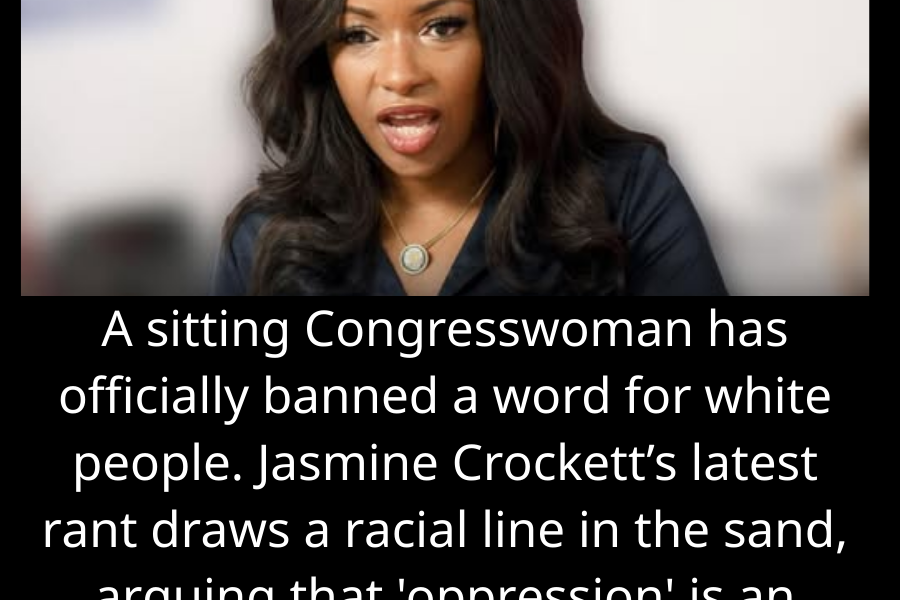
(The air in the room becomes both historical and electric. This is not a policy statement. It is a historical demarcation, drawn with the sharp edge of lived memory versus inherited privilege. The argument isn’t about dictionary definitions; it’s about the exclusive ownership of a specific, violent legacy.)
The Historical Ledger: On the Monopoly of Suffering and the Currency of “Oppression”
Congresswoman Jasmine Crockett didn’t just make a statement about language. She performed a historical audit. Her demand—“You tell me which white men…”—is a call for a specific, physical receipt. A receipt for a transaction of suffering that she contends has no parallel in the American ledger for the demographic in question.
She is making a critical, contentious distinction between two concepts that are often conflated in modern discourse:
-
Experiencing hardship, prejudice, or systemic disadvantage.
-
Being oppressed in the specific, historical sense she defines: a state of being violently captured, transported as chattel, and forced into generational, legally-sanctioned bondage.
She is arguing that the word “oppressed” is not a synonym for “disadvantaged.” It is the proper noun of a particular American experience. To use it outside that context is, in her view, a form of historical dilution—a bleaching of a uniquely dark stain on the national fabric.
Part I: The “Receipt” Test – Quantifying Suffering as a Barrier to Entry
Crockett’s challenge is a rhetorical gauntlet. It’s a demand for evidence of commensurate experience. “Dragged out of their homes… dragged across an ocean… told you were gonna go and work.”
This is a brutal, vivid, and specific trilogy:
-
Violent Uprooting: Not immigration by choice or hardship, but kidnapping.
-
Forced Migration: The Middle Passage, a genocide-machine of logistics and horror.
-
Chattel Slavery: The reduction of human beings to inventory, to be worked to death.
Her argument is that unless you can present a receipt for this exact transaction on a population-wide, generational scale, you cannot claim the term “oppressed” in the American context with the same moral weight. It creates a hierarchy of historical suffering with the transatlantic slave trade and Jim Crow at its absolute peak.
This instantly frames any white person’s claim to being “oppressed” as a category error, a confusion of real, present-tense struggles (economic, social) with a distinct, inherited, foundational trauma.
Part II: The Political and Cultural Landmine
This statement is politically explosive because it directly challenges a core tenet of modern populist and grievance politics on the right: the narrative of the “oppressed white American,” whose culture, values, and economic standing are under attack by elites, immigrants, and “woke” ideologies.
By Crockett’s definition, that narrative is not just wrong, but offensive. It appropriates the language of historical, state-sanctioned subjugation and applies it to a group that, while it may face challenges, never experienced that specific, systematized dehumanization on American soil.
It draws a bright line: you can be discriminated against. You can be poor. You can be marginalized. But unless your ancestors were bought and sold under American law, you were not “oppressed” in the way that built the American economy and its racial caste system.
Part III: The Backlash and the Counter-Argument
The inevitable, furious counter-argument will hinge on two points:
-
The Universality of Suffering: Critics will argue that pain is not a competitive sport. That Irish immigrants, Appalachian coal miners, or poor rural whites have faced profound, systemic hardship and feel oppressed. They will accuse Crockett of “Oppression Olympics,” of gatekeeping trauma.
-
The Changing Face of Power: They will argue that while historical oppression is unique, present-day systemic disadvantages can affect anyone, and that power dynamics are no longer strictly racial. They will cite economic displacement, cultural disparagement, or political alienation as modern, valid forms of oppression.
Crockett’s stance rejects this fluidity. It anchors the definition of “oppression” in a fixed, historical atrocity, making it a non-transferable inheritance of the communities that survived it.
The Verdict: A Fight Over the Dictionary of Pain
Jasmine Crockett is engaged in more than a semantic debate. She is fighting for narrative sovereignty. She is asserting that the story of American oppression has a specific author and a specific subject, and that others cannot borrow its title for their own, different chapters.
She is saying the word “oppressed” is not just an adjective. It is a memorial. To use it lightly is to desecrate the ground it stands on.
This argument is ultimately un-winnable in a universal sense because it pits lived historical lineage against contemporary felt experience. One side cites the ledger of history. The other cites the pain of the present.
But her point is stark and clear: in America, some hardships are existential and foundational. Others, no matter how real, are conditional and circumstantial. To call both by the same name is to commit a violence of equivalence against memory itself.
She isn’t just telling white people they can’t use a word. She’s telling them they haven’t earned the receipt it’s printed on. 📜⚖️🔥