The Pepper Spray Threshold: When Oversight Collides with Enforcement in the Age of Immigration Theater
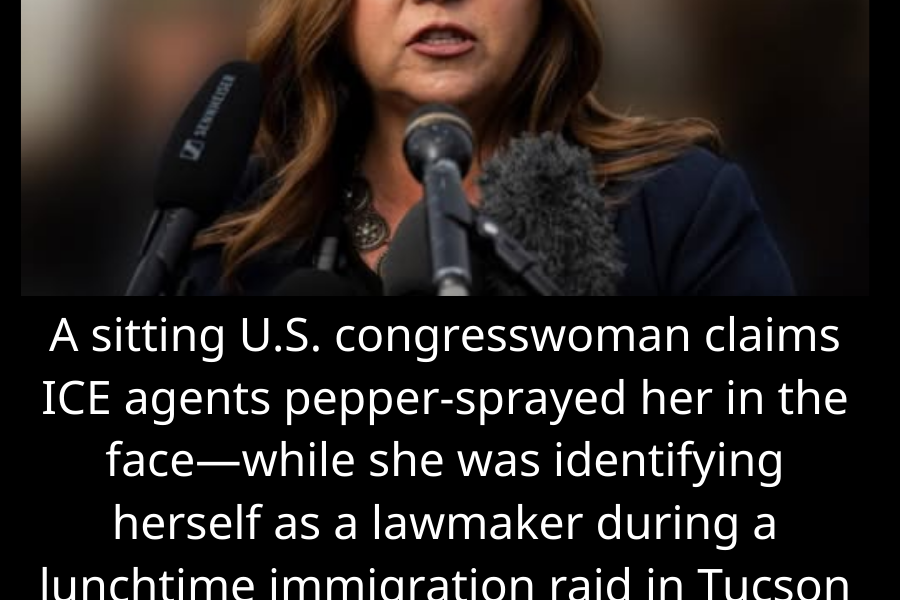
TUCSON, Arizona — 12:47 PM local time. The scene is pure 2024 American friction: a sun-baked strip mall parking lot, the flashing lights of unmarked ICE vehicles, a crowd of protesters chanting, smartphone cameras raised like digital shields. And in the center of it, a U.S. Congresswoman holding a takeout lunch order, getting a face full of chemical spray.
The incident involving Representative Adelita Grijalva (D-AZ) is not just a news clip. It is a perfectly staged collision of dueling sovereignties. On one side, the federal enforcement agency, operating under a mandate of arrest and removal, in a volatile crowd-control situation. On the other, a member of a co-equal branch of government, asserting a constitutional right to oversee that very operation.
The conflicting narratives aren’t just about what happened; they’re about whose story of America gets to control the frame.
The Two Scripts: Victim vs. Violator
Grijalva’s Narrative: The Legislator as Witness
In her account, she was a calm official conducting oversight. She “arrived to get lunch,” “identified herself,” and was “asking for clarification.” The pepper spray and shove were an unprovoked, disproportionate attack on her person and, by extension, on the principle of Congressional oversight. The violence against her becomes symbolic of a government agency that sees itself as unaccountable, operating with impunity against both immigrants and their elected representatives.
DHS’s Narrative: The Agent in the Crowd
The Department of Homeland Security’s spokesperson, Tricia McLaughlin, offers the law enforcement perspective. Grijalva was “near individuals who were… obstructing and assaulting.” The key word is “near.” In the chaos of crowd control, agents don’t distinguish between a congresswoman and a protester; they see a threat perimeter. The spray was a tool to regain control, not a targeted act. The mention of two seriously injured officers grounds the story in the physical risks of the job, reframing the agents as the true victims.
Both stories can be factually true simultaneously. This is the essence of the modern political clash: two legitimate authorities operating on completely different rulebooks, in the same physical space.
The Core Conflict: Where Does Oversight End and Obstruction Begin?
This incident drills into a fundamental, unresolved question: What are the actual, on-the-ground limits of a Congressperson’s oversight power during a live law enforcement operation?
Grijalva asserts it is her “right” to ask questions. But does that right include entering an active enforcement perimeter? Does identifying herself as a member of Congress grant her a forcefield, or does it merely make her a prominent person within a potentially illegal assembly?
There is no clear line. Precedent is sparse. The power of Congress to investigate is broad, but it traditionally operates through subpoenas and hearings, not through real-time, physical intervention at the point of arrest. By placing her body in that space, Grijalva was engaging in a form of performative oversight—using her physical presence as a tool of protest and witness, intentionally blurring the line between legislator and activist.
“This is oversight theater,” argues Dr. Ben Torres, a political sociologist at the University of Arizona. “It’s designed to create the exact kind of visceral, recorded conflict we’re now dissecting. The goal isn’t to glean information a FOIA request couldn’t get; it’s to stage the conflict between compassionate governance and militarized enforcement in a single, shocking frame. The pepper spray isn’t an unfortunate accident; it’s the inevitable climax of the scene.”
For ICE agents, trained for volatility and potential violence, a person—any person—disregarding commands and approaching during an operation is a threat. Their rulebook is about control and safety. Grijalva’s rulebook is about transparency and accountability. In that parking lot, there was no referee to reconcile them.
The Aftermath: Political Fuel and Legal Gray Zones
The fallout is predictable and potent:
-
For the Left: Grijalva becomes a martyr, graphic proof of the brutality and unaccountability of a deportation machine. Calls to “Abolish ICE” gain a new, powerful visual.
-
For the Right: She is an irresponsible grandstander who inserted herself into a dangerous situation, interfered with law enforcement, and is now playing the victim. The injured officers are the real story.
-
For the Institution: It sets a dangerous, escalatory precedent. Will other members of Congress now stage interventions at enforcement actions? Will ICE agents become hesitant, or more aggressive, when elected officials are present?
Legally, Grijalva has no special immunity from crowd control measures. Ethically and politically, however, the spraying of a sitting Congresswoman is a threshold-crossing event. It normalizes the use of force against a member of a co-equal branch.
The Bigger Picture: The Border War Comes Home
Ultimately, this isn’t about a lunch trip gone wrong. It’s about the domestication of the border conflict. The immigration debate is no longer confined to fence lines in Texas; it is now in Tucson parking lots, with federal agents squaring off against federal legislators.
The pepper spray cloud hanging over that scene is more than a chemical irritant. It is the hazy, painful space where our political divisions can no longer be managed by procedure, and instead are settled by force, confusion, and competing videos.
Grijalva will call for hearings. DHS will stand by its agents. The lawsuits will follow. But the lasting image—the Congresswoman, hand to her face, agents in tactical gear turning away—is the new emblem of a government at war with itself, not over policy, but over the very ground upon which it stands.