The Unsettling Ingredient: When Food Safety Becomes a Crime Scene
BILOXI, Mississippi — The scene is a familiar altar of American consumption: the supermarket bakery aisle. The smell of yeast and sugar. The soft, industrial glow on rows of packaged muffins and uniform loaves of bread. It is a place of mundane, trusted routine.
That trust was violated with a chillingly simple weapon: a razor blade pushed through plastic.
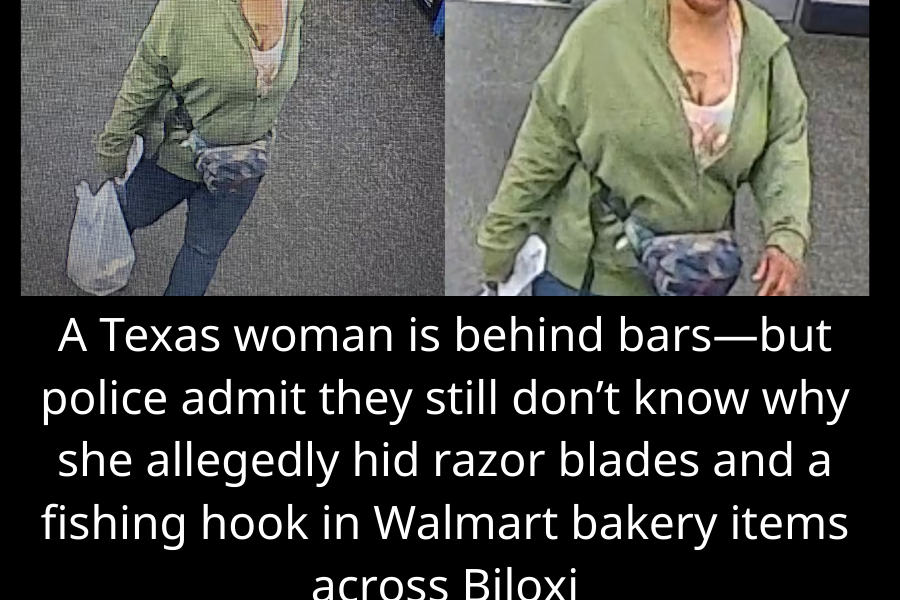
After 11 days of escalating discoveries—first a fishing hook in a banana nut muffin, then razor blades in loaves of bread at two separate Biloxi Walmart stores—police have arrested 33-year-old Camille Benson of Texas. She faces a charge of attempted mayhem, a legal term that evokes a deliberate, malicious act intended to disfigure or disable.
This is not a tale of corporate negligence or supply chain failure. This is a story of individual malice invading a space of collective trust, and the societal vulnerabilities it exposes.
The Anatomy of a “Strange” Crime
Lieutenant Candice Young’s description of the crime as “strange” is telling. It lacks the obvious motives of theft or terrorism. It appears pointedly intimate and cruel. The targets weren’t high-value items or symbols of the state; they were staples of daily life—bread, a muffin. The violence was not explosive but insidious, hidden inside the very sustenance a family might bring home.
The methodology was low-tech and alarmingly effective: piercing pre-sealed packaging to insert sharp metal. It required no insider access, just a moment of privacy in an aisle. This bypasses the traditional safety nets of food production, targeting the product at its most vulnerable point: the final point of sale, where consumer vigilance is lowest.
The delayed police response is a crucial part of the timeline. Each store initially treated the first report as an isolated incident. It was only after a customer complaint on Monday triggered a sweep that the pattern emerged, revealing a potential serial tamperer operating across two locations. This highlights a critical weakness in our system: the gap between local store incident reports and the ability to swiftly connect them to a broader, intentional campaign.
“This is a crime that weaponizes the ordinary,” says Dr. Helen Cho, a criminologist specializing in consumer safety and threat assessment. “It exploits the implicit contract we all sign when we buy packaged food: that the seal is inviolate. It’s not a grand ideological statement; it’s a hyper-personalized form of aggression that turns the domestic act of eating into a potential trauma. The ‘strangeness’ comes from its motiveless malignity—it seems designed to cause harm for harm’s sake, which is uniquely terrifying to the public psyche.”
The Charge: “Attempted Mayhem” and Its Weight
The choice of charge is significant. “Attempted mayhem” is a serious felony, often used when an action is taken with the intent to cause permanent, disfiguring injury. By alleging attempted mayhem, prosecutors are signaling they believe Benson’s actions were premeditated and aimed at causing grievous bodily harm, not merely mischief or tampering.
The $100,000 bond reflects the severity with which the court views the threat to public safety. It frames the act not as a prank, but as a violent assault on the community at large.
The Corporate and Community Response: Sweeps, Refunds, and Vigilance
Walmart’s response followed the standard crisis playbook: remove all potentially affected product, cooperate fully with law enforcement, and offer refunds. Their statement appropriately centers customer safety and gratitude for police.
But the real heroes of this story, as noted by Lt. Young, are the vigilant customers who inspected their purchases and reported their findings. In an era of automated checkout and distracted shopping, their attention to detail likely prevented serious injuries. Their actions transformed them from passive consumers into active nodes in the safety network.
The broader community response is now one of necessary, anxious hyper-vigilance. The police directive is simple but unsettling: if you bought bread in Biloxi, check it. Carefully. The social contract of the grocery store has been temporarily amended, requiring a new step of forensic examination before making a sandwich.
The Unanswered Question: Why?
The arrest brings relief but not resolution. The “why” remains a gaping hole.
Was this an act of personal grievance against the corporation? A twisted attempt at notoriety? A manifestation of severe psychological distress? The suspect’s cross-state origin (Texas) adds another layer of mystery. Was Biloxi randomly selected, or was there a specific reason?
Until a motive is understood, the crime retains its “strange” quality—a senseless violation that feels both random and deeply personal. This ambiguity is perhaps more corrosive to public peace than a crime with a clear ideological motive. We can understand anger at a policy or a person. It is harder to fortify ourselves against an anonymous, inexplicable malice hiding in the banana nut muffins.
The Final Slice
For now, the immediate threat appears contained. A suspect is in custody. The compromised products are off the shelves. Yet, the case of the Walmart bakery tampering leaves a residue more persistent than crumbs.
It reminds us that our complex, trust-based systems of mass consumption are fragile. That safety relies not just on seals and sensors, but on the watchfulness of strangers and the swift connection of scattered data points. And it proves that in a world of high-tech threats, one of the most disruptive acts can still be performed with a razor blade, a fishing hook, and a moment of malign intent in the fluorescent glow of the bread aisle.
The bakery shelves in Biloxi will restock. The trust they hold will take longer to rise.