(The air shifts. This isn’t about law, policy, or grand narrative. This is about a single, raw, human moment of violence and humiliation in a fluorescent-lit airport queue. The response—a laughing emoji and an excuse—is the real story.)
The Pat-Down and the Punch: Where Policy Meets Pain in the Security Line
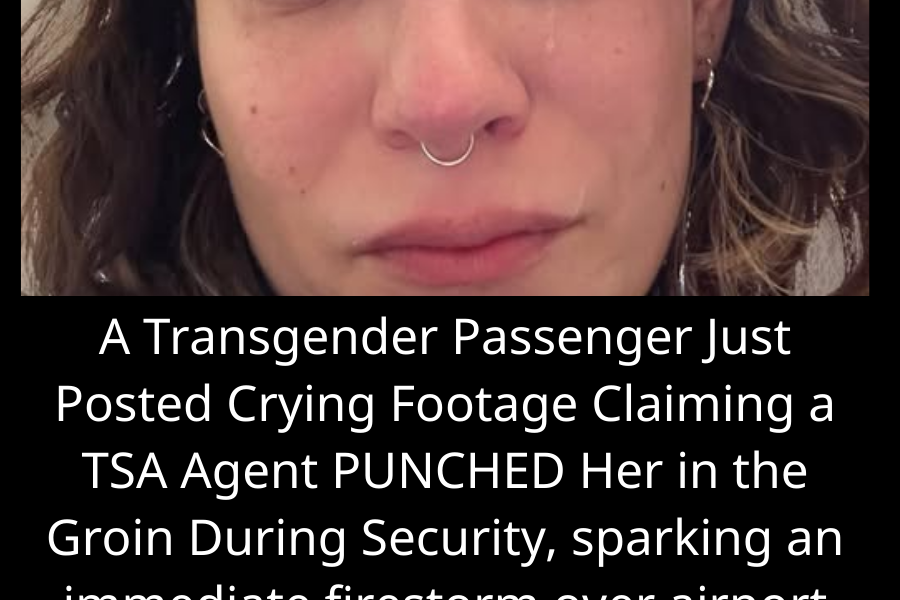
Let’s strip away the politics for a moment. A person—a transgender woman—states she was:
-
Punched in the genitals by a federal officer.
-
Publicly yelled at about her anatomy.
-
Left sobbing in a public bathroom.
The alleged act isn’t a policy dispute. It’s assault. The words yelled aren’t a debate. They’re public degradation.
And the response captured here—“I think the female tsa agent felt violated… which explains her reaction 🤣”—is a chilling artifact of our moment. It’s a sentence that performs three devastating operations:
-
Justifies violence (“explains her reaction”).
-
Erases the victim’s violation by centering the assailant’s purported feelings.
-
Mocks the entire event with the laughing emoji.
This isn’t commentary. It’s cruelty, crystallized into a tweet.
Part 1: The Violence of the “Explanation”
The “explanation” offered is a masterpiece of inverted victimhood. It posits that the TSA agent’s feeling of violation—stemming from the unexpected contact with a transgender woman’s body during a pat-down—justifies a physical assault.
Let’s be forensic:
-
The Agent’s Job: To conduct security pat-downs, which by nature involve touching areas of the body, including the groin (via the back of the hand), on all passengers who trigger the scanner. It is an impersonal, procedural act.
-
The Agent’s Alleged Act: A deliberate punch to the testicles. This is not a pat-down. It is not a procedural error. It is an intentional, punitive, painful strike.
The “explanation” blurs this line entirely. It reframes a violent, retaliatory act as a understandable, almost reflexive emotional response. It says the real crime wasn’t the punch; it was the passenger’s body existing in a way that surprised the agent.
Part 2: The Theater of Public Humiliation
The verbal component—“yelled at me for having a penis (?)”—is violence of another kind. It weaponizes the public space of the security line to enforce a humiliating, biological declaration. It outs, shames, and stigmatizes.
This isn’t about security. It’s about spectacle. It uses the captive audience of other travelers to turn the individual into a public example: This is what happens when your body doesn’t conform. The bathroom selfie, crying, is the aftermath—a document of the private wreckage left by public cruelty.
Part 3: The 🤣 – The Emoji of Dehumanization
The laughing-crying emoji is the period on the sentence. It transforms a story of alleged assault and trauma into a joke. It signals to the in-group: Don’t take this seriously. This is absurd. This is funny.
This is the digital-age equivalent of pointing and laughing at someone who has just been beaten. It signals that the victim is not just wrong, but ridiculous, and their pain is not a claim on our conscience, but a source of our amusement.
It completes the dehumanization: first through physical violence, then through public shaming, finally through communal mockery.
The Verdict: A Single Moment in the Cold War
This incident, and the reaction to it, is a microcosm of the larger conflict. It shows what happens when abstract debates about bathrooms and sports descend to the ground level of human interaction, where one person holds a sliver of institutional power over another.
The debate is no longer about “religious freedom acts” or “sanctuary states.” It’s about a TSA agent’s fist and a stranger’s tears in Terminal 4.
The laughing response reveals a brutal truth: for some, the dignity and safety of transgender people is not just negotiable, but negligible. Their pain is not a crisis; it’s a punchline. Their violation is explained away by the “discomfort” their existence causes in others.
This is where ideology becomes violence. Not in a law, but in a lunge. Not in a speech, but in a shout across an airport line. And not in a protest, but in a laugh emoji that tries to erase the sound of someone sobbing in a stall.
The airport scanner found an “anomaly.” The real anomaly on display was our capacity for empathy, and it was flagged for removal. ✈️😢⚖️