The Quiet Voice in the Storm: On Erika Kirk, Dignity, and the Anatomy of a Forgiving Heart
LOS ANGELES — In the wake of unspeakable violence, the scripts are usually pre-written. There is the public mourning, the outrage, the political recrimination, the forensic dissection of motive. And then, in the age of perpetual culture war, there is the ghoulish victory lap—the faction that views a tragedy not as a human loss, but as a political point scored.
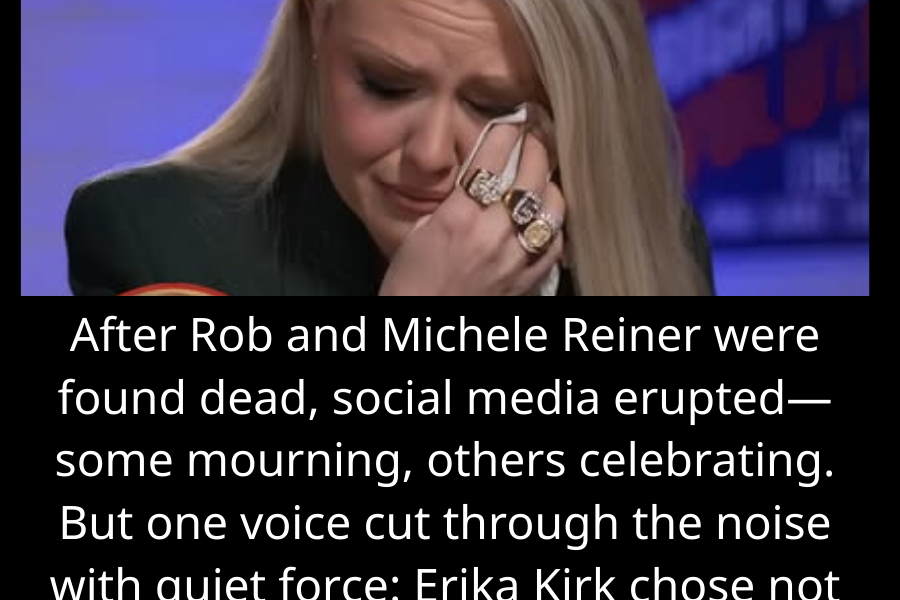
Into this predictable, ugly machinery stepped a voice that stopped the noise. Erika Kirk, the widow of the late conservative talk radio titan Rush Limbaugh, released a statement following the murders of Rob and Michele Reiner that was so startling in its moral clarity, it felt like a corrective to the entire era.
Her message was not loud. It was devastatingly quiet. And it was aimed directly at the rotten heart of our national discourse.
The Anatomy of a Radical Statement
Let’s parse what Erika Kirk did. Her husband, Rush Limbaugh, was a man who architected the modern politics of perpetual conflict. For decades, his voice was the soundtrack of conservative grievance, a cannonade aimed at the very Hollywood and liberal elite that Rob Reiner embodied. When Limbaugh died of cancer, prominent liberals—Reiner famously among them—refused to offer the standard condolences, arguing that his legacy of division forfeited such courtesies.
Now, the script was flipped. The Reiners were gone, victims of a brutal crime. The opportunity for reciprocal cruelty was ripe. The digital jackals were already howling in some dark corners of the web.
Kirk, holding every moral permission slip to return spite for spite, did the one thing our broken politics cannot compute: She chose grace.
“Unlike those who disagreed with my husband and then celebrated his de@th, I will not be that person… I am grown enough to mourn the loss of two human beings and to feel sympathy for an entire family.”
This is not just magnanimity. This is a conscious, public renunciation of the core transactional logic of the culture war. It declares that human loss exists in a realm above political scorekeeping. The phrase “I am grown enough” is not a casual remark. It is a thunderous indictment of the perpetual adolescence of our public life, where every event is fodder for the team’s meme page.
“That is how we break the cycle”: The Most Revolutionary Line in America
Her final line is a manifesto in a sentence: “That is how we break the cycle.”
She identifies the pathology with precision: we are trapped in a self-justifying loop of retribution. You dehumanized my icon, so I will dehumanize yours. You danced on my grave, so I will dance on yours. The insult from the past legitimizes the cruelty of the present, which then legitimizes the vengeance of the future. It is a wheel that turns on the grinding down of our shared humanity.
By stepping off this wheel, Kirk does not just take a moral high ground. She rejects the very terrain of the battle. She says the war for cultural supremacy is not worth the abandonment of basic decency. Her act of mourning for an ideological opposite is a direct rebuke to the notion that our political identities must fully eclipse our human ones.
“This is the antithesis of ‘owning the libs’ or ‘triggering the cons,’” observes Dr. Arthur Bloom, a philosopher who studies ethics in public life. “Kirk is performing a profound act of moral sovereignty. She is asserting that her conduct will not be dictated by the worst behavior of her opponents. In a system wired for escalation, she chooses disarmament. In doing so, she exposes the poverty of the entire project of politics-as-tribal-hatred. Her statement isn’t soft; it’s the hardest thing possible: a voluntary surrender of the weapon of bitterness when it is most justified to use it.”
The Unbearable Weight of Witness
Consider her backdrop: “even after witnessing how her own husband was treated…”
She is not speaking from a place of naïve peace. She is speaking from the scorched earth of personal experience. She saw the vitriol, the celebration, the denial of common grief. She felt the unique agony of watching a loved one’s mortality become fodder for partisan cheer. She had a front-row seat to the very cycle she now refuses to perpetuate.
This is what makes her statement so formidable. It is not the grace of ignorance. It is the grace that comes after the storm, chosen amid the wreckage. It is forgiveness offered with full knowledge of the cost.
The Political Void It Highlights
In a single gesture, Erika Kirk highlighted the catastrophic leadership void in American public life. Where are the politicians, the pundits, the influencers with this “grown enough” maturity? Our discourse is dominated by those who are professionally, financially, and identity-invested in keeping the cycle spinning.
She has, perhaps inadvertently, issued a challenge: Who else is “grown enough”? Who else will remember opponents with dignity? Who else will see a political adversary’s family in mourning and feel, first, sympathy?
Her quiet message is a mirror held up to a screaming nation. And in that mirror, much of what we call politics looks very small, very cruel, and very, very young.
The Last Word
In the end, Erika Kirk did not eulogize Rob Reiner. She eulogized the better angels of our own nature, which we have buried under an avalanche of performative contempt. In choosing compassion over cruelty, she offered a fleeting glimpse of an exit ramp from our hellscape.
She proved that breaking the cycle doesn’t require a summit or a treaty. It can begin with a single, grieving widow, refusing to pass the poison along. In a broken time, that is not just maturity. It is a quiet, world-altering rebellion.