(The sound you hear is not an explosion, but the quiet, methodical click of a lock being picked. The scandal isn’t in a smoking gun email. It’s in the absence of a signature. The breakdown isn’t in the law, but in the ledger.)
The Ghost in the Machine: How Presidential Authority Evaporated in a Game of Email Telephone
Forget the politics for a moment. Forget Biden, Trump, left, right. Strip this down to its constitutional skeleton.
The power to grant pardons is one of the most absolute, personal, and solemn powers vested in the Presidency. It is a direct, unilateral act of clemency from the sovereign to the subject. It is meant to be an act of singular conscience.
What has been described under oath is not a policy dispute. It is the mechanization and dilution of that conscience into digital noise. It is the revelation that the most profound act of presidential mercy can be reduced to a game of bureaucratic telephone, played by exhausted staffers in the final, chaotic hours of an administration.
This isn’t about “who got a pardon.” This is about how the pardon was born. And the birth certificate, it turns out, was forged by a ghost.
Part 1: The “Assistant as Avatar” – Rosa and the Erosion of Identity
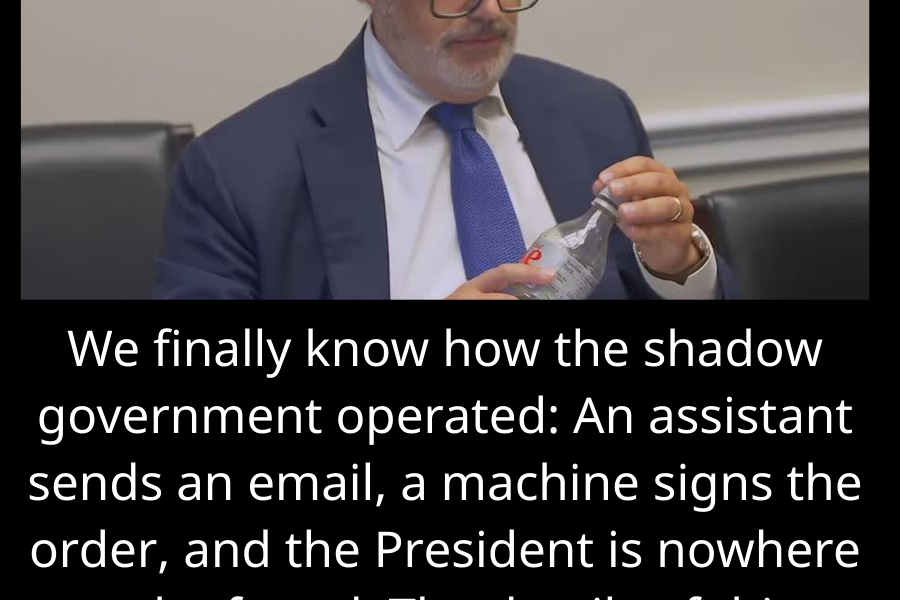
The sworn testimony reveals a stunning, mundane reality: The Chief of Staff’s email identity was a shared workspace.
Rosa, his assistant, had “full access.” She sent emails “under his name” routinely. “It wasn’t infrequent.” The system was built on a fundamental ambiguity: “No one could tell which emails she wrote and which he wrote.”
This is the first crack in the foundation. In the digital age, an email from a high official is a verified act of will. It is a digital signature. What we learn is that the “signature” was a shared password. The “will” was often a delegated task.
When the question is, “Did the Chief of Staff approve this pardon?” the answer under oath becomes: “The email account bearing his name sent the approval. The human being attached to that account did not type it. The human being who did type it was acting on verbal instructions passed through two other people.”
The chain of authority doesn’t just have weak links; the links are made of whispers.
Part 2: The “Verbal Relay” – Authority as a Game of Telephone
Map the chain described:
-
A meeting with Bruce Reed and Ed Siskel (top White House lawyers).
-
They leave the meeting and verbally tell Rosa to call the Chief of Staff.
-
Rosa calls the Chief of Staff at home.
-
He gives a verbal approval to her.
-
She logs into his email and sends the approval for the autopen.
At no point in this chain is there a verifiable, written instruction from the President to his Chief of Staff, or from the Chief of Staff to his deputy, authorizing the specific pardon. It is a cascade of verbal approvals, filtered through intermediaries, at a time when “people were off-boarding… it was thinly staffed.”
This isn’t a chain of command. It’s a game of telephone played with the Constitution. The most critical element—the direct, documented line from the President’s intent to the physical act of the autopen—is replaced by hearsay and haste.
Part 3: The Autopen’s Hollow Script – Signing Without Signing
The autopen is the final, fitting symbol. A machine, programmed with a facsimile of the President’s signature, pressing ink to paper on orders from an email sent by an assistant channeling a verbal relay.
The pardon power requires the President’s “will and pleasure.” What is described is a system where the “will” is diffused across a hierarchy and the “pleasure” is presumed in the chaos of a departing West Wing.
The “killer” admission is not that Rosa sent the email. It is that “There’s no way staff could delineate between an email I wrote and one Rosa wrote.” This means the official record—the email approving a presidential pardon—is inherently un-authentic. It cannot be reliably tied to the conscious, deliberate act of the authorized official. It is a ghost document.
The Scandal Isn’t Corruption. It’s Capability.
This testimony does not prove malice. It proves chaos. It does not reveal a criminal conspiracy; it reveals a catastrophic failure of process surrounding one of the most grave powers of the office.
The “implication” for Biden is not that he was personally scheming. It is far more damaging to the institutionalist image he cultivates: He either presided over, or was oblivious to, a system where his most personal power was executed via a haphazard, un-auditable verbal relay in the final hours of his term.
It paints a picture of an administration whose “ethics oversight” was so brittle that it shattered under the mundane pressure of a last-day deadline. It suggests that the vaunted “adults in the room” lost control of the most basic ledger of executive authority.
For Trump and his allies, this is the ultimate “deep state” fantasy made flesh: not a conspiracy, but a glaring, admitted incompetence at the heart of the “establishment” White House. It validates every claim of a bloated, unaccountable bureaucracy where no one is really at the wheel.
For the country, it’s a sobering lesson: We build elaborate legal and ethical scaffolds around presidential power. But this testimony reveals that in practice, that power can hinge on an assistant’s interpretation of a shouted instruction over a bad phone line, logged into an email account everyone shares.
The pardon was signed. But the authority behind it has gone missing. And in a republic built on the accountability of power, that is not a paperwork error.
It is an existential void.
They weren’t running a government. They were running a message board. And the final, most important post was made by someone else, on someone else’s account, quoting someone else’s hearsay. 💻👻⚖️