The Battle of the Bills: Nancy Mace, AOC, and the War Over Who Gets Exposed
The Setup: A Simple Question, An Explosive Answer
Let’s start with the moment that launched a thousand comments.
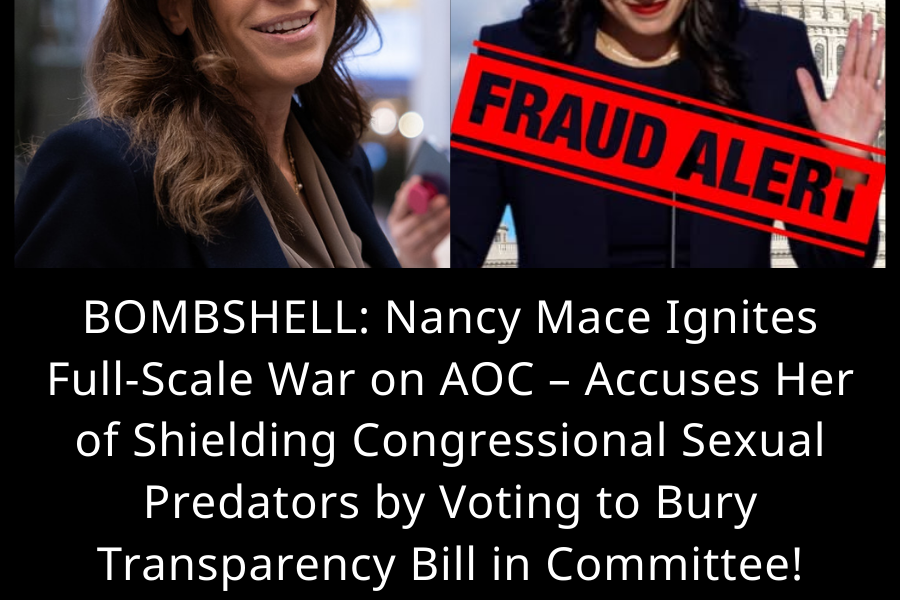
Nancy Mace, Republican Congresswoman from South Carolina, former victim of sexual assault herself, takes to social media with a grenade: “AOC voted down my resolution to release congressional sexual harassment records. I don’t want to hear one more word from her about Epstein. She voted against the truth. She voted against survivors. She is a fraud.”
It’s clean. It’s viral. It’s devastating—if true.
But then, a commenter named T.J. Kennedy asks the question that unravels the narrative: “Seems like they voted to send it to committee to be worked on and improved rather than outright rejection. Isn’t that the case?”
And suddenly, we’re not in a simple story of good versus evil. We’re in the weeds of parliamentary procedure, where the difference between a “no” vote and a “refer to committee” vote is the difference between political assassination and legislative nuance.
Deconstructing the Accusation: What Actually Happened?
The thread becomes a battlefield of competing facts, each side armed with bill numbers and procedural arcana.
The Mace Position (as articulated by “Team Mace”): The bill was designed to release congressional sexual harassment records while redacting “PERSONALLY IDENTIFIABLE INFORMATION of victims, potential victims, witnesses.” AOC voted against it. Ergo, AOC voted against transparency and against survivors.
The AOC Defense (as articulated by commenter David Burt and others): This is a classic case of legislative evolution. The first bill (HR 1072) had flaws—it didn’t adequately protect witnesses. AOC voted no. Mace then introduced HR 1100, which fixed the redaction issues. AOC voted yes on that one. The controversy? Procedural: the second bill was sent to committee for final polishing, a move critics call a “squash” and defenders call “how legislation works.”
The comment section becomes a miniature court:
-
Caitlyn Greco argues that sending to committee is “a sneaky way to quash a bill” and that AOC’s vote to refer it was a vote to “protect potential predators.”
-
D Louise Williamson insists AOC was right to vote down the flawed version and then support the fixed one.
-
Shannon Marie Sova reads both bills and concludes they “both say the victims would be redacted,” leaving her confused about the actual difference.
-
Team Mace doubles down: “False. Rep. Mace’s bill redacted the PERSONALLY IDENTIFIABLE INFORMATION of victims… Try reading it next time.”
The Professor’s Analysis: Why This Fight Matters Beyond the Floor
This isn’t just a he-said-she-said about two bills. It’s a masterclass in modern political communication and the chasm between legislative reality and social media narrative.
1. The Weaponization of Simplicity: Mace’s original post is brilliant because it’s simple. “She voted against releasing sexual harassment records.” Full stop. No mention of redactions, no mention of committee referrals, no mention of a second, improved bill. In the time it takes to explain the nuance, the accusation has already traveled around the world. The rebuttal, no matter how factually accurate, will always arrive late and dressed in complexity.
2. The Procedural Trap: Sending a bill to committee is the legislative equivalent of “we’ll take this under advisement.” To the public, it looks like delay and death. To insiders, it’s often the necessary path to improvement. AOC’s vote to refer could be read as either good-faith legislating or bad-faith obstruction, depending entirely on whether you trust her intent. The comments reflect this divide: some see a “squash,” others see “working on it.”
3. The Survivor Card: Mace’s personal history as a sexual assault survivor gives her unique moral authority on this issue. It’s nearly impossible to accuse her of bad faith without appearing to attack a survivor. This makes her accusations against AOC particularly potent—and particularly resistant to rebuttal. AOC, whatever her procedural reasoning, is placed in the impossible position of defending a vote that can be framed as “against survivors.”
4. The Epstein Shadow: Mace’s invocation of Epstein is the nuclear option. It’s not about the bill anymore; it’s about moral equivalence. By linking AOC’s vote to the Epstein scandal, Mace suggests that anyone who isn’t for her specific bill is essentially protecting pedophiles. This is the kind of rhetorical escalation that makes compromise impossible. If disagreement makes you a defender of Epstein, there’s no room for legislative negotiation.
The Comment Section as Jury
The public’s reaction is a perfect microcosm of our fractured information ecosystem:
-
The Partisans (Derek Christopher, Donald Boles): They don’t need the details. They stand with Mace because she’s their fighter. “Call them out regardless of party lines” is the mantra, though they’re only calling out one side.
-
The Fact-Checkers (David Burt, Shannon Marie Sova): They dig into the bills, compare the language, and try to establish an objective timeline. They are the lonely defenders of complexity in a war of simplicity.
-
The Cynics (Joe Morini): They assume bad faith regardless. “Committee? It’ll conveniently get forgotten about. Watch.” For them, procedure is just a mask for corruption.
-
The Confused (Alex Do): “Ah. Ok. I finally have an answer to why. I’ve been wondering this whole time.” This is the majority of Americans—people who want to understand but lack the time or expertise to dig through congressional records.
The Unanswered Question: What’s Actually in the Bills?
Shannon Marie Sova’s question is the most important one: “I just read both of them and they both say the victims would be redacted. So why again did Aoc vote to block it?”
If both bills contain identical redaction language, then the objection can’t be about protecting victims. It must be about something else—perhaps the scope of records to be released, the mechanism of release, or the inclusion of non-victim witnesses. Or perhaps, as Mace’s team insists, the first bill did protect victims and the objection was always political.
The fact that this question remains unanswered in the thread, despite multiple people claiming to have read the bills, is telling. In the absence of clear, accessible information, narrative fills the void. And the narrative that wins is the one that confirms existing biases.
The Verdict: A Fight That Will Never End
This isn’t a dispute that will be resolved by fact-checkers. It’s a permanent political wound—one that will be reopened every time Mace needs to rally her base or AOC needs to defend her progressive credentials.
The truth, as far as it can be discerned, likely lies somewhere in the middle: AOC probably had legitimate concerns about the first bill’s language, voted no, supported an improved version, and then participated in a procedural move that can be read as either routine or obstruction. Mace, frustrated by the delay and sensing political opportunity, framed the entire episode as a betrayal.
In the end, the only clear winners are the commenters who got to perform their allegiances, and the algorithms that served this firestorm to millions of screens. The victims—actual survivors of congressional sexual harassment—remain waiting for transparency, caught in the crossfire of a war where both sides claim to fight for them.
The lesson: in today’s politics, a vote is never just a vote. It’s a symbol, a weapon, and a Rorschach test. And the truth, whatever it is, will always arrive too late, dressed in complexity, while the lie has already changed the world.