The “Sharia-Free America” Act: The Ghost Law Hunting a Ghost Threat
The scene is pure political theater, a genre we’ve perfected. Senator Marco Rubio stands at the podium, jaw set, eyes flashing with the righteous fury of a man defending a castle no one has seen besieged. His line is crafted for the six-second clip, the viral payload: “Religious freedom is welcome in America. But ‘chopping off hands in my courtroom’ crosses a scarlet line—a line defended by the blood of fallen patriots.”
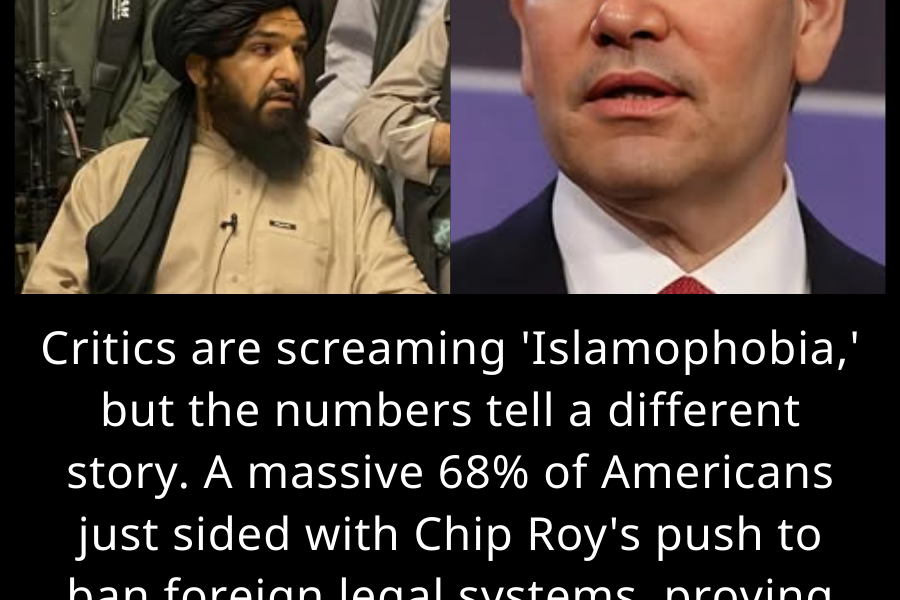
The bill is the “American Courts Act.” The branding, instantaneous and brutal, is the “Sharia-Free America Act.” Its architects, Rep. Chip Roy and Sen. Rubio, present it as a straightforward shield: a ban on federal courts enforcing any foreign legal system—Sharia, Halakha, Canon Law—that contradicts the U.S. Constitution.
The reaction is a perfectly choreographed American fracture. Progressives decry it as a nakedly Islamophobic dog whistle. Conservatives hail it as a long-overdue bulwark against cultural surrender. The internet, that great amplifier of id, screams in stereo.
But here’s the quiet, unsettling fact beneath the roar: 68% of Americans polled support it. That’s not just a conservative base. That’s a supermajority cutting across aisles, a number that includes your aunt who votes Democrat but shared a meme about “creeping Sharia law” back in 2015.
This isn’t a policy debate. It’s a cultural exorcism. And to understand why it’s happening now, and why it’s so potent, you have to stop looking for the actual law of Sharia in American courtrooms. You have to start looking for the ghost.
Act I: The Phantom Menace – Hunting a Law That Isn’t There
Let’s be clinically clear: There is no movement to implement Sharia law in American courts. The American Bar Association, federal judges, and legal scholars across the spectrum have repeatedly debunked this as a conspiracy theory. The Constitution’s Supremacy Clause is unambiguous. When a so-called “Sharia tribunal” (often just a religious mediation council for divorce or business disputes within a community) has its decisions brought to a real U.S. court, the judge applies U.S. law. Full stop.
So what is the bill actually banning? A specter.
But specters are powerful. They are built from algorithmic folklore—YouTube snippets of protests in London, horror stories from Saudi Arabia, and a deep, historical Western anxiety about the “Eastern” other. The “Sharia” in “Sharia-Free America” isn’t a legal code; it’s a cultural bogeyman. It symbolizes everything a certain vision of America fears: the erosion of women’s rights (think: gender equality), the punishment of blasphemy (think: cancel culture), and the supremacy of group identity over individual liberty (think: wokeism).
Rubio’s “chopping off hands” line is genius not because it’s accurate, but because it’s visceral. It collapses a complex, diverse set of Islamic legal traditions into a single, medieval image of barbarity. It’s not arguing with facts; it’s activating a deep-seated civilizational fear.
Act II: The Real Target – It’s Not About Law, It’s About Legitimacy
If the threat is phantom, then the bill must have a real purpose. It does. It’s a political and cultural marker with two brilliant, devastating aims:
1. The Forced Choice: The bill forces every politician and voter into a binary. Do you support the Constitution, or do you support chopping off hands? There is no room for nuance. To vote against it, or even question its necessity, can be framed as being “soft” on a barbaric foreign ideology. It’s a loyalty test. This is why 68% support it—the question isn’t about Sharia; it’s, “Do you oppose medieval punishments?” Who would say no?
2. The Legal Foundation for a Broader War: The text bans any foreign legal system. This is the Trojan Horse. While the rhetoric is about Sharia, the legal architecture could be used to challenge:
-
Tribal Sovereignty: Could Native American tribal courts, which blend U.S. law with traditional customs, be challenged as a “foreign legal system”?
-
International Law: Could rulings from the International Court of Justice or trade dispute panels be more easily ignored?
-
Religious Arbitration: Could it be a stepping stone to dismantle the long-standing legal principle that allows Jewish beth din or Catholic tribunals to arbitrate civil disputes if both parties consent?
The bill isn’t just warding off a ghost. It’s laying the groundwork to reassert a monolithic, sovereign American legal identity against all perceived competitors—global, tribal, or religious.
Act III: The Perfect Storm – Why This, Why Now?
The timing isn’t random. This is the third act of a narrative trilogy.
-
Act I: The Infiltration (The Ilhan Omar Financial Scandal): The story of corruption, of a community allegedly “ripping off” America. The charge: They are stealing our money.
-
Act II: The Disloyalty (The “Treason” Clip): The story of dual allegiance. The charge: They are stealing our sovereignty, loyal to another flag.
-
Act III: The Conquest (The Sharia-Free Act): The story of cultural takeover. The charge: They are coming for our laws, for our very civilization.
See the escalation? From wallet, to heart, to soul. This bill provides the legislative “solution” to the cultural “problems” staged in the previous weeks. It offers a tangible action—a law to pass—in response to the diffuse fear.
It also arrives in the wake of global conflicts (Gaza, tensions with Iran) that have heightened domestic tensions, and in a political moment where the “clash of civilizations” narrative is a potent motivator for a base feeling culturally under siege.
Act IV: The Unintended Prison – Who Gets Locked In?
The greatest irony of the “Sharia-Free America” Act may be who it most securely cages: its supporters’ own worldview.
By legally defining America in opposition to a caricatured “other,” it commits the nation to a permanently defensive, paranoid posture. It shrinks the generous, confident idea of a nation strong enough to absorb and transform all comers into a narrow, frightened one that must constantly police its boundaries.
It also, perversely, empowers the very extremists it claims to fight. For a genuine Islamist extremist, nothing is more useful than the message that America is inherently at war with Islam. This bill is a recruitment video for them, proof that the “Crusader” West will never accept Muslims.
And for the millions of mainstream, law-abiding, patriotic American Muslims? The doctors, teachers, soldiers, and engineers? The message is: “Your faith is a suspect ideology. Your community is a potential fifth column. You must constantly prove you are not the ghost we are hunting.” It is a recipe for alienation, the very thing that breeds the disaffection it purports to prevent.
The Bottom Line: A Law for the Afterlife of an Idea
The “Sharia-Free America Act” will likely face fierce legal challenges. Its practical effect on courtrooms may be negligible. But that’s not the point.
The point is the haunting.
It successfully installs into the legal and political lexicon the idea that a major world religion practiced by millions of Americans is an inherent threat to the republic, a “foreign doctrine” to be legally purged. It makes the ghost official.
We are not arguing about law. We are conducting a séance for a national identity. Chip Roy and Marco Rubio are channeling a vision of America under eternal siege, a vision powerful enough to convince 68% of the country to guard against a threat that exists not in our courtrooms, but in our collective nightmares.
The fight isn’t about Sharia. It’s about which ghosts we choose to fear, and which, in our fear, we accidentally become.