(The air in the room, already heavy with partisan scorekeeping, suddenly crackles with a more profound, constitutional voltage. This isn’t a policy dispute. It’s a declaration of war against a co-equal branch, delivered from the executive’s lectern.)
The “Judicial Activist” Gambit: How a Label Becomes a Lariat for the Third Branch
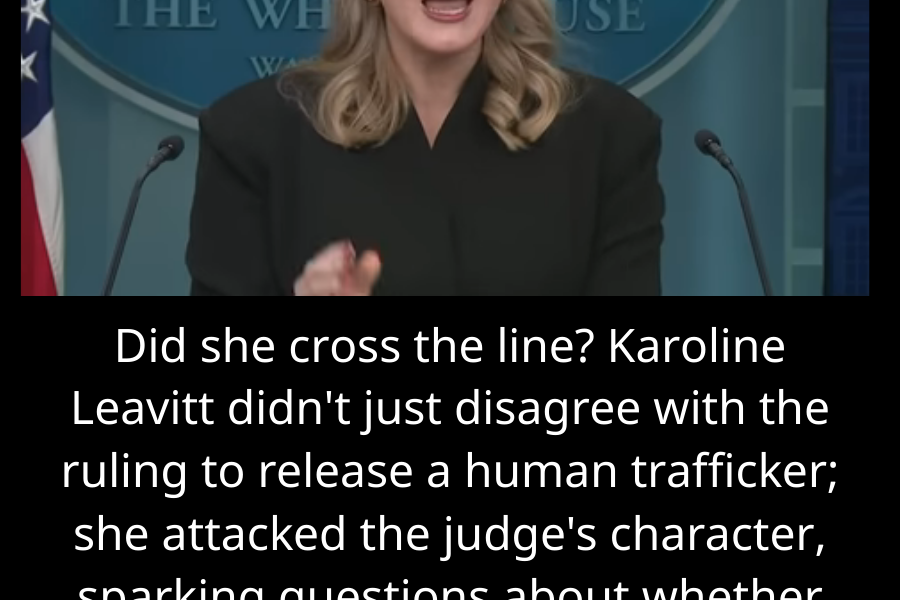
Press Secretary Karoline Leavitt didn’t just disagree with a federal judge’s order. She performed a ritual of reclassification. By labeling the judge a “judicial activist,” she didn’t critique the ruling; she indicted the very basis of the judge’s authority to rule.
This is not semantics. It’s a strategic assault on the separation of powers. The term “judicial activist” is not a legal term; it’s a political cudgel. It implies the judge is not interpreting the law, but imposing a personal, ideological agenda from the bench, usurping the legislative and executive roles.
Let’s dissect the strike:
-
The Order: A federal judge orders the release of a detainee, Kilmargo Garcia, from ICE custody. This is a routine, if contentious, exercise of judicial review—the core function of the judiciary to check executive power.
-
The Leavitt Rebuttal: She doesn’t argue the legal merits. She attacks the judge’s role. The judge is “really acting as a judicial activist, which we’ve unfortunately seen in many cases across the country.”
-
The Implication: The judge’s order is not law; it’s politics. Therefore, the executive branch is not bound by legal principle, but is engaged in a political struggle against a rogue actor. It frames compliance as surrender to activism.
This move completes the transformation of the executive’s relationship with the judiciary: from one of constitutional tension to one of political warfare.
Part 1: The “Activist” Framing – Delegitimizing Dissent
By branding the judge an “activist,” Leavitt achieves several crucial goals:
-
Shifts the Battlefield: The debate moves from the dry terrain of habeas corpus and due process to the emotional terrain of “activism” vs. “law and order.” It’s no longer about Garcia’s rights; it’s about a judge “activating” to free a “proven human trafficker.”
-
Creates a Narrative of a “Rogue” Judiciary: She links this case to “many cases across the country,” painting a picture of a systemically corrupted judiciary working in concert to thwart the Trump administration’s enforcement agenda. It’s not one judge; it’s a network.
-
Empowers the Base: It tells supporters, The system is rigged. The judges are against us. We are the only ones standing for you. It turns a legal loss into a political mobilization tool.
This framing gives the administration moral permission to fight the judge, not just the ruling. It justifies an aggressive appeal and signals a relentless campaign to paint any unfavorable ruling as illegitimate “activism.”
Part 2: The “Proven” Counter-Narrative – Executive Fact vs. Judicial Process
Leavitt’s insistence that Garcia is a “proven human trafficker” and “proven gang member” is the executive branch asserting its own factual authority over the court’s.
In the judicial process, “proven” means adjudicated in a court of law. By using the term preemptively, the White House is saying: Our executive determination of guilt is the real truth. The judge’s procedural concerns about detention are a technicality obstructing that truth. It’s a pre-emptive strike on the presumption of innocence and the court’s role as the arbiter of proof.
It frames the judiciary as a speed bump on the road to enforcement, a nuisance of process standing in the way of the executive’s duty to remove “public safety threats.”
Part 3: The Unspoken “To Please Trump” Charge – Loyalty as the Ultimate Check
The underlying question—is she undermining separation of powers to please Trump?—hits the nerve. The answer is woven into the performance.
Trump’s brand is anti-establishment conquest. The “deep state” includes the judiciary. Therefore, an attack on a judge is not a breach of norms; it is fulfilling the mandate. Leavitt’s rhetoric is the logical output of a presidency that views independent institutions as enemies to be named and shamed.
She is not independently subverting separation of powers. She is articulating the doctrine of a presidency that sees the separation of powers not as a sacred balance, but as an administrative obstacle erected by opponents. Pleasing Trump is synonymous with executing this doctrine. The “activist” label is the approved ammunition.
The Verdict: The Podium as a Battle Station
Karoline Leavitt’s statement is more than spin. It is a declaration of unilateral executive sovereignty. It says the administration will recognize judicial authority only when it aligns with the executive’s policy and political goals. When it does not, that authority will be dismissed as “activism.”
This completes a terrifying trifecta we’ve seen her articulate:
-
Over Legislators: Dismissing Democratic politicians as “con artists” and “unqualified.”
-
Over the Media: Accusing the press of pushing “untrue narratives.”
-
Over the Judiciary: Labeling unfavorable judges “activists.”
All three co-equal branches are, from this podium, recast as partisan adversaries in a unitary executive’s path.
She isn’t just commenting on a case. She is testing a theory of government: that in the Trump era, the only legitimate power is executive power, and any check on it is, by definition, an act of bad-faith “activism” to be publicly flogged and legally circumvented.
The briefing room is no longer a place for questions. It is a staging ground for the dismantling of checks and balances, one “activist” label at a time. ⚖️🎤🔥