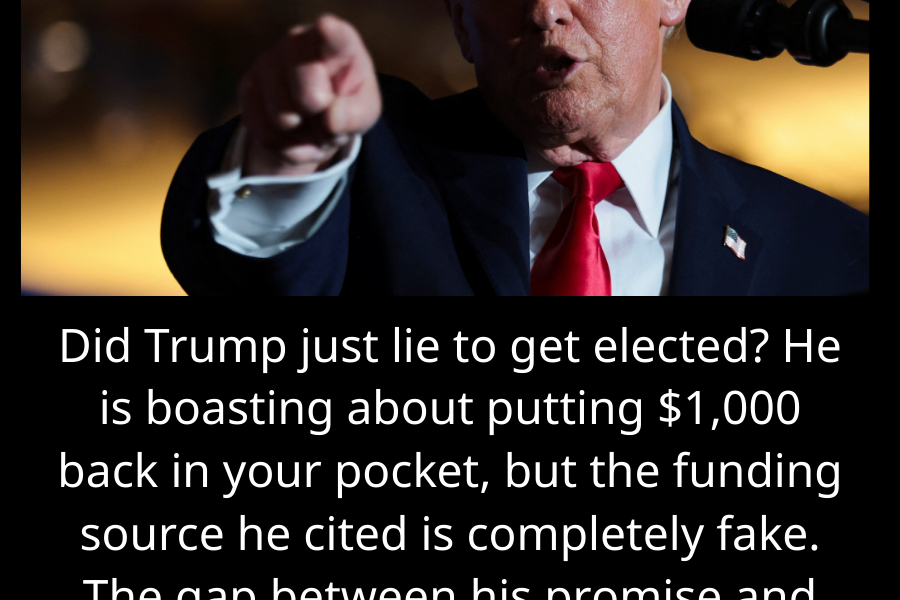
(The scene freezes. Not on the statistic, but on the gaping, silent void just behind it. The “$1,000 refund” hangs in the air like a shimmering promise, but its reflection in the fiscal mirror is something else entirely. This isn’t a policy. It’s a magic trick, and we’ve just glimpsed the hidden compartment.)
The $1,000 Illusion: A Tax Refund Built on a Fiscal Mirage
The press conference has a ghost. It’s not a person. It’s a funding source. Karoline Leavitt, with practiced certainty, promises the American people an “extra $1,000 per filer,” a “one-third larger” tax refund, thanks to President Trump’s “One Big Beautiful Bill.”
But when a reporter holds up the mirror—pointing out that Agriculture Secretary Rollins said the bill’s farmer relief component is paid for by an existing government fund (the Commodity Credit Corporation), not by new “tariff revenue” as Trump claims—the reflection cracks.
Leavitt doesn’t clarify. She pivots to biography. “Do you think the people… don’t know the president’s a billionaire?… He’s a businessman who understands the economy.”
This is the tell. This is the moment the illusion’s mechanics are exposed. When you can’t explain the source of the money, you sell the magician, not the trick.
Part 1: The “Tariff Revenue” Fantasy – Political Alchemy 101
Trump’s insistence that his programs are paid for by “tariff revenue” is a masterstroke of political alchemy. It performs three crucial functions:
-
Creates a Painless Fountain of Money: Tariffs are framed not as taxes on Americans (which economists agree they are, as costs are passed to consumers), but as tribute extracted from foreigners. This creates the fantasy of a boundless, guilt-free revenue stream—”China pays!”
-
Fuels the “America First” Narrative: It visually reinforces the core promise: The world is funding your prosperity. Every refund check is stamped, in the voter’s mind, “Paid for by Beijing.”
-
Obscures the Real Trade-Off: By pretending the money is new and external, it hides the actual, brutal fiscal calculus. That $1,000 has to come from somewhere inside the existing $6+ trillion federal budget: other programs cut, debt increased, or existing funds reallocated (as Secretary Rollins inadvertently revealed).
The “tariff revenue” claim isn’t an economic statement; it’s a mythological funding source. It’s the Pot of Gold at the end of the Rainbow Border Wall.
Part 2: The Bureaucrat’s Contradiction – When Reality Leaks
Secretary Rollins’ statement is the tiny leak that threatens to sink the whole myth. By specifying the CCC—a Depression-era fund within the USDA—as the source, she pulls back the curtain. She reveals the mundane truth: this is budgetary reshuffling. Money is being moved from one government account to another. There is no magical tariff gold.
This creates a crisis for the narrative. Which official do you believe?
-
The President: Promising manna from the globalist heaven.
-
The Cabinet Secretary: Describing routine intra-governmental accounting.
Leavitt’s refusal to reconcile this is a strategic choice. To engage is to admit the trick. Better to change the subject.
Part 3: The “Billionaire” Dodge – Faith Over Finance
This is where the con is fully perfected. When confronted with the “how,” the response is to invoke the “who.”
The logic sold to the room in Pennsylvania is this:
-
Premise: Donald Trump is a billionaire business genius.
-
Axiom: Geniuses understand money in ways bureaucrats and reporters cannot.
-
Conclusion: Therefore, if he says the money comes from tariffs, it does. Your inability to trace it is a failure of your imagination, not his economics.
It replaces fiscal accountability with personal cult. Don’t look at the ledger; look at the leader. The promise isn’t credible because of the math; it’s credible because of the man making it. The “$1,000 refund” becomes an article of faith in the gospel of Trump’s deal-making prowess.
The Verdict: A Promise Funded by Trust, Not Revenue
The “$1,000 tax refund” is not a line item in a balanced budget. It is a political stimulus package, paid for not by tariff revenue, but by the credulity and hope of the voter.
It is a campaign promise that has simply continued past election day. The funding source was never meant to be a real Treasury account; it was always the “Promises Kept” account in the hearts of his base. To question its provenance is, in this framework, to commit an act of political bad faith—to “not believe in America.”
Karoline Leavitt isn’t lying. She is speaking the language of a parallel fiscal universe, where political capital converts directly into monetary benefits, and the only audit that matters is the one at the ballot box. The ghost of the real funding source is not allowed on the podium. Only the golden promise is.
In the end, the $1,000 isn’t coming from China, or tariffs, or the CCC. It’s being drawn, sight unseen, against the limitless credit of a political brand. The bill, detailing the actual source, will be sent to the next generation. The refund arrives just in time for the next election. 💸🪄🗳️